


Oscar Wilde’s “lamia-like” Mrs. Cheveley archly poses to Sir Robert Chiltern, “Questions are never indiscreet. Answers sometimes are.” Wilde’s world (indeed, ours too) is governed by performance, hence the danger is rarely in the crime itself, rather, it’s in the social catastrophe of having to account for it aloud.
Interpretations of An Ideal Husband always depend on a delicate balancing act which seduces its audience with glitter and epigrams, while exposing the moral rot beneath respectability. The new production at the Lyric Hammersmith Theatre understands this first instinct perfectly, that to remain charming, evasive and elegant, is to survive. It has charm up the wazoo. Its tête-à-têtes are timelessly entertaining. Its London is one where political disgrace, glamour, and wit circulate together so naturally that they become almost impossible to separate. The second, less comfortably, slips through its fingers. What remains is nevertheless an immensely entertaining, fiercely acted and often thrillingly modern evening that demonstrates just how little London’s ruling classes have changed in over 130 years since Wilde first sharpened his pen against them.
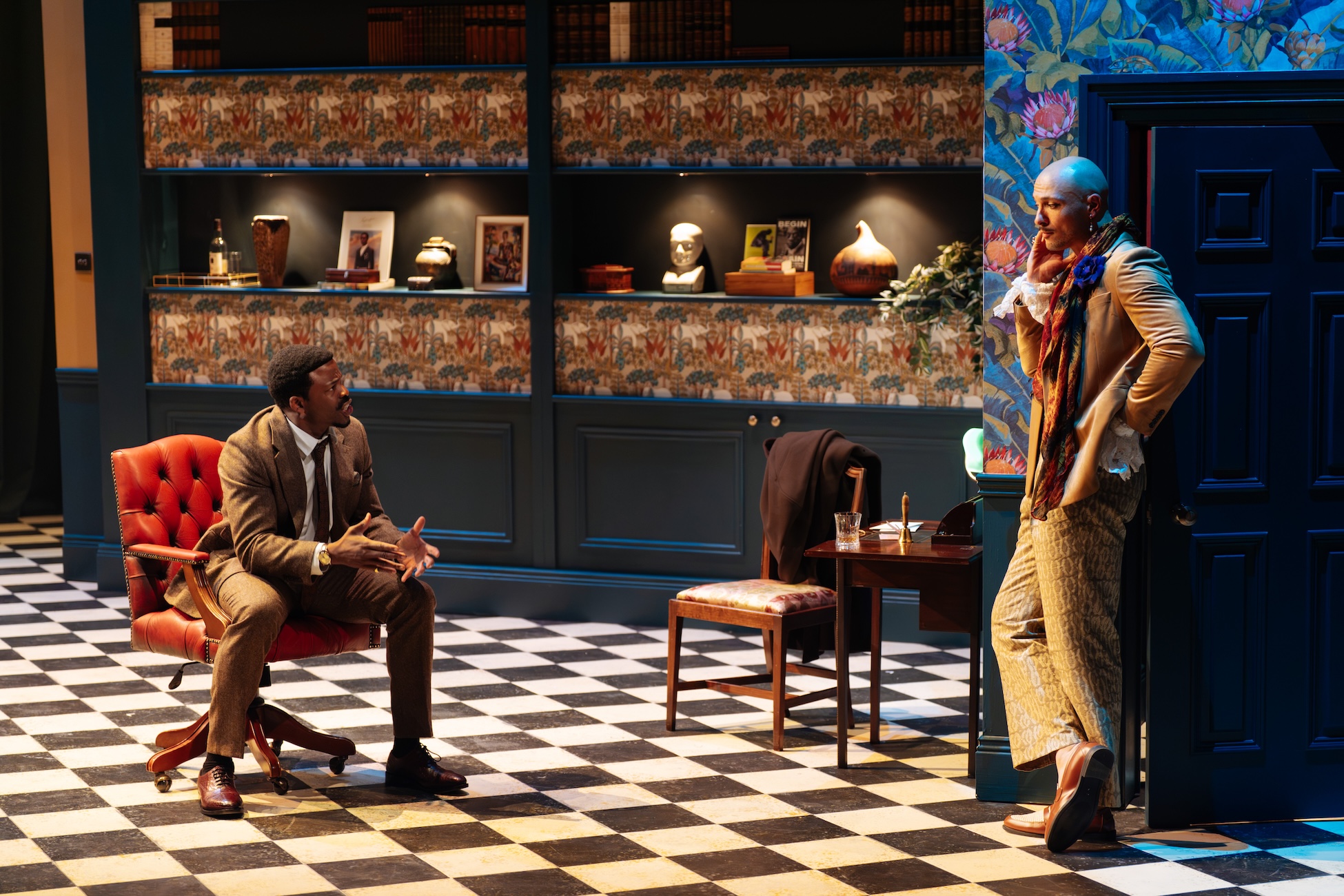
Under Nicholai La Barrie’s astute direction, Wildean archetypes are reintroduced as Black British political elites who inhabit this world with ownership and ease. Rajha Shakiry’s fabulous costuming invests a lot of affection into mixing immaculately tailored pieces with vibrant hues and patterns to emulate the look of British Caribbean heritage.
The play’s modern dance interludes and music choices keep the world alive with a social energy that makes the stage busier than its cast of ten really is. There’s also a moment when the audience erupts in reaction to a character leaping a foot over another like a vault horse to find out the truth. Such flourishes understand that Wildean comedy must move with dangerous speed.
Though the script has not been dramatically modernised (the Argentine Canal scheme and Suez are kept onboard), references to Claude and private data leaking, Barack Obama and Beyonce, and, as expected, the Peter Mandelson affair inform the audience that stories of fame and scandal really are endlessly recyclable, never as different as they ought to be.
The first act, for all the extravagant plot twists of the second, feels the more complete of the two. It gives each character room to register properly, including the excellent Countess of Basildon and Lady Markby (Nimmy March and Suzette Llewellyn). The second act is more obviously entertaining: faster, more gimmicked, quicker scene changes, over-the-top gesticulations, and the euphoria of the deus ex machina happy ending.
The production’s great success lies in its earnestness. Chiké Okonkwo gives Robert Chiltern – whose exceptionalism and propriety might suggest emotional reserve and even dullness – a simmering intensity. His confrontation with Lady Chiltern, particularly when he condemns her inability to perceive morality outside rigid absolutes, genuinely carries both heat and exhaustion.
Tamara Lawrance’s Gertrude “Gigi” Chiltern is not made easy, and that is part of Lawrance’s achievement that she makes her emotional unravelling moving. She simply glides in taking the role through its own five stages of grief at discovering Robert’s past choice, of course ending at acceptance.
Wilde’s repeated insistence that Robert Chiltern is a “genius” (as “a man with a future” is often made out to be) acquires a different texture when embodied by Okonkwo. It speaks of the burden of model-minority exceptionalism, the idea that success must not simply be achieved but flawlessly performed for it to be protected. Robert’s obsession with status and accomplishment suddenly feels attached to something larger and more fragile. The production never overstates upon this reading, but it hovers intriguingly beneath the text.
If the production has a weakness, it may be Mrs Cheveley. Aurora Perrineau is absolutely striking and can certainly snarl as the now-Washingtonian political schemer, but she often swallows whole lines before they have had the chance to bite. Though her first tête-à-tête with Chiltern does have some intrigue, she doesn’t appear to be fully acting out the language with the sense of danger anticipated for the character.
Tiwa Lade’s Lady Mabel, Robert’s sister, is capricious and verbose and gloriously Wildean in her belief that little matters except the things that truly matter. She embodies precisely the sort of “common sense” that so bewilders the Earl of Caversham. Opposite her, Jamael Westman is a magnetic Lord Arthur Goring, switching naturally between being carefree and full of care. Dandy characters like Goring can be performed as and considered to be weightless collections of punchlines, but Westman understands the Wildean dandy as a theatrical provocateur who can weaponise his wit, fashion, and absurdity to bring disruption to conventional thought. From pulling out magic tricks to delivering thoughtful advice as a mediator and observer to others’ machinations, he earns every laugh.
The audience finds themselves genuinely rooting for Robert and for his wife, for Arthur and Mabel’s back-and-forth flirtation and their eventual betrothal, even as the script’s moral machinery reminds that his mistake may not merely be the youthful indiscretion it’s concluded to be. The production remains curiously uninterested in the victims of political deceit and does not dig deeper, though it does present itself as the opportunity to do so. Lyric Hammersmith has already asked the most indiscreet question – hinting at Britain’s colonial past with its excellent casting – then stops asking.
That tension is, of course, part of Wilde’s social irony, but the performances come off as so emotionally sincere and warm that it loses this more contemplative, socially vicious element of the farce. The emotional sincerity is not necessarily a flaw in itself. In many respects, it is the source of the evening’s immense appeal. But it does mean the production stops short of becoming a truly thorough reading of Wilde’s play.
Wilde’s social theatre survives because it remains porous enough to absorb each era’s anxieties and vanities, our own age of scandal and self-justification. Thanks to this cast, tropes that once belonged exclusively to a narrow theatrical establishment – the dandy observer, the political golden boy, the aristocratic romantic heroine – are revitalised simply by who now embodies them.
★ ★ ★ ★ 1/2
Written by Oscar Wilde
Directed by Nicholai La Barrie
Set/costumes designed by Rajha Shakiry
Lighting designed by Zeynep Kepekii
Sound directed by Holly Khan
Movement directed by Alexzandra Sarmiento
Cast: Emmanuel Akwafo, Jeff Alexander, Tiwa Lade, Tamara Lawrance, Suzette Llewellyn, Nimmy March, Chiké Okonkwo, Aurora Perrineau, Sule Thelwell, Jamael Westman
Photo: Helen Murray
Running time: 2 hrs 45 mins including 25 minute interval
Until: 6th June 2026