

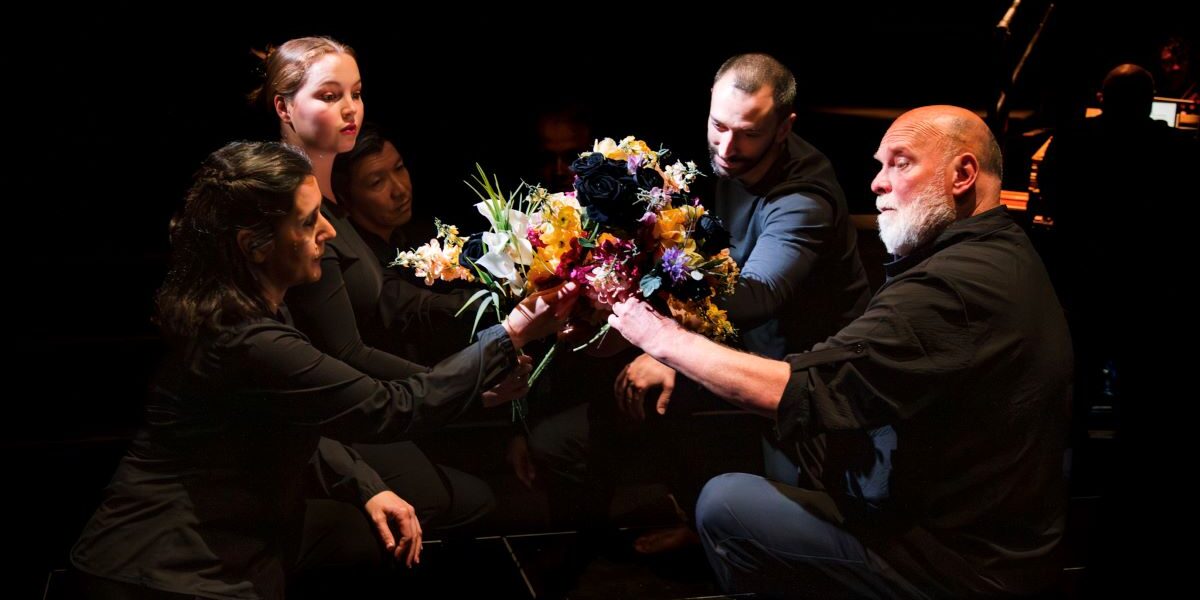

Ahead of its residency at the Grimeborn Festival, Ensemble OrQuesta offers a couple of Academy production at the Cockpit Theatre which blend student singers with established members of the company and orchestra, offering a chance for experiment and development, whether with individuals or production ideas. This production offered an abbreviated version of Monteverdi’s second surviving opera, with a stripped-down version of the music, and action that directed attention powerfully towards the key concerns and dynamics of the work.
As director Marcio da Silva said in his interval talk, to perform all the surviving music would take four hours. Much better in this context to concentrate the drama instead on the mental world of Penelope as she ponders in frustration whether her wait for the return of Ulysses will ever end. Her preoccupations are literally embodied in the set design, a series of simple raised platforms, in which the rear represents the real world and the forestage the world of her imagination and projection. Much of the rear raised stage was therefore static, with Penelope enthroned, and the vigorous action, whether from suitors or gods, or the return of Ulysses himself, conducted on the forestage.
Generally this worked better in the second half where the presence of the three suitors and the involvement of Ulysses energised the performances and raised the interest of the visual components to a new level. While the static, silhouetted shapes suited the symbolic prologue, perhaps the flow of movement needs more work in this earlier phase. It was also the case that the great variety of musical forms deployed by the composer was more in evidence in the later acts. Generally the direction was impressive, with an emphasis on significant, deliberate abstract gesture rather than naturalistic movement. This suits the eloquent, mostly grave and hieratic groove of the music. The lighting design added helpful emphasis at points too, though this could be elaborated still further.
Rosemary Carlton-Willis and Marcio da Silva took the lead roles and conveyed the authority and presence you would expect from their experience in this genre. The first appearance of Ulysses on Ithaca was particularly well engineered, and there was a true rapport between them when finally reunited. Jean-Max Lattemann, Paul Jenkins and Jay Rockwell as the three suitors were a distinguished trio, distinctive both in their individual vocal colours and different acting styles. The dynamics of movement between them and Penelope was especially well done, and the use of flowers, cheeky little arrowheads and a few other carefully chosen props was again a very successful feature of the second act, the minimalism of gesture amplified by significant objects and splashes of colour in telling ways. There was a lot of light and shade and charming humour in play too. Sofia Galvao was a forceful Minerva, making the most of her role as dea ex machina. The final twenty minutes or so of the evening was very moving as everything came together in a real zone of concentration even though some characters and episodes from the original were omitted.
The harpsichord, violin, gamba and theorbo fielded by Ensemble OrQuesta relished the varied sonorities of the work, with the harmonic balance enhanced by Marcio da Silva on guitar when he was not otherwise engaged on stage.
While there were parts of the production and some roles that need further polishing and development, this first take on the opera promises well for its full and further unfurling in future. Given the fragmentary state of parts of the text and the score, interventions by the director and conductor are essential, and most of the key decisions taken here are careful, considered and ultimately successful.
Music: Claudio Monteverdi
Ensemble OrQuesta Baroque
Marcio da Silva Stage/Music Director
Ensemble OrQuesta Opera Academy
Until 11 June 2026
2 hrs, with interval