

“Are we all here?” As Quince asks the inaugural question, the line lands with an arch, modern self-awareness. As the performance begins in the lingering late-June daylight, the audience remains fully visible under the ambient lighting yet is asked to stare directly into a staged “invisibility”.
In his seminal book Anatomy of Criticism, Northrop Frye posits the concept of the “Green World”, a chaotic, metamorphic natural space where the constraints of the “civilised” world are dissolved and re-ordered. To stage A Midsummer Night’s Dream at Regent’s Park Open Air Theatre is to engage in a meta-theatrical loop where this Green World is physically inhabited.
One can think of these woods as a purely whimsical faerie playground. Banerjee channels Jan Kott’s darker, mid-century reading of the play from Shakespeare Our Contemporary, viewing the forest as an unhinged psychological space where identity is destabilized and animalistic impulses are stripped bare. This is felt most acutely in the reimagined quartet of lovers. Misia Butler’s Lysander is delightfully, agonizingly overwrought, leaning into voice cracks and a deranged, desperate energy that captures the absurdity of magically induced infatuation. Opposite him, Hiftu Quasem’s Hermia embraces a visceral, clawing physical comedy during the confrontation and chase with Helena over the changed affection of their lovers. The performance is deserving of what is now probably one of Shakespeare’s most quoted lines: “Though she be but little she is fierce.”
The real emotional anchor of the subplot is Mary Malone’s Helena. Malone infuses the character’s chronic insecurity with an extraordinary, resonant pathos that completely recontextualises her early line: “Love looks not with the eye, but with the mind; and therefore is wing’d Cupid painted blind.” When Helena begs Demetrius to “use me as your spaniel,” Malone drops to her knees in a playful gesticulation that nevertheless bites with psychological desperation.
The production’s most triumphant conceptual masterstroke lies with the Mechanicals, delivering the fan-favourite performance from D/deaf actor Nadeem Islam as Nick Bottom. Islam’s performance is reliant on hyper-expressive slapstick and British Sign Language, which the rest of the troupe, particularly Gordon-Anderson’s doting Quince, integrate into their staging. When Bottom is transformed into an ass, wearing a literal blue furry donkey head and braying with a startlingly equine vocalisation, the production hints at a deeper existential isolation that is compelling to watch. At the climax of the Mechanicals’ play, in which a heartbroken Pyramus draws his sword and stabs himself, he takes a melodramatically long time to die (the play-runners unabashedly milking the moment for laughs).
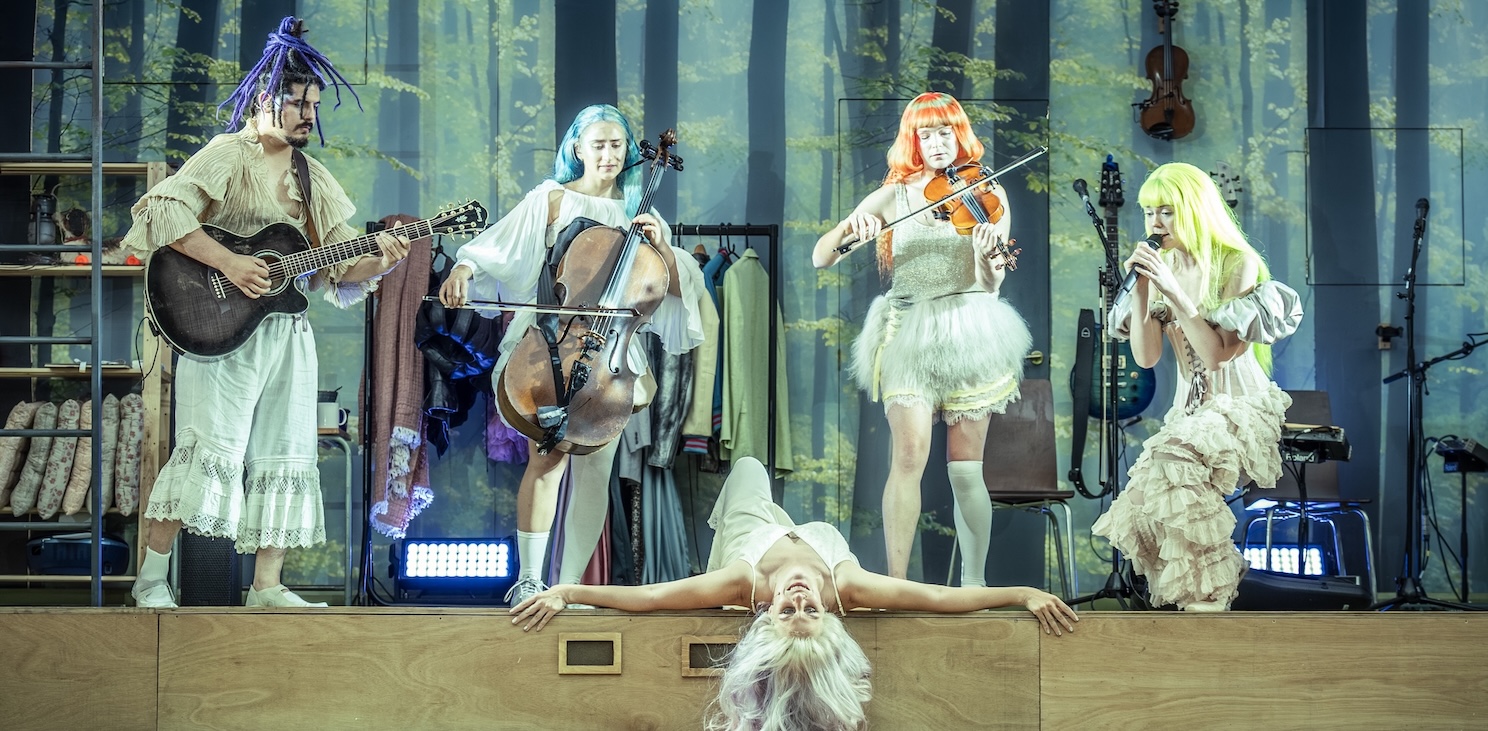
The faeries act as an on-stage live band, providing interludes that represent the crossing of mortal and immortal realms. At its best, Maimuna Memon’s sound design functions beautifully to represent magic (the effects of love-in-idleness), emotion, and weather all at once. The best example would be the echoing, over-amplified arguments between Oberon (Olivier Huband) and Titania (Jenny Rainsford) which start in shouting and end in ballad, voices blending beautifully with the mystique they’re trying to project.
However, Banerjee frequently allows the music to hijack the play’s narrative momentum. Soliloquies are stretched into full-length musical numbers; it takes Titania an absolute age to finally fall asleep because an entire ballad must be cleared first. Too often, the music feels less like an organic extension of the text and more like an artificial injection of adrenaline designed to compensate for a pacing that occasionally sags on Naomi Dawson’s stark, brutalist set of unadorned wooden steps. The transitions/differences between the Athenian court and the forest are unclear; further emphasis to separate these is needed for the play’s catalyst to be believable.
Tomás Palmer’s costume design is a jarring, eclectic scattergun of aesthetics: a chaotic melange of furry jackets, modern streetwear, hipster overalls, and ensembles inspired by a cottage-core moodboard without a clear unifying theme. In other words, the production throws ideas at the hedge to see what sticks. When Oberon announces “I am invisible” and casually slips on a pair of colourful sunglasses, the audience’s laughter is guaranteed.
Finally, the effervescent Georgia Bruce’s Puck serves as the perfect emblem for the production as a whole: childish yet wiser than most, deadpan yet tongue-in-cheek, and infinitely energetic, running at full speed from the top of the audience seating to the stage and elaborately rolling down the steps every time Titania utters a changing of the seasons. They do Robin Goodfellow justice as the glue of the production.
Ultimately, the success of this dream-like night depends entirely on what the viewer demand from the Green World. For those looking for a tightly unified directorial vision, where every costume choice, pop-culture nod, and musical interlude locks into a singular thematic thesis, Atri Banerjee’s production will frustrate. It is an undeniable aesthetic grab-bag, routinely opting out of Shakespeare’s narrative stakes and favouring a carefree, sitcom energy. Regent’s A Midsummer Night’s Dream is uneven tapestry that doesn’t always know what it wants to say, but it’s an immensely entertaining night with a staggeringly talented, diverse cast under the stars.
Regent’s Park Open Air Theatre
Penned by William Shakespeare
Directed by Atri Banerjee
Music designed by Rachel Barnes
Set designed by Naomi Dawson
Movement directed by Anjali Mehra
Running time: 2 hrs 40 mins including 20-minute interval
Photo credit: Marc Brenner
Until: 18th July 2026