

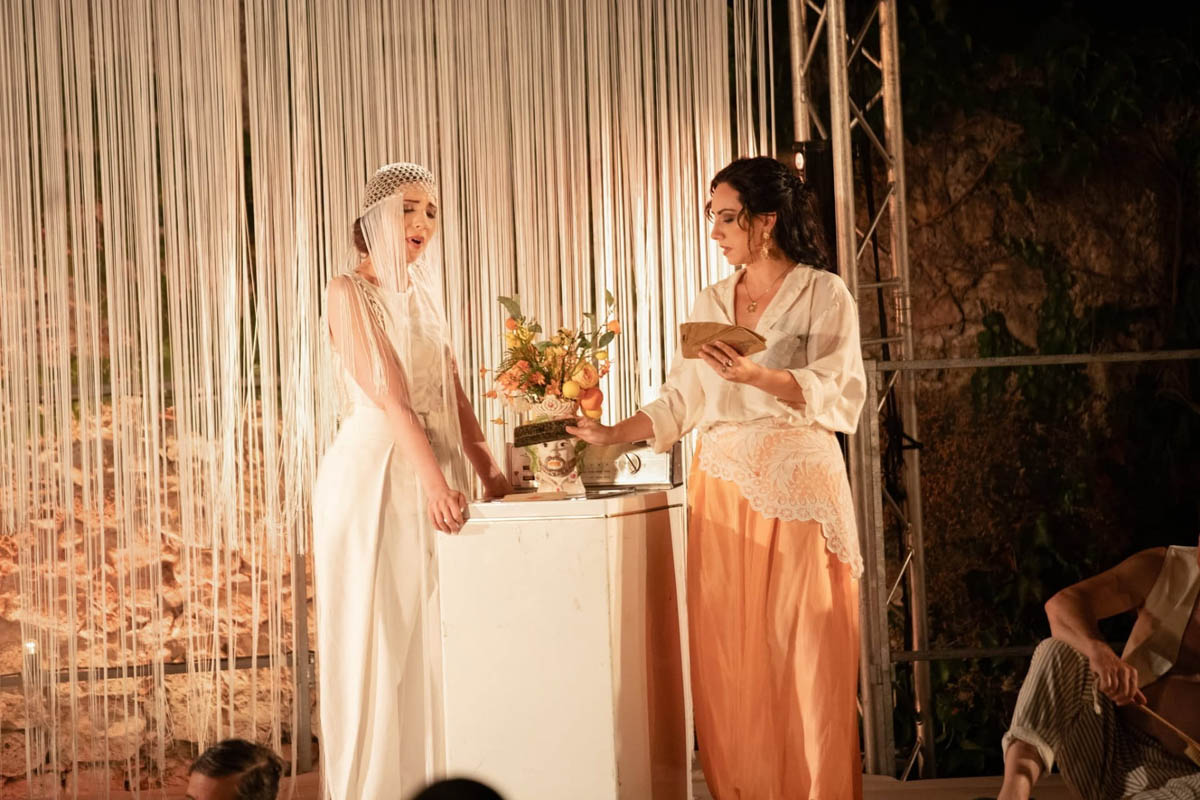

For thirty-seven years, Opus Opéra has presented a festival in the medieval hilltop village of Gattières that has become an established part of the region’s cultural life. Set against the spectacular backdrop of the Var valley, the festival stages productions of high musical quality, introducing young singers in the intimate surroundings of the open-air Place Grimaldi. This year’s offering is Rossini’s The Italian Girl in Algiers (L’Italiana in Algeri).
Composed in just eighteen days, L’Italiana in Algeri was Rossini’s eleventh opera, written when he was only twenty-one. It already displays the melodic richness, trademark crescendos, dazzling vocal virtuosity and irrepressible comedy that would become his hallmarks.
Inspired by the eighteenth-century fascination with the Ottoman Empire, Rossini transformed an existing libretto into a masterpiece of Italian opera buffa. Isabella, a resourceful Italian heroine, throws the men around her into perfectly orchestrated chaos before ultimately restoring order.
Mustafà, the Bey of Algiers, has grown tired of his devoted wife Elvira and orders his Italian slave Lindoro to marry her, hoping to replace her with a beautiful Italian captive from a recent shipwreck. Fate intervenes when Lindoro’s beloved Isabella arrives among the survivors, accompanied by her persistent admirer Taddeo. Clever, fearless and entirely in control, Isabella immediately outwits the men around her. She invents the absurd ‘Pappataci’ ceremony, persuading Mustafà to eat, drink and ignore everything around him, allowing the Italians to escape. Chastened, he is finally reconciled with Elvira.
Louise Brun’s production begins not in Ottoman Algiers but in a contemporary bathroom, from which Isabella’s imagined world gradually unfolds. A bubble bath, ingeniously created from a shallow stage depression filled with cotton wool, eventually becomes Isabella’s escape boat. The recurring bubble-bath motif suggests that the opera may be unfolding entirely within Isabella’s imagination, neatly linking the production’s domestic setting with its comic fantasy.
With little more than the bubble bath, a top-loading washing machine, a washing line, a hairdryer pressed into service as a gun and a handful of props, Brun wisely places the emphasis on Rossini’s music. The singers’ vocal agility, comic timing and characterisation drive the performance. The washing machine and bubble bath become recurring sources of visual humour, while one particularly successful running gag sees Mustafà remove his sunglasses to impress Isabella, revealing spectacular panda eyes that prompt her delighted cry of “O che muso!” (“What a face!”).
The intimate theatre allows Marc Leroy-Calatayud, one of the most promising young French conductors of his generation, to draw remarkable nuance from both the soloists and the excellent Nice Philharmonic Orchestra. Rossini’s wit and brilliance sparkle throughout the evening.
Swiss mezzo-soprano Lamia Beuque is the outstanding Isabella. Possessing a rich, warm voice and compelling stage presence, she negotiates the demanding coloratura with impressive ease. In “Cruda sorte” she effortlessly combines charm, wit and sensuality with flashes of genuine vulnerability, creating a heroine who commands every scene she enters.
Spanish tenor Juan de Dios Mateos, as Lindoro, overcomes an initially nervous vocal flutter to reveal an attractive, flexible tenor ideally suited to Rossini’s florid writing. His musical elegance makes Lindoro a thoroughly likeable romantic hero.
French soprano Cécile Lo Bianco’s radiant voice belies her slight frame, particularly in the ensembles. As the neglected Elvira, she also displays excellent comic instincts, most memorably when she appears as a coffee table serving coffee to the other characters.
Chilean bass-baritone Ricardo Seguel Iturra has an instinctive gift for comedy and creates an entertaining Mustafà. He does, however, have a tendency to aspirate the coloratura, articulating each note with an audible “ha”, which makes the passagework unnecessarily effortful and contributes to occasional insecurity in the upper register. It is a minor technical issue that should be readily corrected, as both the voice and stage presence are impressive.
Belgian-Bulgarian baritone Ivan Thirion, a Cardiff Singer of the World finalist in 2017, brings warmth and dignity to Taddeo with his dark, attractive voice. He turns the Kaimakan aria into a comic showpiece, at one point threatening the company with the hairdryer, reinforcing the suggestion that the entire adventure exists only within Isabella’s bathtime fantasy.
French baritone Thibaud Deplantes as Haly and soprano Noelia Ibáñez as Zulma both make the most of their smaller roles, contributing warm, generous voices and lively stage personalities.
With scarcely a spare seat in the audience, this delightful L’Italiana in Algeri demonstrates that, when the score is given priority and performed with imagination and conviction, opera needs neither grand theatres nor extravagant budgets to provide an immensely satisfying evening.
Location: 54 Boulevard Gambetta, 06000 Nice, France
Music by Giachino Rossini (1792-1868)
Libretto Angelo Anelli
First performance Teatro a S Benedetto Venezia 22 May 1813
Conducted by Marc Leroy-Calatayud
Directed by Louise Brun
Orchestre Philharmonique de Nice
Cast includes Lamia Beuque, Juan de Dios Mateos, Ricardo Seguel Iturra, Thibaut Desplantes, Ivan Thirion, Cécile Lo Blanco, Noelia Ibáñez
Photo Credit Sophie Kilian