

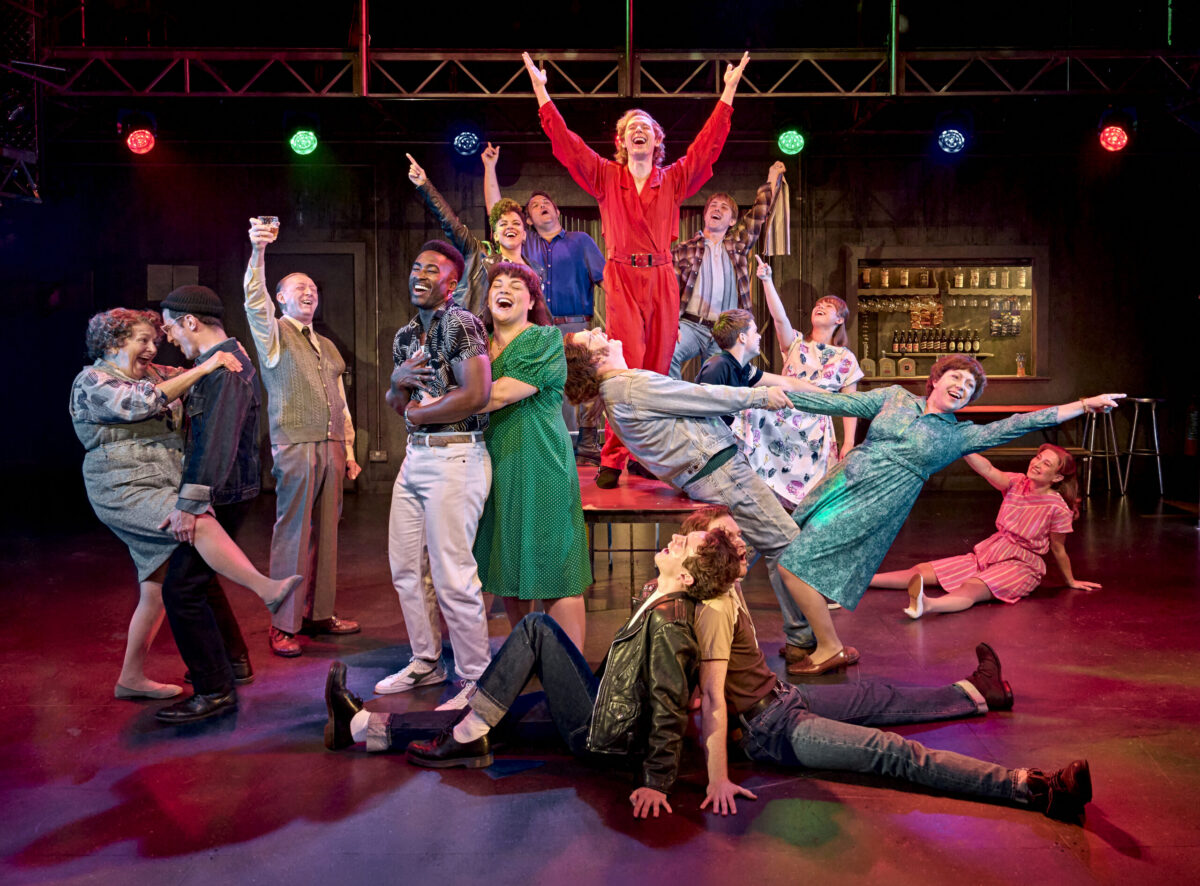

Based on the 2014 film Pride, the new musical at the National Theatre tells the remarkable true story of a collection of London gay and lesbian activists who set out to support striking Welsh miners during the bitter miners’ strike of 1984. It is an unlikely alliance — gay activists and striking miners hardly seem natural bedfellows — but the two factions gradually discover that they have more in common than either could have imagined.
Director Matthew Warchus and writer Stephen Beresford, who made the film together, have now turned it into a charming and heartfelt musical. With a young, strong cast performing on a stage surrounded by metal scaffolding, and music that is lyric-rich and tells the story rather than simply punctuating it, the show has something of the energy of Rent and London Road, with a strong ensemble feel.
The story’s protagonist is real-life activist Mark Ashton, played on the evening I saw the show with verve and panache by understudy, Daniel Forrester. Almost as an afterthought one evening, Mark comes up with the idea of raising money for the striking miners and forms a ragtag collective he calls LGSM — Lesbians and Gays Support the Miners. When the group ventures into South Wales and connects with the striking mining families of the Dulais Valley, the show combines pathos, heart and humour in equal measure. At first reticent and suspicious, the Welsh residents gradually form strong bonds of friendship and appreciation with their unlikely supporters from London.
The music plays a large part in helping the production to shine. The score by Christopher Nightingale, Josh Cohen and DJ Walde moves between rock, pop and the seductive sounds of Welsh choral music. The musical ensemble is excellent, and the songs help carry the story along rather than stopping it in order to give us a musical number.
The production also takes some risks and unusual turns. Jonathan, played by a mesmerising Samuel Barnett, opens Act II with the Broadway-style showstopper You Might as Well Live, complete with feather boas and silver tap shoes, as he confronts his AIDS diagnosis. It is a striking change of mood and one of the show’s most memorable moments. Equally poignant is a powerful number by Sarah Pugh as Siân, who reflects on sacrificing her own ambition and intelligence in order to fulfil her role as a mother and miner’s wife. Lewis Cornay belts out an anthem to coming out proudly as gay, and loving it.
There is also an extremely bawdy and hysterical song in which the Welsh women discover the details of gay sex during their night out in London. It is one of the funniest moments in the show, and a good example of how the production manages to balance its more serious themes with a lot of humour.
The set is relatively simple, with the steel structures and the cast themselves doing much of the work, but it suits the production. More important is the atmosphere the cast creates. There is a real sense of everyone being part of an improbable, blended human family, and that infectious feeling carries the audience along with them.
At the end, the cast line up and tell us what eventually happened to some of the principal characters. It is a simple but very effective way to finish the story, and there were people crying around me as we learned what became of them.
Pride is not perfect, and some of its changes of tone are more successful than others, but it is difficult not to be caught up in its warmth, humour and extraordinary story. Two very different communities find friendship and understanding across seemingly deep divisions — a message that feels especially relevant in our contemporary, fractious times.
The National Theatre –until 12 September
Transferring to the Bridge Theatre on 12 November
Book and Lyrics: Stephen Beresford
Music: Christopher Nightingale, Josh Cohen and D J Walde
Developed and Directed by: Matthew Warchus
Set and Costume Designer: Bunny Christie
Cast includes: Samuel Bernett, Lewis Cornay, Daniel Forrester, Sarah Pugh, Gillian Elisa, Matthew Durkan
Running time: 2 hours and 30 minutes, 1 interval
Photo Credit: Manuel Harlan