


Cavalleria rusticana carries a danger that its own success has made almost inevitable: collapsing into a postcard of an imaginary rural Sicily. Born in 1890 from the encounter between Giovanni Verga’s raw and unsparing eponymous novella and Pietro Mascagni’s theatrical musical idiom, it is a one-act opera that compresses the psychological drama of characters crushed by the unwritten codes of a patriarchal society. Reputation, honour, and religion are the instruments through which the community exercises control over private life. Too often, however, all of this is flattened into picture-postcard folklore and stereotyped gestures verging on caricature, and musically into performances laden with cloying sentimentality. The paradox is that this musical ‘Sicilian-ness’ is itself an invention to begin with: as conductor Gaetano d’Espinosa explains in his interview, Mascagni quotes no authentic folk melodies but instead constructs a generic, almost imagined Mediterranean colour.
Fortunately, the collaboration between director Marco Gandini and conductor d’Espinosa in this new Teatro Massimo production gives us an evening centred on the psychological truth of the characters.
Gandini explains that he conceived the piazza not as a mere setting for the action but as the space of the community and its gaze, where the village’s unwritten rules demand that compromising liaisons remain hidden even when everyone, in fact, knows or senses what is happening. It is a code of silence that consists not in not knowing, but in not saying. However, once the truths are spoken aloud, the action plunges towards its tragic end.
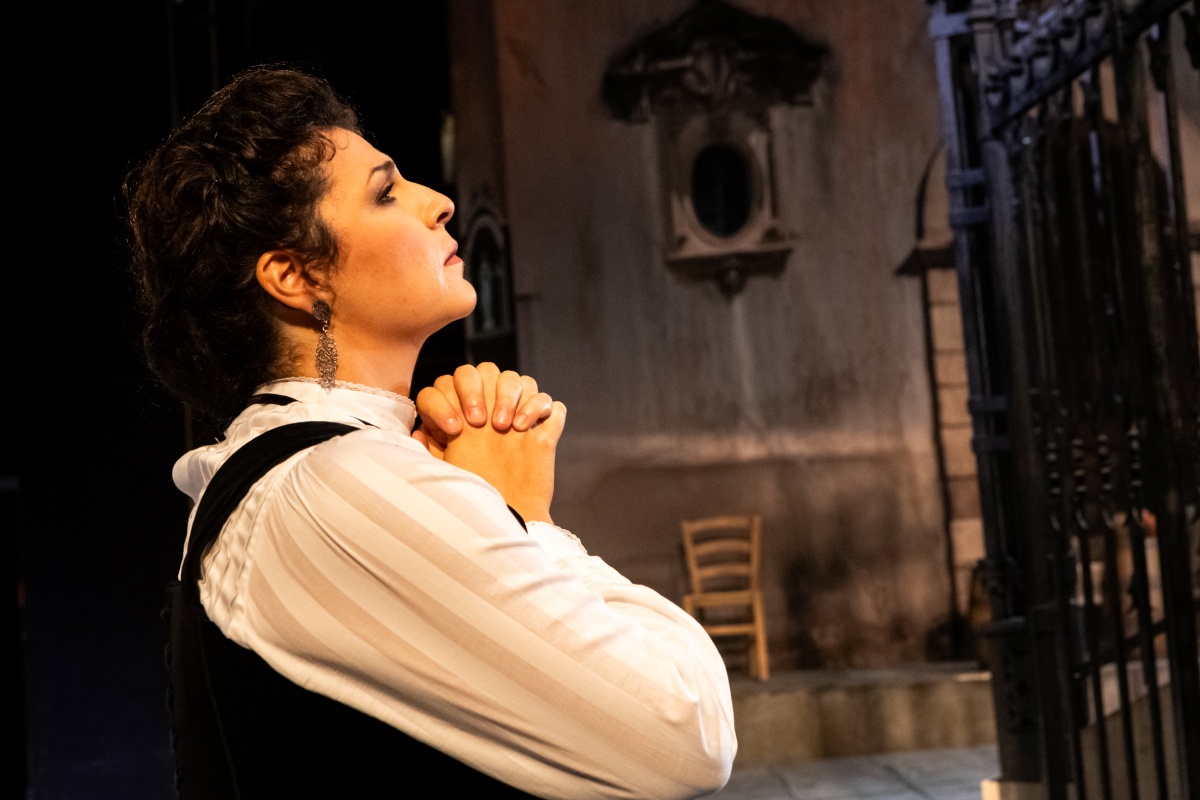
Equally central to Gandini’s reading is the interweaving of the sacred and the violent. It is Easter, and the characters’ language is saturated with God, sin, and confession, merging in the same breath with curses and anathemas: «A te la mala Pasqua, spergiuro!» (“A cursed Easter to you, oath-breaker!”), Santuzza cries at Turiddu in her moment of deepest pain. Excommunicated and shut out from the rite herself, she is not shut out from faith, which she invokes with an intensity the director makes vividly clear on stage.
The production’s visual approach stays close to the Italian tradition of painted, perspectival scenery, reinterpreted with contemporary tools: the church’s grand staircase is modelled on the Cathedral of San Giorgio in Ragusa Ibla, while the large backdrops are photographic prints processed with the help of artificial intelligence, shifting in colour as the day passes. There is no shortage of more immediate local colour either: the statues carried in the Easter procession supply the necessary folk touches.
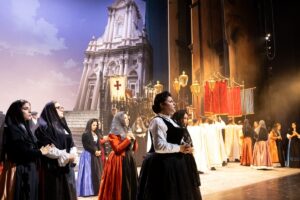
The chorus, trained by Salvatore Punturo, gives an excellent vocal performance, but also stands out as a character, watching and judging.
But it is the musical direction that truly holds the evening together. Gaetano d’Espinosa’s reading is taut and gripping, with an almost obsessive attention to musical detail and no concession to easy sentiment. The drama moves forward, direct, necessary, inevitable. Tight tempi and a direction that never lingers in Romantic languor are paired with excellent control and an exemplary balance between pit and stage. Verga’s dry verismo finds full realization here, especially in the scene between Turiddu and Santuzza, in its balanced alternation between declamation and lyrical outburst.
Teresa Romano’s Santuzza is exceptional, a mezzo-soprano of intense dramatic weight whose voice alternates power and tenderness. Her characterization is thoroughly convincing on stage: not simply a victim, but also an agent of her own tragedy, through the jealousy and rage that ultimately cost her the man she loves. She prays and pleads, but here too without extreme or exaggerated gestures, keeping her balance and dignity intact.
Fabio Sartori’s Turiddu is convincing in his traditional Italian vocal manner: his bright, warm timbre lends itself to a passionate reading without excess. It is a shame that this vocal quality does not always match his stage action, which costs the duet with Santuzza some of its dramatic tension. His farewell to his mother in the final scene, however, is genuinely moving.
Ambrogio Maestri, one of the most beloved baritones of his generation, seemed on this evening not especially compelling. The voice sounded clouded, with little projection, unable to carry even the most dramatically charged moments. The news of Lola’s betrayal passes almost unnoticed. His stage authority as a great performer, however, remains undiminished.
Kamelia Kader is a fine Mamma Lucia, a worried mother grieving for her son’s fate; Sofia Koberidze’s Lola is appropriately coquettish and naïve.
Overall, this remains an excellent production, one that, while working within tradition, chooses to place the emphasis on the characters’ psychological drama, with a musical reading that is dry, dramatic and taut. The production was warmly received by the audience.
Teatro Massimo Palermo, Italy
Opera in one act
Music: Pietro Mascagni
Libretto: Giovanni Targioni-Tozzetti and Guido Menasci, after the novella and play by Giovanni Verga
Conductor: Gaetano d’Espinosa
Director: Marco Gandini
Orchestra and Chorus of Teatro Massimo di Palermo
New production of Teatro Massimo di Palermo
Cast includes Teresa Romano, Fabio Sartori, Ambrogio Maestri, Sofia Koberidze, Kamelia Kader
Run until 20 March 2026
Running time: 1 hour and 10 minutes
Photo credit: Rosellina Garbo