

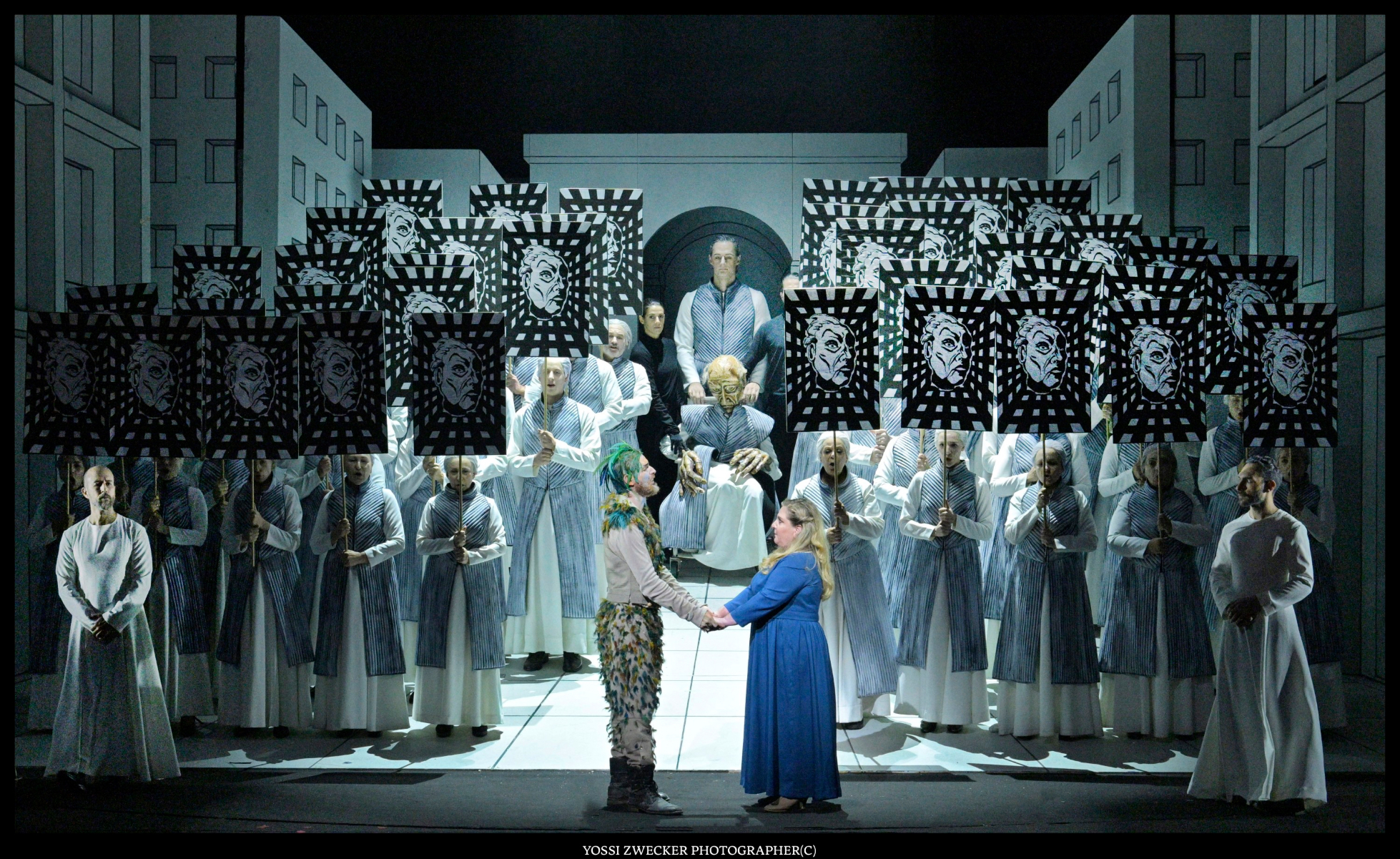

During my last visit to London, I noticed a growing trend on the West End: several major musicals, including Into the Woods and My Neighbour Totoro, featured puppets in prominent roles. Mozart’s The Magic Flute traditionally incorporates puppetry as well, usually to represent the wild beasts Tamino tames with his magic flute – in her wonderful production for the Metropolitan Opera, Julie Taymor famously imagined them as floating bears. However, director and puppet designer Nikolaus Habjan took this concept a step further, transforming both the Queen of the Night and Sarastro into puppets. While intriguing on paper, this artistic choice proved far less successful on stage.
When the Queen of the Night tempts Tamino into rescuing her daughter from Sarastro’s supposed abduction, the audience is confronted by a large, grotesque, elderly puppet. As the puppet’s lips move, the soprano providing the vocals remains obscured in the darkness behind it. Sarastro is similarly depicted as an elderly puppet, bound to a wheelchair. In his case, at least, the singer stands behind the puppet in full light, allowing the audience to appreciate the actual performer. Serbian bass Sava Vemić, a remarkably tall man, was magnificent in the role, commanding the stage with a rich, resonant, and powerful voice.
Nofar Yacobi, on the other hand, left a less impressive impact as the Queen of the Night. Her pleasant soprano lacked the sheer power required to overcome the challenging acoustics of the Tel Aviv Opera stage. Shortly before the opera’s conclusion, both characters shed their puppet identities. This shift suggested the conceit may have been intended as a metaphor for public personas or pretense; whatever the underlying intention, the dominant effect was distracting rather than illuminating.
More broadly, the production felt like a hodgepodge of ideas that never quite coalesced into a coherent whole, though it was punctuated by several beautiful moments. One distinct highlight was the appearance of Papagena (the wonderful Shaked Strul), who emerged from behind a tree like a radiant vision before the despairing Papageno. The forest set, composed of towering tree trunks rising out of the gloom, made a powerful impression. Sarastro’s temple was revealed as the stage revolved, leaving the trees visible in the background—a lovely touch that subtly implied the Queen of the Night’s dark realm and Sarastro’s supposedly holy domain are merely two sides of the same coin. Unfortunately, the temple set itself, with its somewhat abstract, rectilinear design, was nowhere near as striking as the dark forest.
Ultimately, what saves this production—which originally premiered at the Dortmund Opera in December 2023—is its exceptionally strong cast, which does full justice to Mozart’s gorgeous score. Yael Levita was in top form as Pamina. Her beautiful soprano soared throughout the evening, earning enthusiastic bravos from the audience for “Ach, ich fühl’s” (“Ah, I feel it”), the aria in which Pamina gives voice to her agonizing fear that she has lost Tamino’s love. Levita’s rendition was deeply moving, conveying the character’s profound anguish with genuine emotion.
Austrian tenor David Kerber made a dashing Israeli Opera debut as Prince Tamino. He demonstrated excellent control over his pleasing voice and possessed a vibrant stage presence, suggesting he would be equally at home in musical theater as he is in opera. The scene-stealing Papageno was performed by Oded Reich, who reprised the role from the 2021 Tel Aviv Opera production. His performance was considerably stronger this time around; not only did he sing beautifully, but he was also thoroughly entertaining as the perpetually hungry birdcatcher who simply cannot stop talking.
The Three Ladies—American soprano Marie Webb and Israeli mezzo-sopranos Anat Czarny and Rachel Frenkel—were spectacular together. Their voices complemented one another beautifully, and their performances were delightfully cheeky and amusing. Meanwhile, the Three Boys who guide Tamino were sung by three young female sopranos: Neomi Ben Shachar, alongside high school students Mika Halperin and Avigail Kaminker. Their angelic voices stood in stark contrast to the baffling directorial decision to dress them in black suits and grey wigs, making them look like old men.
Conducting The Israel Symphony Orchestra Rishon LeZion, Dan Ettinger led the ensemble with exceptional verve and precision, holding the musical elements of the evening together beautifully. All in all, this new production did not shed new light on the convoluted plot of this well-loved opera, nor did it resolve the clash between silly comedy, serious drama, and philosophical aspirations – but it certainly pleased the ears.
Opera
Music by Wolfgang Amadeus Mozart
Director and puppet designer: Nikolaus Habjan
Conductor: Dan Ettinger
Sung in German with Hebrew and English surtitles
Cast includes Yael Levita, David Kerber, Oded Reich, Nofar Yacobi, Sava Vemić
The Israeli Opera Tel-Aviv-Yafo האופרה הישראלית תל-אביב-יפו
Running time: 3 hours, including 1 intermission