


As part of the preparations for the 75th Wexford Festival the final ‘fun’ opera for the main house was selected by vote of the audience. This is a vindication of the much-battered democratic process, for the choice turned out to be inspired – one of Rossini’s very earliest ventures – L’Equivoco Stravagante – written in 1811 at the exceptionally precocious age of 19!
Already the champagne fizz is uncorked, and many of his key devices are in place – the wide dynamic range in short compass, the complex word-patter collective numbers, the solo arias that pin a character down immediately in their crucial dimensions, the brilliant showpiece orchestration that alternates with expressive solos taking you to the heart of what the instruments can do. Above all, a precise sense of structure, so that in the right hands the scenes can gather momentum through each act, with points of repose and reflection too, where the audience can draw breath.
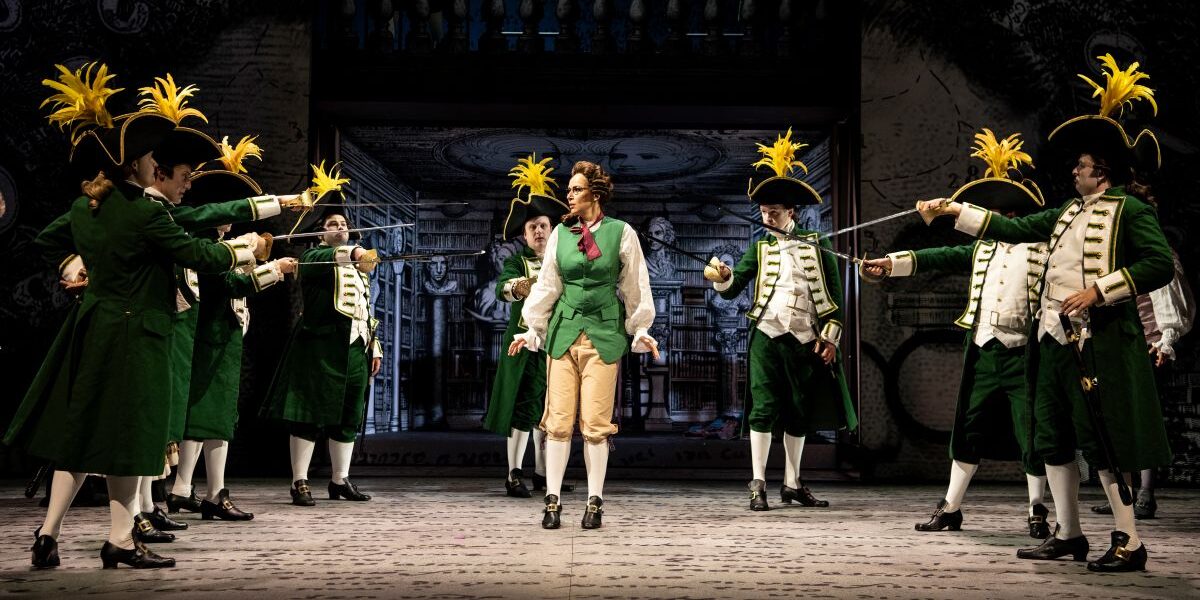
Here there is no doubt the opera is in the right hands. From the first bars of the overture Riccardo Bisatti shows himself fully attuned to the demands of the genre, with exquisite blending of the orchestral lines, and subtle adjustment of dynamics to support and enable the singers. There is give and take rather than relentless speed for its own sake. Likewise, director Max Hoehn does a superbly discreet job in moving all the many singers, chorus members and extras around naturalistically so there is plenty of visual humour and always something going on in the many layers of Darko Petrovic’s split-level set. There is a lot of amusing stage business throughout, as there needs to be, but it never seems rushed and the singers are never put under the kind of pressure that prevents them performing their main job to the best of their abilities.
The plot such as it is, has the usual Rossini conventions – a gouty squire, Gambaretto, determined to enhance his fortunes, seeks to marry off his bookish daughter, Ernestina, to a wealthy foppish, older man, Buralicchio. However, the tenor hero Ermanno has other ideas, abetted by the customary wily servants with their own agenda. The ‘Bizarre Misunderstanding’ of the title is an attempt to persuade Buralicchio that Ernestina is in fact a castrato seeking to dodge military service. This is a cue for a lot of predictable shape-shifting over gender identity, jokes about contemporary philosophy, and an excuse for the local military to put in a fanfare appearance. Age is outwitted, youth gets its way, and the women take the lead.
The quality of the singing and acting is mostly outstanding. Maria Barakova is all over the mezzo role of Ernestina, fully equal to the technical demands, and giving a convincing bluestocking impersonation and entering more than plausibly into the trouser-role joke, helped by a wonderfully flexible trouser-dress as costume. As her father, Stefan Astakhov is splendidly splenetic, relishing his rage arias, and Gurgen Bayevan is both funny and poignant in the key role of Buralicchio, always acting off the speech to good effect and incisively projecting this light baritone role. The chorus of farm hands and soldiers and talking sculpture busts are impeccable, and Kelli-Ann Masterson, Carlos Natale keep the plot bowling along through their machinations.
I have only two reservations to report: Sebastian Mach was underpowered and under the note for much of the evening as Ermanno, despite a reliable top register; and the interior space opened up in the set for domestic scenes was a bit too cramped to allow the action in some key scenes to register fully. Otherwise this evening was a delight from start to finish, whizzing by in apparently no time, despite the actual running time of nearly three hours.
Music: Gioachino Rossini
Libretto: Gaetano Gasbarri
Conductor: Riccardo Bisatti
Director: Max Hoehn
Cast includes: Stefan Astakhov, Maria Barakova, Gurgen Baveyan, Sebastian Mach, Kelli-Ann Masterson, Carlos Natale
2 hrs 50 mins with interval
Until 29 October 2026
Photo Credit: Padraig Grant