

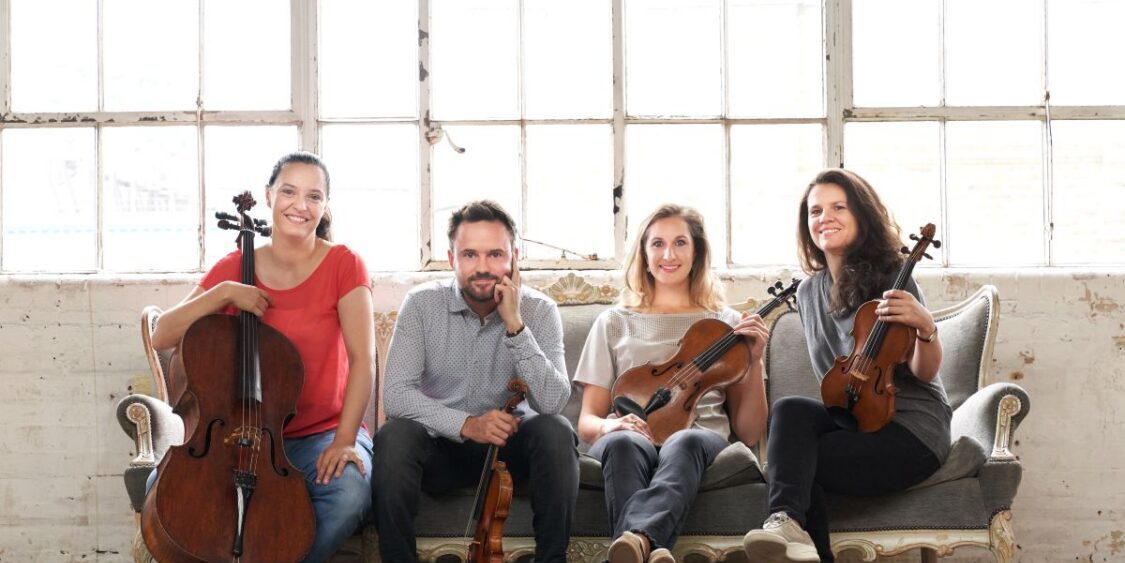

As part of the celebrations of her 70th birthday, composer Sally Beamish joined up once more with regular collaborators, the Elias Quartet, for performances of two works they have commissioned together with Schumann’s first string quartet from 1842, itself the point of departure for Beamish own most recent work of commentary and reflection.
Scotland, its landscape and its musical traditions, have played a major role in Beamish’s development as a composer, and those influences were woven into the first work on the programme, ‘Reed Stanzas’, her third string quartet. Donald Grant, the second violinist in the Elias, is also a traditional Scottish fiddle player, and his role helped determine the focus and structure of the overall work.
The opening offers a magical moment of spatial awareness. Three players enter, and you wonder there is a problem with the second violin. But then a distant melody begins from the green room that instantly evokes a distant Scottish vista, before Grant enters, playing as he goes, to complete the formation. In formal terms the work borrows from the shaps of pibroch music with the wistful melody of the opening recurring at the end and with a sequence of highly ornamented variations in between, offering a wide range of emotional moods. If you closed your eyes you certainly got the sense of a remote landscape with the high strings suggesting bird calls and the concerted sections evoking wind wafts through the reeds, whether in the Hebrides or at Snape, where Beamish has often played.
The Schumann is a natural point of inspiration in that it is a work that largely avoids traditional formal shapes and conventions, constructing its four movements out of various fragments, which Beamish then proceeds to deconstruct again for her own work like a set of little Kurtag miniatures. The quartet were not afraid to explore a wide range of dynamics in a work which is as quirky as any of Schumann’s more obviously programmatic works. As ever in Schumann’s chamber music, a sensitivity to quicksilver dialogue and gradations of emotion in repeated passages is essential, and this experienced set of players certainly provided it, especially in an exquisitely sustained account of the slow movement.
Beamish’s response to the Schumann offers nine short movements, with the viola, Beamish’s own instrument, as an independent sustained line throughout, representing Clara Schumann herself. This quietly determined, implacable voice makes its own way through the flurry of different textures surrounding it as a still voice of calmness, patience and resignation. Throughout there is a sense of the full range of sonorities available to each instrument – as you would expent from a composer who is also a string player with a weath of chamber music experience. The independent validity of each line of writing is never blurred, but the total effect is more than the sum of its parts. You also hear the rests and silences as part of the intended sometimes other-worldly aural landscape of the piece. At different points there is an eerie use of harmonics, akin to a glass harmonica, which refract Schumann’s themes and sonorities through a ‘broken mirror,’ perhaps anticipating his own tragic mental disintegration, but also summoning up desolate landscape imaginings akin to the impact of the first quartet in the programme.
We returned to Scotland briefly in the final two pieces, both arrangements of Scottish folksongs by Donald Grant, the first a rhapsodic hymn, and the second a more lively, dancing finale.
What stood out in the playing across the evening was the intimacy and immediacy of the communication between the four members of the group. They seem to anticipate each others’ initiatives and instictively adjust their tone and intensity to provide a unified meld of collective sound. It was especially interesting and original, however, to see Beamish accord prominent roles to the inner voices of the quartet, the second violin and viola, which often lack independent agency in quartet writing. This kind of cooperation and experiment between composer and performers demonstrates the commissioning process at its most rewarding for all concerned – not least the audience.
Elias Quartet
Composers: Sally Beamish and Robert Schumann
5 November 2026
2 hrs with interval
Photo Credit: David Shapiro