


Would Gluck have liked and used the marimba?
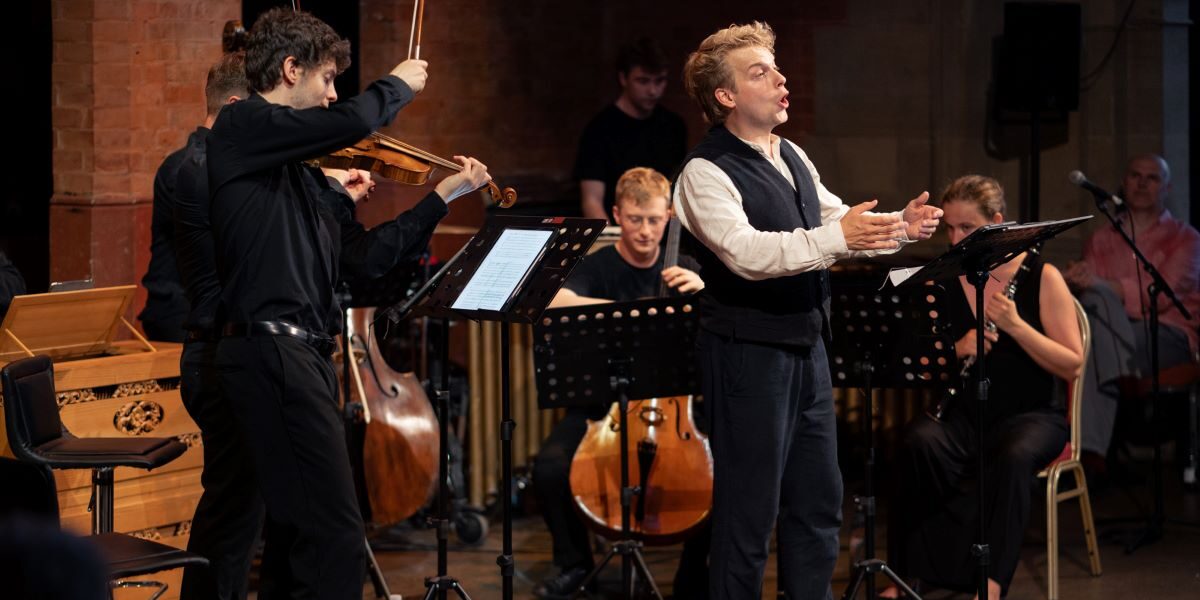
This unlikely question lay at the heart of a fascinating preview concert offered by Hugh Cutting and chamber group FIGURE at Stone Nest. Ahead of performances of the whole opera in November, they gave us a taster of what they have in store, and particularly for the chamber orchestra, who came in one by one one by one as they set up the layer of the introduction to the first number, Purcell’s ‘One Charming Night.’ Alongside familiar strings, were a harp, various forms of percussion and a chamber organ, all intent, in the words of the song on showing how to ‘make the pleasure longer last, A thousand, thousand several ways.’
Wht followed was a delightful sequence of mainly familiar numbers that were made to seem interestingly unfamiliar by the textures and colours applied to the orchestral layers, particularly through the presence of a full percussion section and a modern concert harp, the latter of course of central relevance to the legend of Orpheus, but applied equally liberally and rewardingly to the other listed composers.
The programme was interspersed with commentary from various members of the creative team about the forthcoming production. Unfortunately from where I was seated I could not hear the contributions of the director and choreographer, so I cannot comment on those aspects. But Hugh Cutting and Frederick Waxman, director of FIGURE, explained how this project emerged as a way updating Gluck on his own terms. His reforms, starting with Orpheus and Eurydice in 1762, began with a critique of the conventions of Baroque Opera, determined to displace mere display with an insistence on the priority of dramatic needs, subordinating music and vocalists to advancing the narrative purposively. The view of Waxman and his colleagues is that that very drama can be given a new dimension by taking the opera out of the ‘sound palette’ of the eighteenth century and into a new set of contemporary resonances and timbres.
I am not sure that this logic entirely holds. No production I have ever seen of this opera has lacked dramatic urgency; and with the vocal lines unaltered and the structure of scenes presumably the same, the essence of the drama is still the original work of the composer. But having said that I have sometimes found Gluck’s orchestral palette undeniably restrained, self-consciously so, in comparison with other composers of the period; and so an attempt to add extra sounds and layers that still serve the needs and emphases of the drama is welcome.
On this showing, the full version to be heard in November will offer an enriching experience that may make us think about familiar arias afresh. Cutting’s account of ‘Chiamo il mio ben cosi’, for example, had all of his familiar fresh-voice charm, but also some delightful idiomatic writing for the harp. Even more striking where the new arrangements of some of the ballet music, which plays as important a role as the vocal numbers. Here Gluck’s original does seem underpowered especially for the needs of the drama in the Underworld. Certainly, I have heard performances of this opera in which the Furies sounded more like ortolans than orcs. No danger of that here, as conventional impressions were displaced altogether, like recolouring a familiar image on an i-pad. But there was a welcome sense of moderation too. When we reached the famous ‘Che faro senza Euridice’, the measured poise of the simple strophic stanzas was still present, and the accompaniment suitably subordinate, but with eerie, disturbing overtones. Rightly so, given the position in the drama.
Alongside the Gluck were several items by Purcell, which made me want to suggest a whole evening devoted to similarly playful rearrangements – such is this composer’s rhythmic vitality and contrapuntal skill that the jazz inflections present in many of these arrangements deserve to be given freer rein. Cutting also gave a ravishing account of Oberon’s ‘I know a bank’, with an accompaniment that wisely added little to Britten’s original.
All in all, this was a fascinating anticipation of a full-length evening where forces and venue seem ideally combined to set up a wholly absorbing and revelatory experience, come November.
Figure, led by Frederick Waxman
Singer: Hugh Cutting
24 June 2026
1 hr 10 mins
Photo Credit: Sam Cornish