


Madama Butterfly confronts contemporary audiences with a striking contradiction between critical awareness and musical seduction. From the outset, the vocal lines make it disconcertingly clear that the central romance will not end happily—and should not be expected to. Yet Puccini’s music renders this doomed, illusory love irresistibly compelling.
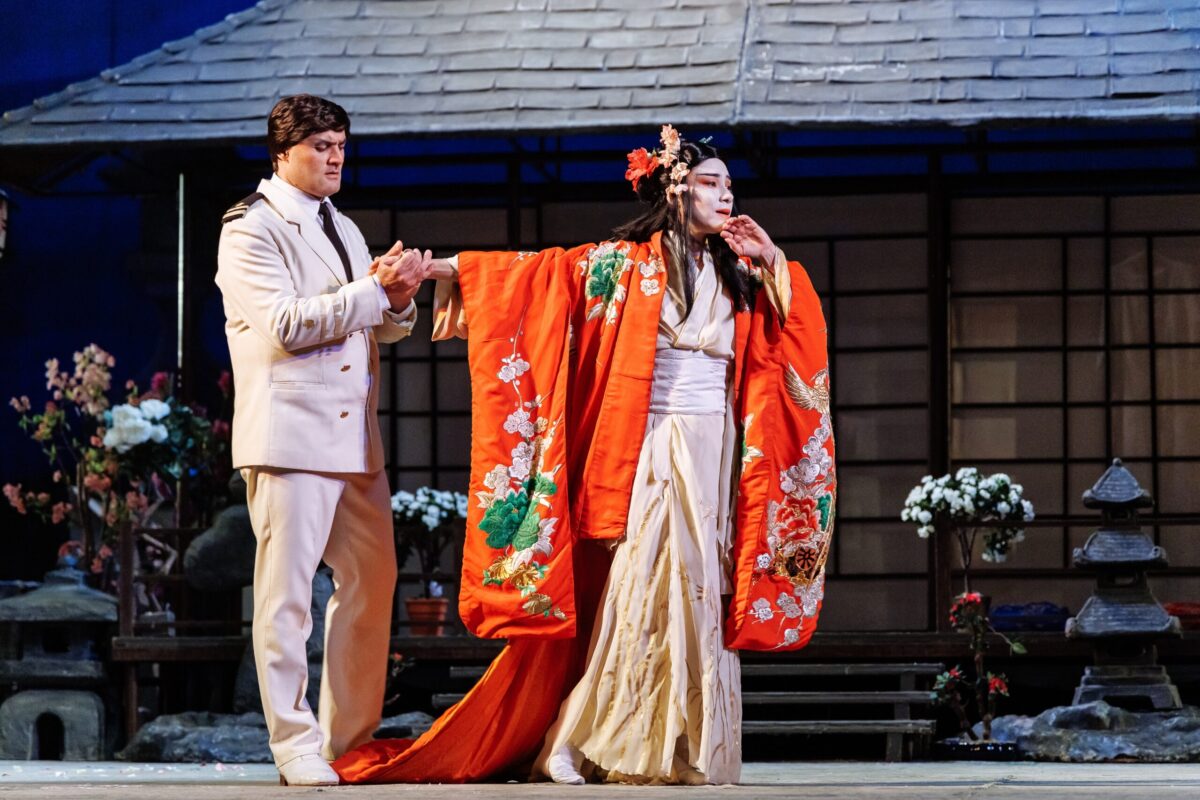
Ellen Kent’s production embraces this tension within a visually rich and immersive staging. At its centre stands a traditional Japanese minka, a wooden house with sliding paper walls, set against a distant mountain in twilight blue. Around it, asymmetrical arrangements of pink blossoms, stone ornaments, and water basins create a stage picture that feels both carefully composed and alive. Framing vines above add an understated finishing touch. The gentle sound of a running stream at either side continues even in quieter musical moments, lending a subtle but persistent atmosphere. The sliding paper doors, beyond their practical use, create a delicate sense of intimacy.
The production avoids excessive movement, and while the stage is not always fully occupied, it remains expressive through the music. In Act I, Cio-Cio-San enters with her companions, their ascent unfolding like an exuberant ceremony. Though the staging remains grounded, the music suggests a gradual, almost weightless rise. The vocal lines move in patterned phrases, creating a gentle, processional rhythm that seems to lift the stage itself. It is a moment of pure anticipatory happiness.
This happiness is, of course, fragile. Even before the drama fully asserts itself, Pinkerton’s casual, dismissive attitude casts a shadow over the marriage. Yet the love duet that closes Act I remains undeniably enchanting. Interweaving vocal lines and swelling orchestration build wave upon wave of emotional intensity, rising and falling with a fluidity that seems to lift the joy towards the infinite. The frequent parting and rejoining of Cio-Cio-San and Pinkerton mirror this movement on stage, adding a physical dimension to the same ebb and flow. At moments, the orchestral texture sharpens with brass and percussion, cutting through the score like distant warnings. The love never fully convinces.
In Acts II and III, the focus shifts from spectacle to psychological progression, and the production handles this transition with clarity. Isolated, financially strained, and abandoned, Cio-Cio-San clings to the promise of Pinkerton’s return with near unwavering conviction. That hope endures, yet feels increasingly fragile. Importantly, she is portrayed as a fully human figure, rather than an object defined by others. The staging remains visually consistent. The addition of a small Buddha figure beside the larger one may seem incidental, but in the final act—when her child kneels before it holding a small American flag—it reads as a poignant and ironic echo of her earlier renunciation of faith. The image is simple, but its implications are not.
Elena Dee’s Cio-Cio-San shines both visually and vocally. Her performance moves convincingly between innocence and resolve, supported by a voice rich in colour and intensity. Though Pinkerton is hardly a sympathetic figure, Oleksii Srebnytskyi’s performance is striking; his confident delivery makes the emphatic boos at the curtain call unsurprising. Yelyzaveta Bielous brings warmth and steadiness to Suzuki, while Vitalie Cebotari’s restrained Sharpless conveys quiet compassion and moral clarity.
It is no surprise that Madama Butterfly continues to appear on contemporary stages. Puccini’s seductive musical language may explain part of its enduring appeal, but it is the tension between beauty and discomfort that keeps the work open to reinterpretation, inviting each new production to reflect on its relevance today.
Opera
Madama Butterfly Music by Giacomo Puccini
Directed by Ellen Kent
Conductor: Vasyl Vasylenko
Photo Credit: Ellen Kent Opera & Ballet International
Cast Includes: Elena Dee, Yelyzaveta Bielous, Oleksii Srebnytskyi, Vitalie Cebotari, Hovhannes Nersesyan, Ruslan Pacatovici.
Until (on tour): 13 May 2026 (Wolverhampton)
Running Time: 2 hours and 30 minutes including an interval