


With that deceptively simple observation, Christine Lahti opens one of the most compelling evenings of theatre currently on the London stage. The recipient of an Academy Award, Emmy Award and Golden Globe Award, Lahti strips away every trace of celebrity to present something far more courageous: herself.
At first glance, The Smile of Her appears to be an autobiographical solo play. It is, but it is also much more. It is a meditation on memory, family, identity and the stories we inherit, inviting us to reconsider not only those who shaped our lives but also the assumptions we have carried about them.
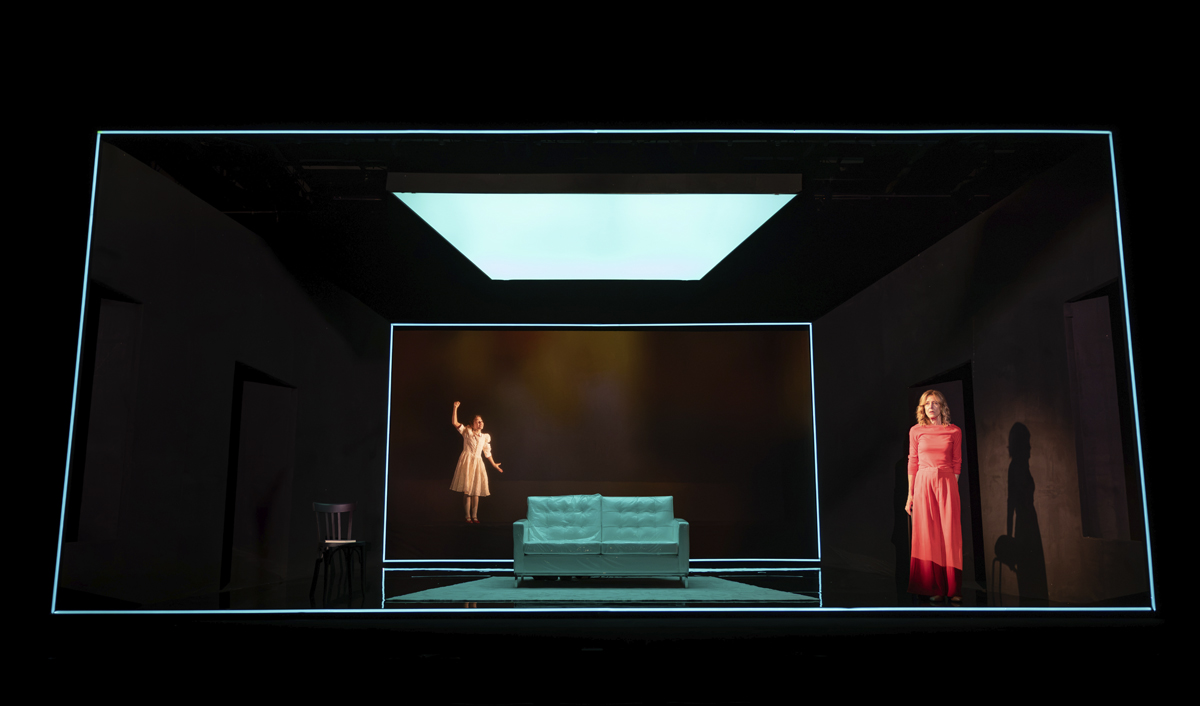
The set, sophisticated in its simplicity, says almost everything before a word is spoken. A pale neon outline traces the walls of an immaculate living room, while a second, smaller illuminated frame glows within it, creating the impression of a room suspended inside another. At its centre sits a pristine white sofa, preserved rather than lived in. It feels less like a home than the memory of one, quietly echoing Lahti’s description of “a living room that bears no trace of living.”
Beautifully directed by Michelle Danner, the production unfolds with remarkable restraint. Lahti, tall and slender, commands the stage with extraordinary assurance. Her movements are economical yet deeply expressive; a subtle turn of the head or the gentle movement of a hand often conveys more than pages of dialogue. Like a prima ballerina, she fills the stage with graceful precision, while her true orchestra is her voice—warm, nuanced and effortlessly capable of moving between humour, vulnerability and quiet heartbreak.
The audience is welcomed almost as guests. Lahti acknowledges individuals seated before her, immediately dissolving the barrier between performer and spectator. What follows feels less like a theatrical performance than an intimate conversation.
Adding another emotional dimension is Isabella Ford, whose remarkable stage debut as the young Christine is performed with confidence well beyond her years. She never seeks to imitate Lahti; instead, she captures the openness and vulnerability of childhood with complete authenticity. Frequently occupying the smaller illuminated frame at the rear of the stage, she appears to inhabit a realm where memories continue to live. At key moments, the younger and older Christine speak in unison, their voices briefly collapsing time as memory becomes present. In one of the production’s most arresting tableaux, they stretch across the sofa until their hands meet, gently recalling Michelangelo’s The Creation of Adam. It is a quietly beautiful image, suggesting not creation but reconciliation—the woman finally reaching back to embrace the child she once was.
Lahti revisits a childhood governed by appearances and discipline. Her father, a respected surgeon admired by many, projected authority both professionally and at home. Some recollections are quietly devastating. A family holiday becomes unforgettable when a disagreement between her parents escalates, leaving six frightened children convinced their mother has been abandoned. Such moments reveal how childhood memories are shaped not only by events themselves but by the fear they leave behind.
Central to the play is the image of her mother’s smile. As a young girl, Christine interprets it as passive acceptance, a symbol of everything she is determined not to become. Yet one of the play’s greatest achievements is its willingness to revisit that judgement. With maturity comes the painful realisation that, in trying so hard not to become her mother, she had failed truly to see her. That moment transforms the evening from personal memoir into something deeply universal.
Professional success brought its own challenges. Despite becoming one of America’s most respected actresses, Lahti recalls the abuse of power that women routinely encountered within the entertainment industry. Refusing sexual advances carried professional consequences, yet these experiences are recounted without bitterness or self-pity.
The play’s most harrowing passages concern sexual violence. Lahti wisely resists sensationalism. Rather than lingering over individual episodes, she allows them to emerge as part of the fabric of a lifetime, revealing how trauma reverberates across families, friendships and generations. Each disclosure deepens our understanding of the woman before us, until the final revelation arrives with devastating emotional clarity. There is no theatrical excess. The simplicity of the telling leaves the auditorium in profound silence.
What makes The Smile of Her so exceptional is that it never becomes a catalogue of suffering nor a political manifesto. It is, instead, an exploration of resilience, memory and understanding. Lahti allows compassion to sit alongside anger, humour beside sorrow, ultimately inviting us to look again at those closest to us with greater generosity.
Marylebone Theatre provides the perfect setting for such an intimate work. Its scale allows every pause, glance and subtle shift of emotion to resonate. Supported by an elegant design and Michelle Danner’s assured direction, the production trusts both its audience and its performers.
To hold an audience utterly absorbed for ninety minutes with little more than a sofa, carefully crafted lighting and the extraordinary power of storytelling is no small achievement. Christine Lahti accomplishes precisely that.
The Smile of Her is a remarkable piece of theatre—intelligent, emotionally generous and quietly unforgettable.
Writer: Christine Lahti
Director: Mêlisa Annis
Set, Costume and Prop Designer: Sarah Beaton
Sound Designer :David Gregory
Lighting Designer :Matt Haskins
Running Time: 90 mins (no interval)
Until: 29 Aug 2026
Age Recommendation:12+
Photo credit: Mark Senior