
Tosca is now in its 126th year, a staple of opera houses around the world. In this revival, English National Opera (ENO) reimagines Puccini’s classic tale of love and power. The action, originally set in a church in Rome in 1800, is transposed to a generic concert hall. As a metaphor, this works well, offering an imaginative echo of Jonathan Miller’s famously modernised, fascist-era production of Tosca for ENO. Yet the challenge facing radical reinterpretations lies in the libretto itself: how many concert halls, after all, have Madonna chapels in which escaped republican leaders can hide?
On an upstairs stage, Mario Cavaradossi is painting Mary Magdalene, partly modelled on his lover, the singer Floria Tosca. She is, he declares, his only thought (il mio sol pensier). His celebrated romanza, Recondita armonia, establishes the intensity of their love affair and provides an impressive showcase for the rich vocal range of Chaz’men Williams-Ali. His Cavaradossi is a troubled hero: brave, idealistic and loyal in a dangerous time of political strife. It is no coincidence that his first encounter with Tosca follows his promise to help Angelotti (Alaric Green) escape the clutches of Scarpia (Christopher Purves).
Tosca’s fiery jealousy of an imagined rival is powerfully conveyed by a visceral Axelle Fanyo. She is firing on all cylinders from the outset in Non la sospiri la nostra casetta, while Cavaradossi’s tribute to her eyes, which he considers the most beautiful in the world, offers gentle reassurance of his enduring love.
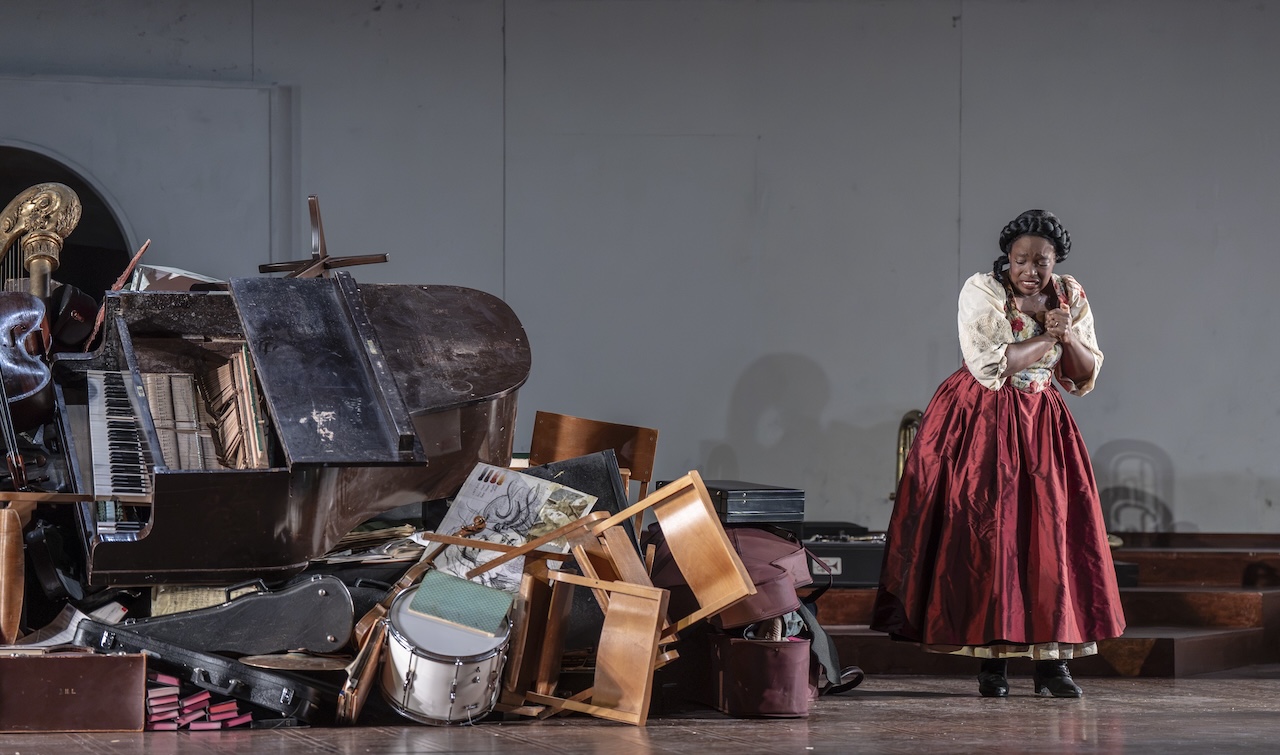
The opera sets love and loyalty against political expediency and cynicism. Its unspecified wartime setting is evoked by men strutting in military uniform and the shockwaves of intermittent explosions offstage. The contrast with the concert-hall setting, complete with grand piano, violins and an enormous double-bass case, reinforces the central theme of this reimagined Tosca: the symbolism of the double-bass case doubling as Scarpia’s coffin is unmistakable. Here, music and art stand on the frontline in the struggle against tyranny, censorship and state violence. In this respect, Annilese Miskimmon’s production succeeds brilliantly.
It could hardly be more relevant at a time when the promise of ‘peace in our time’ seems as fragile as it did in the 1930s. The message resonates all the more strongly because Miskimmon presents us with a shabby, run-down concert venue. There is no money to prop up the place, yet it continues to pulsate with energy and passion: for music, for art, and for love and sex. The latter find glorious expression in Tosca’s Vissi d’arte, sung sublimely by Fanyo to rapturous applause, and in Cavaradossi’s equally memorable E lucevan le stelle.
Scarpia, the villain of the piece, is portrayed by Christopher Purves in a truly stellar performance, both dramatically and vocally. He moves seamlessly from political predator to sexual blackmailer.
There is no doubting the political punch of this Tosca, whose thrust remains true to the spirit and soul of Puccini’s opera. Perhaps that is why the children’s chorus sits somewhat awkwardly within this darkly imagined production, its presence seeming almost incongruously festive. Or is the intention to suggest that, despite everything, there may yet be hope for the future?
Under the expert baton of Ben Glassberg, the ENO orchestra dazzles, while the late Amanda Holden’s superb translation once again demonstrates her unfailing ear for words written to be sung.
English National Opera
Music: Giacomo Puccini
Libretto: Luigi Illica
Translator: Amanda Holden
Conductor: Ben Glassberg
Director: Annilese Miskimmon
Set Designer: Rosanna Vize
Photo credit: Ellie Kurttz
Cast includes Axelle Fanyo, Chaz’men Williams-Ali, Christopher Purves, Alaric Green, Robert Hayward, Osian Wyn Bowen, Steffan Lloyd Owen, Ronald Nairne, Elliot Michael/Tristan Meziere.
2 hrs 45 mins with interval
Until 11 December 2026