

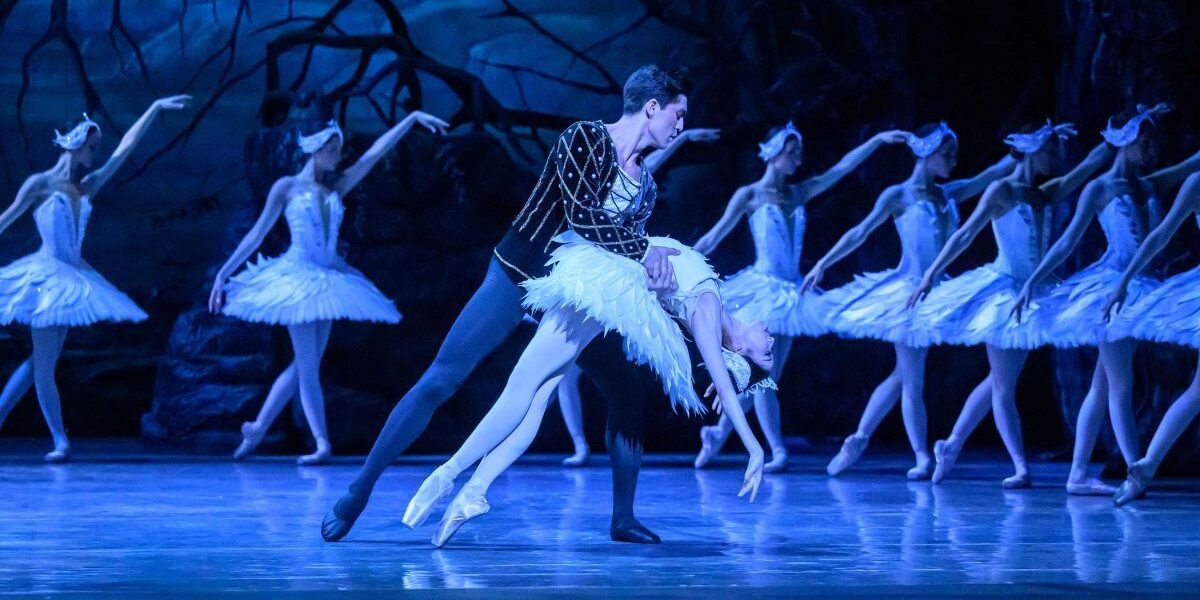

The marvel of Swan Lake is its plasticity and flexibility in the hands of so many generations of performers, directors and designers. It is extraordinary to think that it was not a success at its premiere, when Tchaikovsky’s music is so varied and inventive. It has been some years since I last heard the ballet performed live, and from the opening bars one is struck by the range of orchestral colours that, from one short movement to another, create a kaleidoscope of indelible impressions and possibilities upon which a creative team can build something fresh. There are productions that go for a tragic ending, while others favour a more redemptive conclusion; there are productions, such as Matthew Bourne’s famous remake of 1995, that even take the music of Act 1 and turn it into a disco jive. The greatness of the score, and indeed of the foundational choreography by Petipa, is that it can absorb all of this reinterpretation and emerge as fresh and exciting as ever.
This is certainly the case with Nina Ananiashvili‘s production with the State Ballet of Georgia, now in residence at the Coliseum.
In some ways this is a traditional production, and none the worse for that. The swans are in tutus, a romantic medieval chivalric aesthetic envelops the production, and the world is put to rights by the end. However, in significant and beneficial ways it breaks with tradition too. This is a carefully edited production, coming in at just over two hours of performance time. There is much greater dramatic urgency as a result, yet I never felt that any essential choreographic or musical sequence had been sacrificed. By and large, the music and choreography are carefully adapted to use dance to tell the story while minimising the becalmed periods of plotlessness. There is an art that conceals art here, from which many productions could learn.
Also, if you are going to embrace tradition, you should do it with conviction across the board. The detailed realism of the sets, the grandiose extravagance of the costumes, and the elaborate contrasts within the lighting design all contribute to a rare intensity of experience across a familiar work. Often tradition is used to reinvent, rather than simply repeat. This is beautifully illustrated in the setting of Act 2, for example, where the meticulously detailed Gothic set provides a jewel-case setting for the confrontation between Siegfried and Odile, and the lighting designer achieves a fine coup in contriving Odette’s reappearance silhouetted against a stained-glass window. The whole act has dramatic momentum throughout and is prefaced by genuinely characterful dance routines making use of Georgian folk tradition that lift a sequence which, in lesser hands, can seem merely decorative.
Every Swan Lake has to be judged in the end by the quality of its principals and the corps de ballet who constitute the flock of swans. Here there are no weaknesses. From the first collective shimmering shimmy the swans display consummate technique and, where needed, individuality. They protect and identify with Odette powerfully, an embodiment of strength and resilience rather than fragility. As Odette/Odile, Nino Samadashvili finds a wide expressive range from delicacy and despair through to exuberance and defiance. Quite rightly, she garnered a huge round of applause for her execution of the 32 consecutive fouettés in the climactic ballroom scene. The same appreciation was extended to Oleg Ligai for his magnificent sequential leaps in Prince Siegfried’s solo dances. There was also strongly characterised support from Marcelo Soares as Rothbart, a much more memorable presence than is often the case in a brilliant avian costume of his own, and from Masaaki Goto as Benno, no pale imitation of the prince in his athleticism.
The Royal Ballet Sinfonia has this music in its DNA, but nevertheless this was a wholly idiomatic and sympathetic performance of the score under the dexterous leadership of Levan Jagaev. On what I understand to have been only one rehearsal, they provided the dancers with an entirely dependable foundation while at the same time offering so many clean, burnished highlights of their own. There are also several key solo moments—notably for the harp, violin and trumpet—where the rapport between pit players and dancers was immaculate, as in the finest chamber music.
There were two relatively minor areas where I believe the production fell marginally short. The opening of Act 1 in the Palace Gardens is perhaps the most difficult to bring off: it can seem too static and ceremonial, with one movement succeeding another, where the music is certainly contrasted but the courtiers are not. The direction seemed a little lacklustre here, with little effort made to advance the story or introduce the principal characters except through their technical dance skill. I also wondered at times about the chemistry between the two leads, something that can occasionally arise when one partner is appearing as a guest artist rather than as a regular member of the company.
Otherwise, this evening was a wonderful testament to the strength in depth of the State Ballet of Georgia, steeped in the traditions of Russian classical training while bringing its own distinctive flair and national character to bear on a timeless classic. With another week of performances remaining, this is a production that any London dance enthusiast should make every effort to see.
State Ballet of Georgia
Director: Nina Ananiashvili
Royal Ballet Sinfonia
Conductor: Levan Jagaev
Performers include: Masaaki Goto, Oleg Ligai, Nina Samadashvili, Marcelo Soares
Until 26 July 2026
2 hrs 40 minutes with interval
Photo Credit: Katja Ogrin