


Some productions never quite leave you. I first saw Tom Stoppard’s Arcadia in Trevor Nunn’s celebrated 1993 National Theatre production. Although I was new to English theatre and missed much of Stoppard’s dazzling wordplay, I left utterly enthralled by the experience. More than thirty years later, I can still picture scenes from that production with extraordinary clarity. It inevitably shaped my expectations of Carrie Cracknell’s new staging.
The brilliance of Arcadia lies in its dialogue between past and present. Carrie Cracknell’s production succeeds only in part because one half of that conversation proves consistently more compelling than the other.
This production of Arcadia is effectively two plays. The Regency scenes sparkle with wit, warmth and intellectual vitality, brought to life by an outstanding ensemble. By contrast, the contemporary scenes rarely ignite. Their humour often falls flat, the pacing slackens and, with the exception of Bernard, the present-day characters emerge as curiously colourless.
This imbalance matters because the play depends upon its two narratives illuminating one another. Here, however, every return to the twentieth century feels like an interruption rather than a continuation. Instead of building dramatic momentum, the production loses it, and the modern characters rarely develop beyond sketches. Bernard, although entertaining, is played with such exuberance that he occasionally borders on caricature.
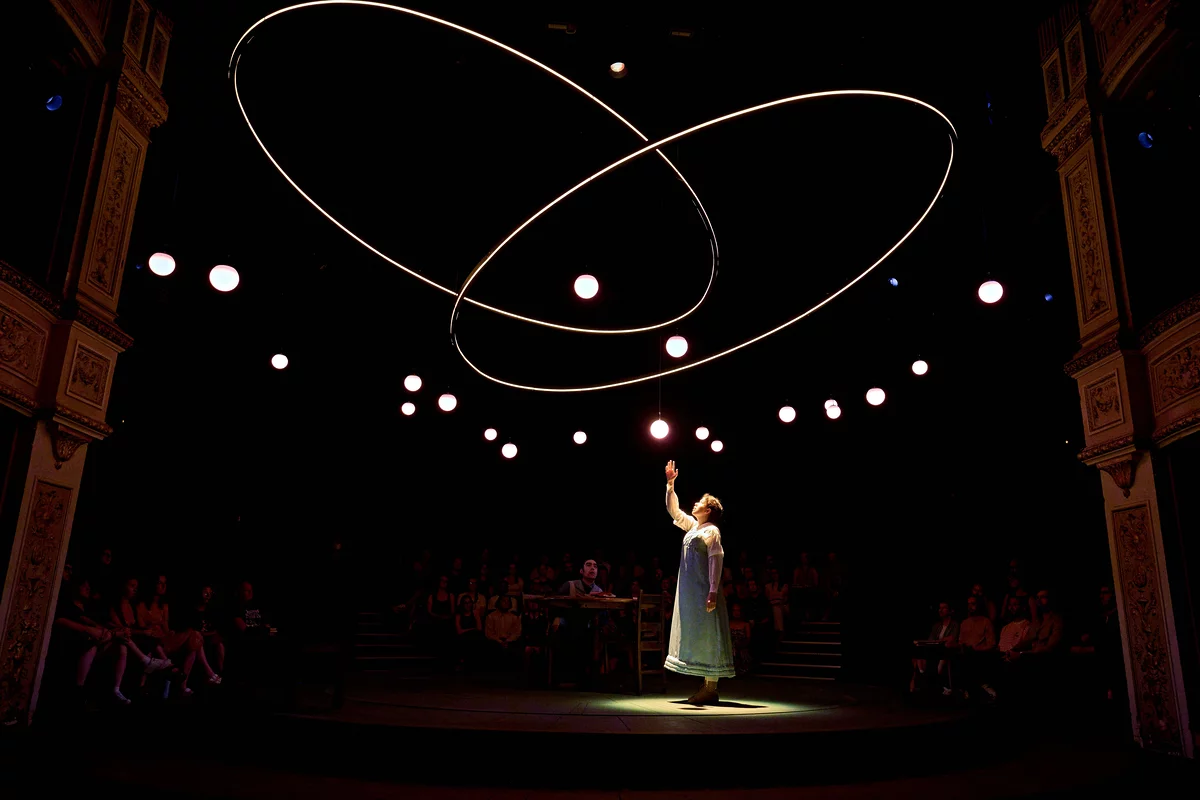
As Thomasina Coverly, Isis Hainsworth beautifully captures the character’s precocious intellect without sacrificing her youthful innocence. She moves with natural grace, combining adolescent curiosity with an unexpected poise that hints at Thomasina’s extraordinary potential. Her impeccable comic timing and effortless command of Stoppard’s densely woven dialogue make her performance one of the evening’s greatest pleasures.

Seamus Dillane proves every bit Hainsworth’s equal. His Septimus is witty, intellectually assured and quietly compassionate, balancing irony, emotional restraint and growing tenderness with remarkable subtlety. He delivers Stoppard’s dazzling dialogue with effortless fluency while allowing the character’s deeper feelings to emerge gradually and without sentimentality.
Matthew Steer gives a wonderfully judged performance as Ezra Chater, a mediocre poet whose boundless self-importance far exceeds his talent. His outrage at his wife’s infidelity stems less from wounded affection than from injured pride, a distinction Steer understands perfectly. He reveals Chater as a man whose vanity blinds him to his own inadequacies, creating a character who is simultaneously comic, pathetic and wholly believable.
Yolanda Kettle’s delightfully imperious Lady Croom dominates every scene she enters. Balancing aristocratic authority with razor-sharp comic timing, she perfectly captures Lady Croom’s exasperation at her husband’s fashionable plans to replace the classical landscape with the latest picturesque fad.
Tim Frances, in the comparatively small role of the butler Jellaby, leaves a distinct impression, quietly enriching the household’s constant flow of gossip with understated comic precision.
The twentieth-century scenes are less successful. As the garden historian Hannah Jarvis, Nikki Amuka-Bird brings intelligence and authority to the role, but the production never allows the character to generate the same dramatic energy as the Regency figures. At times, her delivery is insufficiently projected, causing some lines to lose their impact.
Oliver Chris injects Bernard Nightingale with welcome theatrical energy, but the performance is pushed so broadly that it occasionally slips into caricature. His exaggerated physicality and mannerisms blur the distinction between an inflated academic ego and outright comic parody, weakening a character who should remain both exasperating and recognisably human.
Alex Eales’ elegant set, beautifully complemented by Guy Hoare’s atmospheric lighting, is crowned by two suspended elliptical rings that hover above the stage like celestial orbits. More than a striking visual image, they become a poetic metaphor for Stoppard’s play itself: two worlds separated by time, yet forever circling the same enduring questions of love, knowledge, memory and mortality. It is one of the production’s most eloquent visual ideas.
The final waltz remains one of the most moving scenes in modern theatre. Isis Hainsworth and Seamus Dillane play it with exquisite restraint, allowing Thomasina and Septimus’s unspoken affection to emerge with heartbreaking inevitability. Their final moments together possess an emotional and almost sensual intensity that holds the audience spellbound. Stoppard’s final tableau invites the two periods to illuminate one another, yet here the twentieth-century characters recede into the background. Rather than enriching the emotional climax, their presence feels indistinct, leaving the production’s central dialogue only partially resolved.
While this production never achieves the perfect equilibrium between past and present that lies at the heart of Arcadia, its magnificent Regency ensemble and two outstanding central performances make it a rewarding, often exhilarating evening. It may not replace the memory of Trevor Nunn’s unforgettable production, but it compellingly reminds us why Arcadia remains one of the greatest plays of the modern era.
Arcadia – first performed in 1993 at the National Theatre (London)
By Sir Tom Stoppard (1937 – 2026)
Director Carrie Cracknell
Set Designer Alex Eales
Costume Designer Suzanne Cave
Lighting Designer Guy Hoare
Sound Designer Donato Wharton
Movement Director Ira Mandela Siobhan
Composer Stuart Earl
Cast Isis Hainsworth, Seamus Dillane, Yolanda Kettle, Matthew Steer, Nikki Amuka-Bird, Oliver Chris, Tim Frances, Angus Cooper, Holly Godliman, Matthew Doswell, Aaron Anthony
Running time: 2 hours and 50 minutes
Photo credit: Manuel Harlan.