

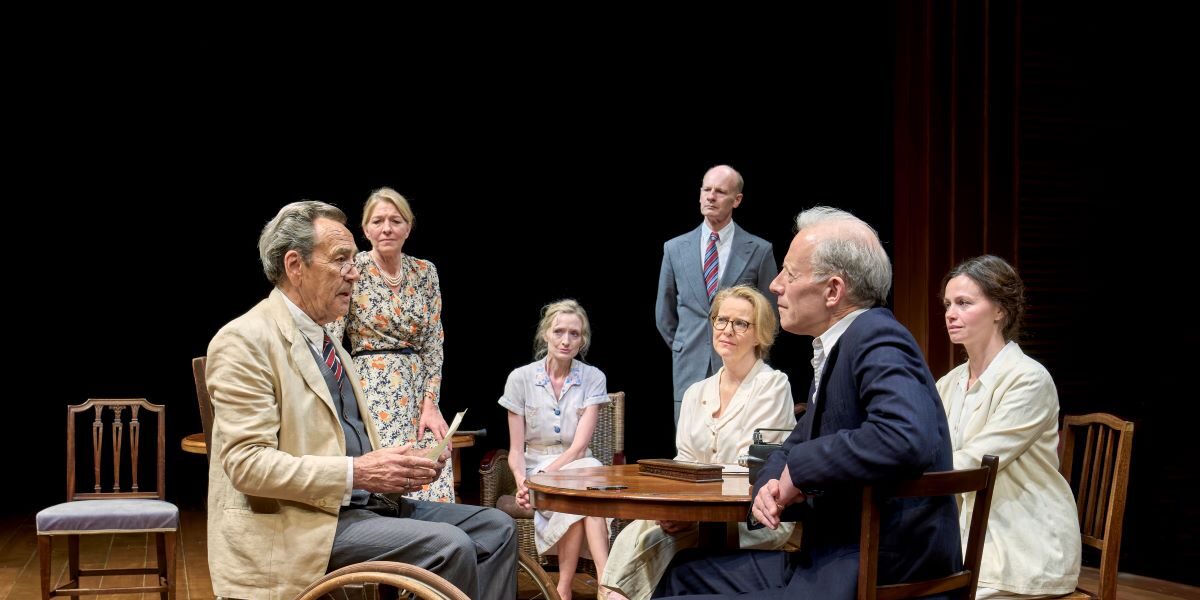

When did it become the fashion to ring the changes on play or a film so that each has to morph one into another, or even into a musical?
Just because the story has enjoyed success in one medium does not mean it is meant to find another life in a different format. Sometimes the adaptation can work very well, but often you find the subject matter stranded between genres and never fully shedding the forms of its original conception. This is rather the case with Springwood, which has previously existed as radio play and film and never quite finds its feet as a play. Its shortcomings stem from these unresolved ambiguities.
The action reimagines, with considerable liberties, a genuine state visit made by George VI and Queen Elizabeth to the Untied States in June 1939. On the eve of World War Two, they did indeed stay at Hyde Park, the Hudson Valley residence of Franklin Roosevelt. Here they met not just the President but his wife, Eleanor and his mother, together with the other members of his menage, including Daisy and Missy, whose exact relationship to the President remains an object of speculation to this day.
Given the current debate over the ‘special relationship’ between Britain and the United States, and the recent state visits by King Charles and President Trump, the issues evoked by this play could not be more topical – what difference does personal diplomacy make, particularly for the supplicant partner? What do these events reveal of the extent of Transatlantic (mis)understandings? Is there anything ‘special’ about this relationship, or is it purely transactional?
Unfortunately, the play has little to say on these themes, focusing instead on the mostly inconsequential personal engagements between the key players. There is a lot of back-and-forth about protocol, with a tiresome running theme over whether the king and queen should be expected to eat a hot-dog at a picnic, much satire of American and British mores, and an implausible overnight exposure to the King of Roosevelt’s private affairs. This is mildly diverting for a while, but not over a whole evening. All the more so when quite a bit of the dialogue was inaudible from where I was sitting at the back of the stalls, accompanied by many slow scene changes as the actors themselves rearranged the furniture. These are the sorts of problems that develop when you have the writer doubling as the director, something, in my experience that rarely works, and is a reminder of the essentially distinct nature of the director’s role. As a result the evening lacked pace and sustained dramatic impetus.
On the other hand, there were quite a few well crafted performances across the cast. Jemma Redgrave, as Eleanor Roosevelt, injected energy and a much-needed note of incisive criticism and commentary into all of her scenes. Robert Lindsay, as Franklin, likewise gave a performance of strong personality, wisely not a direct imitation of Roosevelt, but quite plausible in his mixture of bonhomie and political cunning. Rachel Pickup gave a detailed and empathetic portrayal of Daisy, the secretary who was probably also the President’s mistress, awkwardly trying to navigate one impossible situation after another. I found the depiction of the British visitors less persusasive. While Andrew Havill captured the polite diffidence and the stutter of George VI, he is much older than the monarch was at the time, which in a drama that aims to offer historical accuracy, does matter. Whereas, Rebecca Night, as the Queen, was exactly in the right age bracket, but did not convey the savvy and deft social skills, which were well known as part of Queen Elizabeth’s armoury throughout her public life.
While many fine ingredients went into this play, unfortunately what emerges on stage does not measure up to the film or radio versions that preceded it.
Writer & Director: Richard Nelson
Cast includes: Andrew Havill, Robert Lindsay, Eileen Nicholas, Rebecca Night, Rachel Pickup, Jemma Redgrave
2 hrs 20 mins, with interval
Until July 25 2026
Photo Credit: Manuel Harlan