

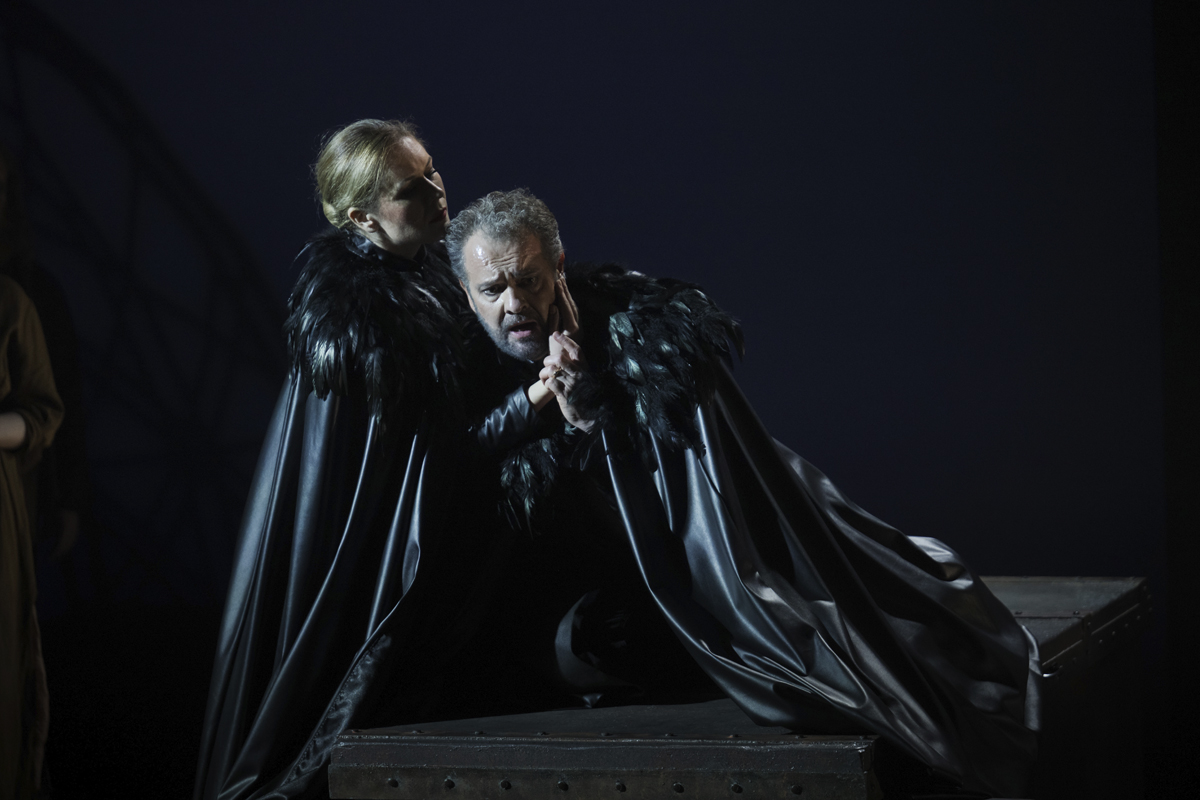

Verdi regarded Shakespeare’s Macbeth as “one of the greatest creations of man”, declaring: “If we cannot make something great out of it, let us at least do something out of the ordinary.” Longborough Festival Opera’s compelling new production demonstrates just how extraordinary this neglected masterpiece can be.
Premiered in Florence in 1847 and substantially revised for Paris in 1865, Macbeth remains one of Verdi’s least frequently staged operas. Longborough’s decision to present the later Paris version is therefore especially welcome, allowing audiences to experience one of the composer’s most dramatically daring works in the intimacy of its beautifully acoustic theatre.
Shakespeare’s three witches become, in Verdi’s hands, a women’s chorus divided into soprano, mezzo-soprano and contralto. They are no mere observers but the opera’s driving dramatic force. Although Longborough cannot field the vast chorus available to larger companies, its nine singers produce an astonishingly rich, atmospheric sound. The Act IV chorus, Patria oppressa—one of Verdi’s finest choral inspirations—is sung with profound pathos and impressive musical refinement.
Director Karolina Sofulak makes several bold dramatic choices. Duncan is portrayed as lascivious, assaulting a young woman on his arrival at the Macbeths’ castle, offering one possible explanation for his downfall. His murder, traditionally kept offstage, is graphically depicted, while Lady Macbeth also dies onstage following the sleepwalking scene. Both ideas intensify the drama. Less convincing is the recurring puppet theatre, introduced during the overture and revisited throughout the evening, which occasionally trivialises the action.
Designer Kimie Nakano’s stark, fractured set vividly evokes both Scotland’s desolation and the psychological isolation of its characters. Particularly effective is Sofulak’s solution to the perennial challenge of Banquo’s ghost: emerging eerily through the cracked dining table, he becomes an unsettling presence, echoed later by the apparitions rising from the same fractured world.
The intimacy of Longborough’s theatre allows Mark Stone to chart Macbeth’s transformation from celebrated warrior to increasingly haunted tyrant with remarkable psychological detail. His warm, rounded baritone is ideally suited to Verdi’s writing, while his interpretation of Pietà, rispetto, amore displays the elegant legato and tonal variety essential to the role. His terror during Banquo’s ghost scene is especially compelling.
As Lady Macbeth, Viktoriia Balan delivers an exceptional performance both vocally and dramatically. She makes one of Verdi’s most demanding soprano roles appear deceptively effortless. Ambizioso spirto, with its treacherous coloratura, extreme dynamic contrasts and relentless vocal demands, is sung with complete assurance. The sleepwalking scene proves even more remarkable. Honouring Verdi’s wish that it be sung with closed eyes, Balan concludes with the notoriously difficult top D marked pianissimo fil di voce—a note many sopranos wisely avoid. She not only attempts it but sings it with complete control. Her richly coloured voice and commanding stage presence make for a memorable Lady Macbeth.
Stone and Balan prove ideal dramatic partners. Their chemistry underpins the opera’s psychological tension, and their duet Fatal mia donna ranks among the evening’s finest moments.
John Molloy appears less comfortably cast as Banquo. Intonation problems and inconsistent vocal support produce an occasionally unsteady tone, particularly noticeable in the closing phrases of Come dal ciel precipita, where the vocal line loses its breadth. Dramatically, however, his spectral return as Banquo’s ghost is genuinely unsettling.
South Korean tenor Jung Soo Yun is outstanding as Macduff. His account of O figli, o figli miei is among the finest heard in recent years, combining vocal beauty with genuine emotional intensity. His studies with Dennis O’Neill are evident in the stylistic assurance and security of his singing.
Welsh tenor Rhydian Jenkins gives a dependable performance as Malcolm.
Conductor Nil Venditti favours brisk tempi, particularly in the overture and parts of Act II. While the dramatic momentum is undeniable, a little more space would occasionally allow the singers greater freedom to shape Verdi’s long vocal lines.
Verdi sought to create something extraordinary from Shakespeare’s tragedy, and Longborough comes remarkably close to fulfilling that ambition. Outstanding central performances, imaginative staging and a superb chorus combine to make this an exhilarating account of one of Verdi’s most unjustly neglected masterpieces.
Macbeth – opera in four Acts
Based on Shakespeare’s Macbeth
First performance Teatro della Pergola, Florence, 14 March 1847
Music by Giuseppe Verdi (1813-1901)
Libretto Francesco Maria Piave and Andrea Maffei
Conducted by Nil Venditti
Directed by Karoulina Sofulak
Designer Kimie Nakano
Cast includes Mark Stone, Viktoriia Balan, Jung Soo Yun, John Molloy, Rhydian Jenkins, Bernadette Johns, Connor Baiaono
Longborough Festival Opera 2026
Running Time Four hours 50 minutes with 90 minute interval.
Until 16th July 2026
Photo Credit Matthew Williams-Ellis