


Monument: A Plea for Imagination
Przymierska greets us in character as we enter, while black-and-white newsreels of post-war Czechoslovakia play behind her. Warned about the audience participation, I take a seat several rows back, which turns out to make no difference. A few minutes into the performance, each audience member is given a marker and two minutes to design the most creative and inspired monument to Stalin. An endless list of requirements then follows, including that Stalin must point towards the sky, making the task more daunting than ever. Volunteers are invited on stage, their drawings politely mocked, and the audience asked why nobody has produced anything brilliant. The joke, of course, is that under these conditions nobody could. This is where the play operates at its best. It does not simply describe Soviet ideology and the values of an autocratic regime; it makes us viscerally feel their claustrophobic and oppressive nature.
Created and performed by Polish-British artist Margot Przymierska, Monument is a distinctive theatrical experience in which the audience is repeatedly invited on stage to perform alongside her. The play unfolds in two contrasting halves. The first, set in post-war Prague, satirises Soviet authoritarianism through the construction of the largest monument to Stalin ever built. The second turns its attention to capitalist consumer culture through the story of a Polish builder and aspiring rapper constructing luxury apartment blocks in London.
In the first half, Przymierska plays Apparatchik, a low-level official overseeing the competition, who climbs the bureaucratic ladder by constantly bending to satisfy Comrade CEO, the unseen authority at the other end of the telephone. Comrade CEO eventually selects Otakar Švec’s design without reviewing the other entries, or Apparatchik’s own.
Švec was a renowned sculptor whose work was exhibited internationally but who is now remembered chiefly for the Stalin monument that destroyed his life. Ironically, many believe he submitted such an extravagant design precisely because he never expected to win. The play acknowledges his suicide shortly before the monument’s unveiling, offering a darkly comic explanation involving a taxi driver who remarks on the unfortunate placement of a woman’s hand on one of the soldiers. The post-show Q&A, however, reveals the full scale of Švec’s tragedy: five and a half years working under secret police surveillance, the denunciation of friends, and his wife’s suicide. While this historical context deepens our understanding, its absence from the performance itself slightly diminishes the emotional weight of his story. Nevertheless, Przymierska uses humour with considerable skill to illuminate both the personal tragedy and the ideological system that produced it.
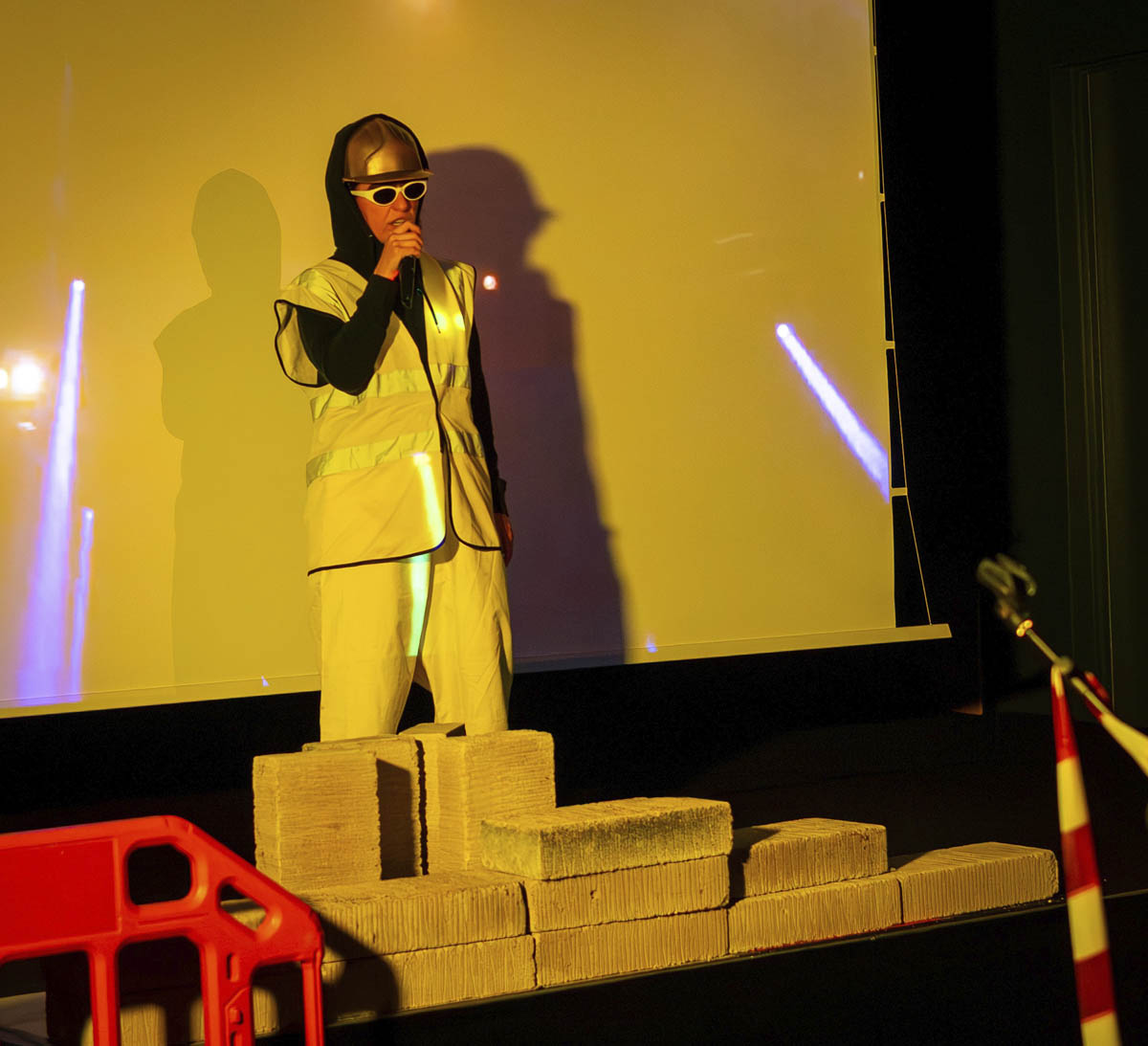
The first half feels complete and dramatically satisfying. By contrast, the second half becomes a collage of rap, TikTok videos and conventional scenes that mirrors the themes of the first without providing the same narrative resolution. Its fractured structure causes the performance to lose momentum. Here, Przymierska plays Bogdan, a Polish builder pursuing both wealth and a rap career while constructing luxury high-rises modern monuments that he himself will never inhabit. Bogdan gradually embraces hyper-masculine ‘red pill’ ideology, an outlook that complements his consumerist ambitions until it is challenged by the war in Ukraine.
Przymierska is an engaging performer with a remarkable ability to encourage audience participation without making anyone feel uncomfortable or exposed. Ultimately, a line spoken early in the performance that “the biggest victim of our time is imagination” captures its central concern. Monument argues that both authoritarianism and consumerism can become systems that limit creativity and independent thought. Although its second half is less cohesive than its first, Przymierska has created an inventive, ambitious and frequently very funny piece of interactive theatre that encourages audiences to question the political, economic and cultural monuments that continue to shape our lives.
Venue: Czech Embassy Cinema, London
Creator and Performer: Margot Przymierska
(production is developed in collaboration with The People Speak )
Event title:MONUMENT: An Interactive One-Woman Comedy Show
Date:Tue 21 Jul 2026