


Neither of the one-act operas that make up this unusual and compelling double-bill is performed often enough, and both offer timely commentaries on our own troubled times. While Opera Prelude had only one night at Opera Holland Park they adjusted to the space and the walkway around the orchestra far better than some other ensembles. On this showing, it is very much to be hoped that they will return.
Trouble in Tahiti is early Bernstein – 1952 – and such is his chameleon gift as a composer you do a double-take at the opening number which sounds like perky early Sondheim, full of jaunty jazzy wordplay. But the drama that follows digs much deeper, offering a searing satire of suburbia, with a portrait of a couple whose relationship is beset with dissatisfactions which they can neither end nor mend. We follow husband and wife, Sam and Dinah, from fractious breakfast through to office work for him and a therapist for her; on to a chance meeting in the street when they lie to avoid each other’s company, before escape to a cinema for her, and a gym contest for him. At the end conventional expectations close over them again inexorably, where there is ‘silent screaming and screaming silence.’
This summary sounds depressing, but there is a lot of humour there along the way, together with a bravura display of styles by the composer – a dream interlude for Dinah that sounds like Copland’s wide open lyrical spaces, and an escapist orientalist vision in the cinema – ‘Island Magic’ – where the pastiche is immensely skilful, and great fun for everyone to perform. None of this is easy to bring off though, and all credit to this young cast for their brio and poise in doing so. Jack Holton and Alexandria Moon bring their characters to life with light and shade and vocal confidence, a very believable couple, all told. The three-person chorus provide pert commentary, and everyone helps out in shifting the segmented set designed by Peiyao Wang. This is an ingenious way of importing a range of portable locations for just one night that still gives a real sense of the variety of one day in the city.
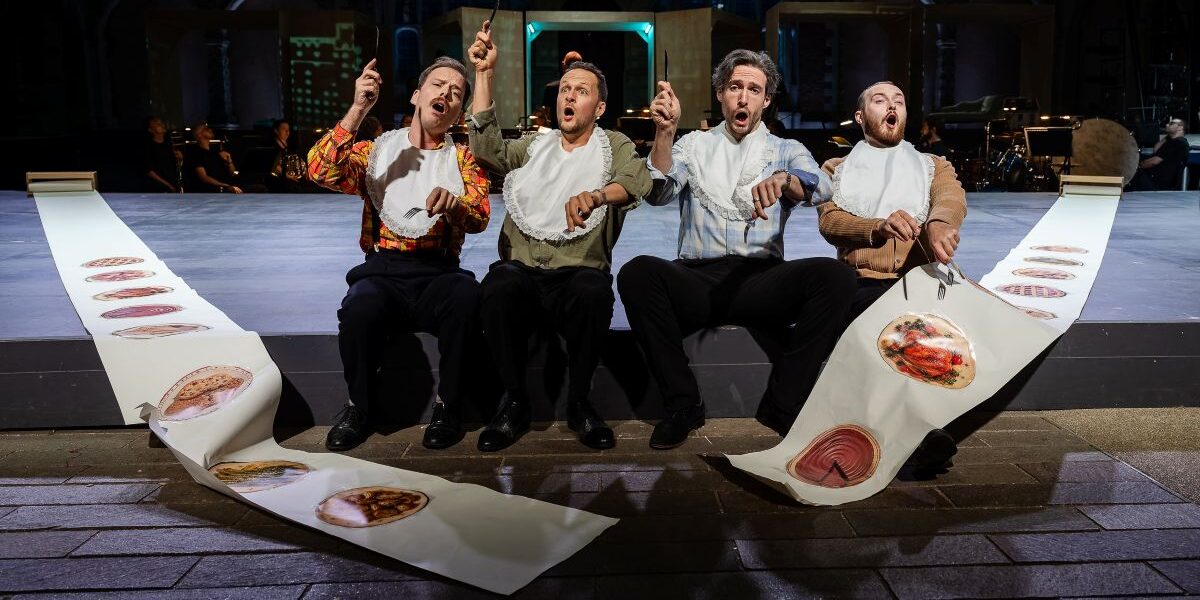
In the second half we returned for a different dose of alienation. The Seven Deadly Sins is Brecht at his most mordantly effective as a critic of capitalist excess. In a classic reversal of expectations, the ‘sins’ are not committed by Anna, the focus of the action, but by those around her and then imputed to her. Anna has the task of raising money for the construction of a family house at the behest of her grasping relatives, and we see her navigate the challenges through two separate embodiments of the same character. The action spreads itself through seven American cities and invites the question ‘What price success?’ The first Anna, sung with voluptuous forcefulness by Stephanie Wake-Edwards, learns to be the canny, adaptive deal-maker, whereas the second Anna, a danced role, with a poignant performance from Yanki Yau, reacts with instinct and spontaneity and gets burned. What is left of the real Anna at the end?
The orchestra threads its way through Weill’s brittle, nervy score with verve and skill, while director Verboni deserves great credit for suggesting shifting locations through a minimum of props and costume changes, and again making clever use of those swivelling boxed mini-sets. The satire and relevance of this piece, as with the first, could not be more telling and prescient and the ensemble missed no opportunity to point it out.
Opera Prelude
Trouble in Tahiti: Words & Music – Leonard Bernstein
Seven Deadly Sins: Music Kurt Weill Words: Bertholt Brecht
Director: Valeria Perboni
Conductor: Lewis Gaston
Casts include: Jack Holton, Alexandria Moon, Stephanie Wake-Edwards, Yanki Yau
20 August 2026
2 hrs
Photo Credit: Julian Guidera