
Can domestic staff outwit their privileged masters? Mozart and Da Ponte’s answer was yes – and then some. The Marriage of Figaro was written in 1786 as an opera buffa, a humorous opera defined by its relatable characters, witty dialogue and earthy stories. Beneath its farcical façade there was a serious political purpose: Europe was taking a revolutionary turn, and here was a production that dared to ridicule the ruling aristocracy’s intellectual deficiencies and flagrant abuses of power. Particularly incendiary portions of material had to be excised from Beaumarchis’ 1784 play La folle journée, upon which the opera’s plot was based, yet The Marriage of Figaro remained, at its heart, a piece written in favour of underdogs.
Appropriately then, this Wild Arts production eschews the eighteenth-century’s infamous opulent excesses, stripping Mozart’s opera back to its raw essence in terms of staging, narrative and music. Designer Laura Stanfield cleverly limits the set—a Spanish castle in which farcical antics unfold—to a few turquoise toile boxes, some chairs, and painted wooden panels (serving as bookshelves, groves of trees and boudoir doors). This economical design adds comic and unexpected meaning to the piece. In a dining room scene featuring the Count and Countess Almaviva, a cotton cloth is punched in frustration only to reveal there is no table beneath it, subtly conveying the aristocracy’s vanishing power.
Reduction is also evident in the orchestration (in most performances it is cut to just a 10-person chamber orchestra). Single wind instruments play rather than double, and the traditional chorus sections are cut. But the fanfare contributed by these elements isn’t missed. The audience is instead made to feel an enhanced sense of emotional intimacy and connection, complimented well by the small auditoriums in which this production is being staged. Mozart and Da Ponte’s characters, this show makes clear, are real people, not slapstick buffoons; they possess boundless depths of passion, practical intelligence, and are often victims of their own recognisably human folly.
To this end, Danielle de Niese’s presence as director is powerfully felt. A celebrated soprano in her own right, de Niese’s performances are typically characterised by a stunning fusion of vocal talent with electric acting abilities. It is evident that all the performers here have been deftly guided by her to excel on both these fronts, exhibiting character work that is rooted in acute psychological understanding. This is a feat that is seldom accomplished to the standard displayed in this production, even in Europe’s most renowned opera houses.
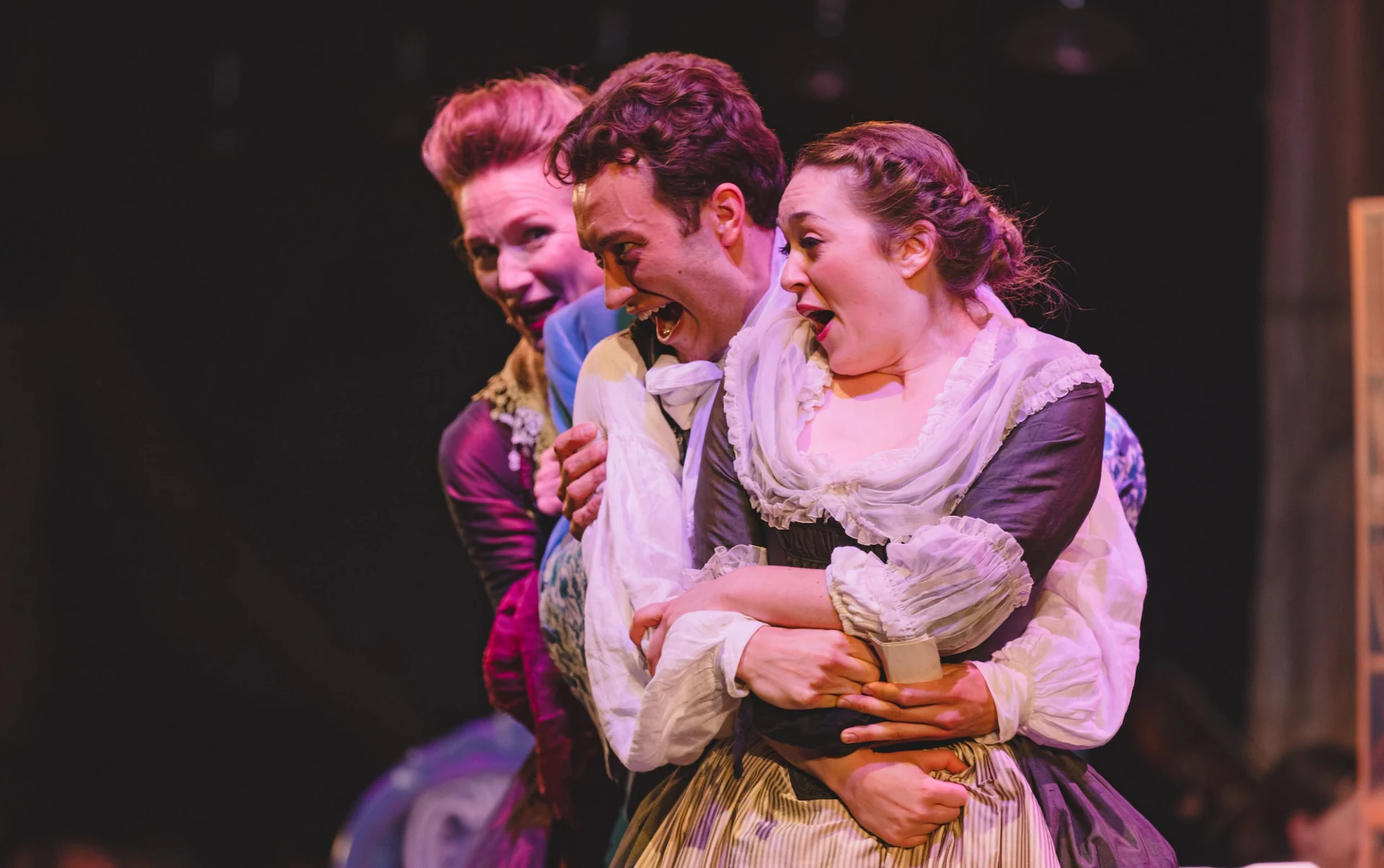
Exemplifying de Niese’s directorial mastery is Jack Sandison’s embodiment of Figaro, a character that is far more than a quick-witted strategist bent on humiliating his aristocratic employer. He is a genuinely affecting lover, above all concerned with protecting his sexually threatened fiancé, Susanna. Playing her in a spirited and playful manner is soprano Ellie Neate, who uses her euphonious voice to evoke every emotional nuance of the libretto. The lovers are well supported by Timothy Nelson’s spiky and splenetic Count, a man slavishly under the grip of his sexual appetites, and Elinor Rolfe Johnson’s Countess, whose emotional fragility is suggested in her sensitive and resonant vocals. Smaller roles are also made much of. Abbie Ward is an endearingly chirpy Cherubino and delivers a spry, energetic performance of the ‘Non so più cosa son, cosa faccio’ aria in Act I, capturing the anguish of endlessly being in love.
None of these performances would have been possible without the flawless conducting of Orlando Jopling. His leadership was as sharp and vigorous as ever, creating a seamless unity between voice and music. Indeed, even though his back was turned away from the performers in the Opera Holland Park staging, his sense of timing was exact and unerring. A further delight was the rhythmic dexterity of the English translation, worked on by de Niese and Jopling. It never felt clunky or unnecessarily florid, serving purely the story and the score.
There is everything to love about this production of The Marriage of Figaro. It puts paid to the notion that opera is an art form that hinges on vast orchestras and flamboyant aesthetic spectacles. Emotional human stories, Jopling and de Niese remind us, are its lifeblood. Over the past few years, it has become increasingly obvious that Wild Arts is one of the UK’s most important organisations in ensuring that opera continues to speak to the widest possible audience irrespective of location or age. It is a charity deserving of great public recognition and support – which you can do with pleasure by seeing this sparkling firework of a show.
The Marriage of Figaro
Music: Wolfgang Amadeus Mozart
Libretto: Lorenzo Da Ponte
Translation: Orlando Jopling and Danielle de Niese
Director: Danielle de Niese
Conductor: Orlando Jopling
Orchestra: The Wild Arts Ensemble
Photo credits: Lucy Toms
Cast includes: Jack Sandison; Ellie Neate; Timothy Nelson; Elinor Rolfe Johnson; Abbie Ward; Timothy Dawkins; Olivia Ray; William Searle; Eleanor O’Driscoll.
Running Time: 2 hours and 40 minutes, with a 20 minute interval
Touring at venues around the UK until 27th September 2026