

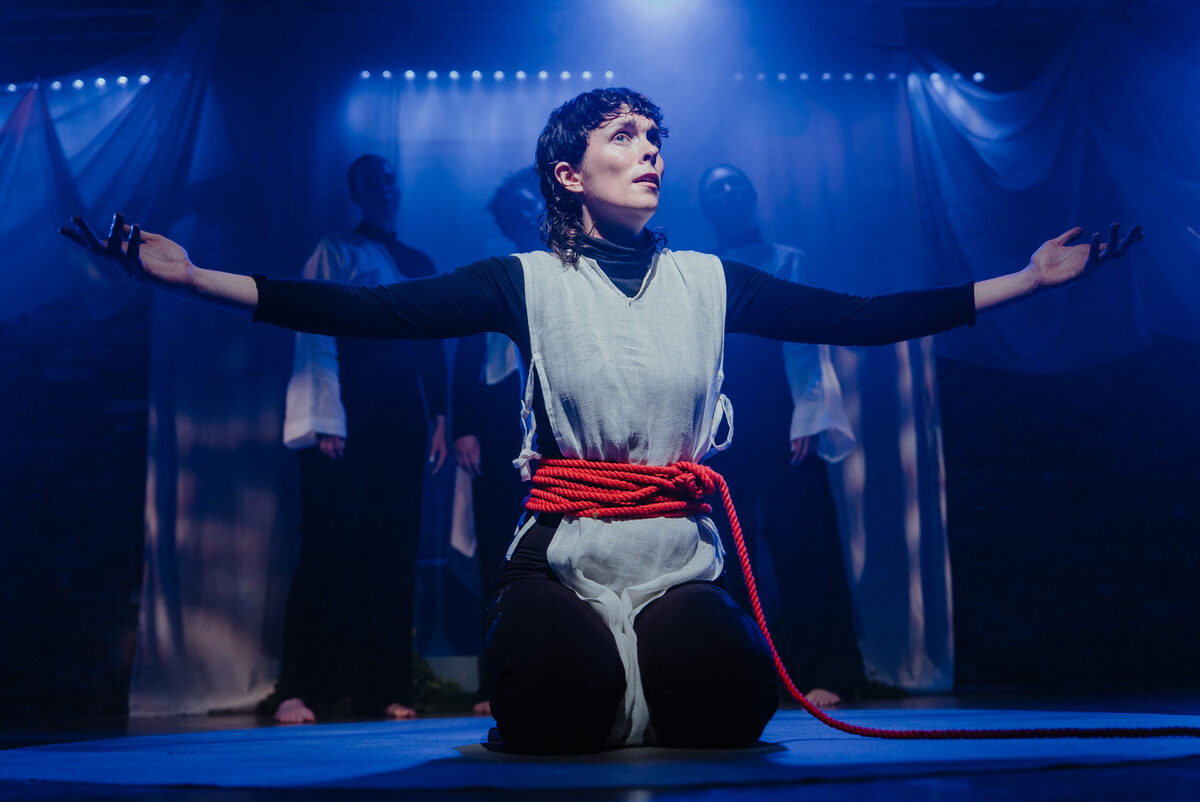
To watch Bitter Visions is to implicitly agree to be part of a ritual. Upon entering the downstairs studio at the Arcola, theatregoers are handed black veils to immerse themselves in a drama that reaches back to the twelfth century. Ordo Virtutum, as the piece was then known, was composed for convent performance by polymathic abbess Hildegard von Bingen (1098-1179) – a woman who was as comfortable composing religious chants as she was penning a medical treatise concerned with gynaecology.
The production loosely adapts the structure of a medieval morality play, in which forces of good and evil battle for the human soul. However, Florence Carruthers-Andrews, who conceived this revival, eschews any essence of religious fervour. Despite its papal trappings and ceremonies, Bitter Visions is a pointedly secular piece, where awakened sensual desires become the root of internalised conflict.
The Soul is played by Carruthers-Andrews, who gives herself commendably to the role, appearing by degrees entranced and possessed as she is slowly consumed by seductive passions. Opposite her is Eleanor Westbrook’s ‘Devil’, a character who crawls on all fours predatorially, agitating the Soul and luring it into a snare. The sinister pitchfork and cloven foot are left behind, however. What is refashioned in its stead is a pagan puck, a sort of ‘Green Woman’, full of nature’s exuberance and frolicsome troublemaking. Arguably this diminishes the stakes of the piece, since the antagonism of Westbrook and Carruthers-Andrews, while wonderfully captivating, could certainly cut deeper.
From a dramatic point of view, the performance accelerates in its final act where we are made to witness a cathartic purgation ritual. With Bacchanalian frenzy, lemons are pulled down from suspended wires by each Virtue only to be squeezed over the Devil in a triumphant act of cleansing. The celebration of chastity affirmed in Hildegard’s liturgical drama is rewritten as a bold statement against the shame historically tethered to women’s sexuality. As the program puts it, Carruthers-Andrews wishes her audience to see that desire is ‘an inherent part of’ ourselves to be ‘accepted and celebrated’. It’s a clever way to make a historical piece relatable to contemporary values, yet one can’t help but feel that something more troubling is implied if Catholicism is retained in so far as it suits aesthetic choices and abandoned when it comes to deep religious teachings.
If in search of religious wonder, Hildegard’s musical bravura and compositional skills bring it to the fore of this production. Music, for the abbess, was an essential part of her devotional practice; she believed that the transcendent, celestial quality of musical was a reflection of the divine God. Carruthers-Andrews offers a lucid, plangent soprano, effectively punctured by occasional shrieks and wails when the Soul writhes in pain. Westbrook’s Devil, true to Hildegard’s original, mostly speaks, often in a taunting manner with a microphone. However, once purified, a beautiful soprano is unleashed, one that truly befits their ascension to the community of the Virtues. Indeed, these veiled personified Virtues (performed by the Ololyga vocal ensemble) contribute a richly layered vocal texture to the performance through Latin plainsong, harmonically balancing and accentuating the solos and, through a powerful interplay of diverse voices, underscoring feminine solidarity.
Electronic music may seem a surprising choice to accompany a liturgical choral performance, yet it works fantastically. The spacey synth beats and melodic touches of xylophone make the production feel of another world, one where the modern and the ancient sit unexpectedly, thrillingly side by side.
Bitter Visions admirably brings to the stage a piece of historical drama refreshed for contemporary sensibilities. While its use of religious iconography and aesthetics may be problematic for some, the outline of Ordo Virtutum is retained and brought to a new generation of spectators. Through its impressive experimental electronic score and arrangement of choral harmonies, Florence Carruthers-Andrews production successfully conjures the mystery and marvel that Hildegard once identified as at the heart of artistic creativity.
Bitter Visions
Grimeborn Festival
By Hildegard von Bingen and Florence Carruthers-Andrews
Photo credits: Alice Underwood
Cast includes: Florence Carruthers-Andrews; Eleanor Westbrook; Salome Siu; Miranda Ostler; Amy Kearsley; Lydia Ward; Emily Beech; Issy Roberts; Sara Knight.
Running Time: 50 minutes
Review by Olivia Hurton