

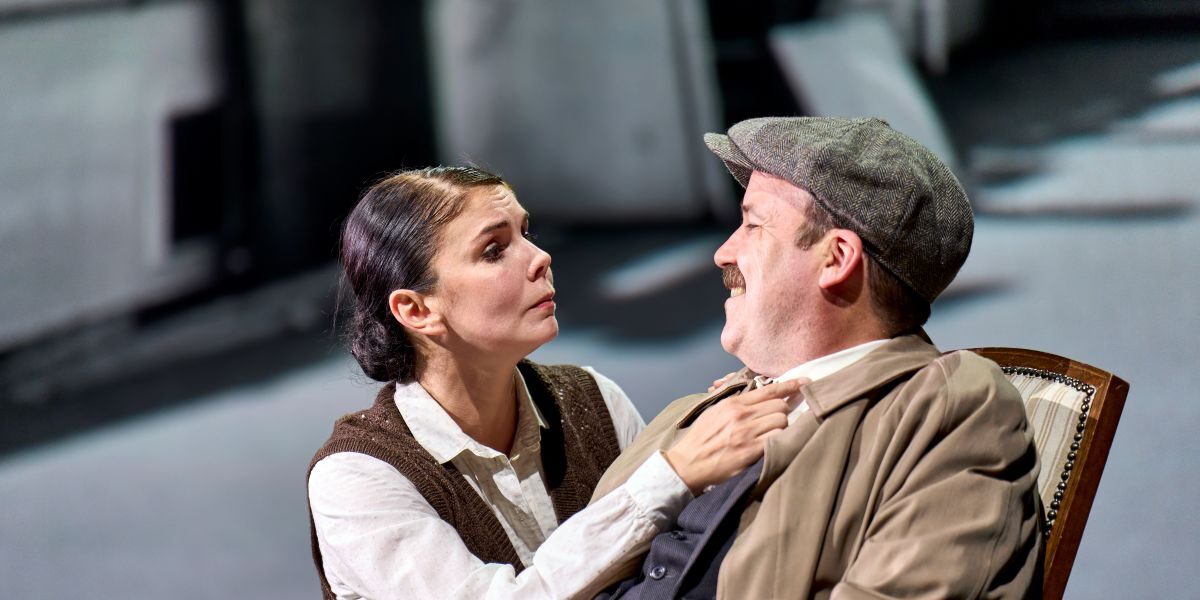

J.M. (Maynard) Keynes is hardly an unfamiliar figure, whether as one of the twentieth century’s leading economic theorists, or as a patron of the arts or as a member of the Bloomsbury Group; but rarely are all these aspects viewed together as part of an overarching quest for the answer to a simple question – ‘What is needed for a Good Life?’ It is a tribute to the ambition of James Graham’s new play that it seeks to intercalate all these themes in a single dramatic structure. It is a high-wire act to keep all these plates spinning as dramatically convincing themes, but in large measure he succeeds in crafting a play that is both witty and entertaining, and also a thought-provoking tract for our own times.
Particular care has gone into making the economics accessible to a modern audience, a tall order. Graham achieves this by pitting Keynes against his real rival and antithesis, Friedrich Hayek, in a series of miniature debates, one even taking place while both were acting as roof-top fire wardens at King’s College, Cambridge, a point where truth really is stranger than fiction! This allows the writer to broaden the canvas so that we can see that the schools of thought each represents are an eternal yin and yang between choices for growth or austerity that is still very much with us. This could hardly be more topical.
Interwoven with this strand is Keynes’ equal focus on the importance of art and culture as a condition of human flourishing – again this comes through powerfully as we learn how Keynes not only bankrolled the Bloomsberries, despite their often lofty disdain, but also was a key figure in founding the Arts Theatre in Cambridge with his own money, and furthermore founding the Arts Council in the very last months of his life, a life tragically foreshortened by heart disease. And here the key link is not the Bloomsbury Group but the Russian ballerina, Lydia Lopokova, whom the hitherto-homosexual Keynes rather surprisingly married at the end of her time with the Ballets Russes. The theatre was built for her, and the place of dance within the work of the Arts Council was thanks to her.
There are some magnificent performances at the heart of unravelling all this cultural and intellectual complexity. Rory Kinnear captures Keynes’ intellectual self-confidence and desire to win, his appetite for culture and creativity, and his slow-burn sensuality. Natlia Osipova, not only resembles Lopokova, but finds a warmth and directness that cuts to the chase and through the pretensions of Bloomsbury with unerring skill. She has fine comic timing, and dances the various ballet scenes and interludes that gradually introduce her, with flair and precision. Laurie Kynaston, in the sometimes thankless role of Hayek, finds an intensity and sincerity that makes him a convincing counterpoint to Keynes on a human level as much as an intellectual one, and Pip Carter offers a brilliant cameo as a petulant, perpetually peeved and waspish Lytton Strachey.
Where the writing and playing is less successful is in finding enough time and space to develop and explain character and relationships. Everyone is so busy being a mouthpiece for complex opinions there is not enough time for them all to interact plausibly in real time with one another. This matters because we need to know in more detail how and why Keynes could move from a deeply loving relationship with Duncan Grant to a contented marriage to Lydia. Thomas Flynn, as Grant, is so busy emoting on aesthetics there is no time for his emotion for Keynes. Likewise we are short-changed a bit in the transition from Duncan to Lydia, plausible as all the relevant scenes are in the playing. Many of the Bloomsbury characters are necessarily gauzy sketches, mouthpieces for views, rather than finished characters.
On the production side it is no surprise that such a crack team produces a smoothly oiled product. Bob Crowley’s deceptively simple set allows for a set of differently shaped panels to rise and fall from the flies, and then act as projection screens. This device references the abstract art of the period while also allowing for a lot of history to receive swift, economical visual presentation. Hytner’s direction is as fluent and well placed as ever, ensuring a sequence of short scenes have clear narrative continuity; and even the minor roles get space and time to register. Lighting and costumes sketch in the pastoral tones of Sussex, the gloomy corridors of Whitehall, and the elegant Georgian squares of Bloomsbury as needed, but with a light touch.
While it is sometimes content-heavy at the expense of dramatic vitality, this is a necessary and important play that arrives at just the point when the kind of shift in economic ideology it debates seems to be taking place again, against a similarly dire set of economic conditions. It could hardly be more timely.
Writer: James Graham
Director: Nicholas Hytner
Cast includes: Pip Carter, Thomas Flynn, Naomi Frederick, Rory Kinnear, Laurie Kynaston, Natalia Osipova, Claire Price
2 hours including interval
Until 12 December 2026
Photo Credit: Manuel Harlan