

‘The last act is the greatest treason. To do the right deed for the wrong reason.’ This famous line takes us the heart of Eliot’s verse drama Murder in the Cathedral, currently receiving a distinguished, thoughtful, and in many ways original revival from the Orange Tree Theatre at St John the Divine, Richmond. How disinterested is the defiance of the state by an individual? Are motives ever pure and unmixed in such self-assertion? What are the limits both on the state’s claim to exercise authority in its own self-protection, and the defiance an individual is entitled to proffer before courage topples over into hypocrisy and self-promotion?
For Eliot, the backcloth was the rise of fascism in the 1930s, and the role of well-meaning fellow travellers in that story; and for us there are many contemporary parallells easily found. But the success of the evening rests ultimately not how you read the play, but on how well it still works as drama.
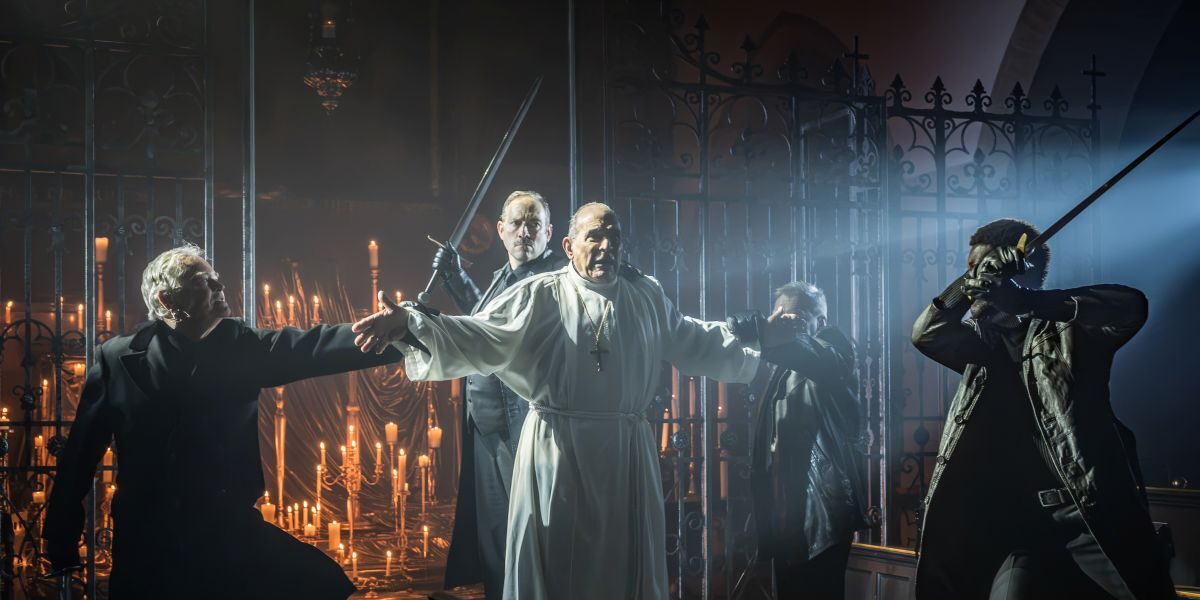
The historical setting is Christmas 1170, as Archbishop Thomas Becket returns to Canterbury in defiance of King Henry II, formerly his close friend. We hear little of the twists and turns of politics that have led to this point, as we learn gradually about the disturbed state of the kingdom from the chorus of the women of Canterbury, anxious, precarious and fearful. The centrepiece of the first act revolves around four tempters who provide increasingly shrewd and perceptive interpretations of the situation in order to dissuade Becket from his stand in defence of the rights of the church. In the second half, although of course we know the outcome, there is a real tension as four knights (played by the same actors as the tempters) arrive at the cathedral to demand at sword point that Becket change his ways. After the climax, the knights return, each of them providing a separate sophistical justification of their actions, before the priests of the cathedral and the female chorus take us through to an elegiac conclusion.
For a play so suffused with Christian ritual and doctrine, a lot depends on the authenticity of the setting, and here the production is superlative. St John the Divine is a plain box shape with a good natural acoustic and fine set of sculptures depicting the Stations of the Cross. Into this framework designer Robert Jones has inserted a walkway in the shape of a crucifix and an illuminated doorway into the Sanctuary, itself memorably illumined by gold drapes and many lit candles. There is scope for dynamic movement, with many points of entrance and angles of vision, reinforced by a fine lighting scheme from Peter Mumford that floods the building with rich primary colours at key points and a vivid sound design by Max Pappenheim involving peals of bells, a drum placed like a steel font at the centre of the action, and the bolting and unbolting of doors that seem to be taking place in the building in real time.
David Suchet gives a commanding performance as Becket, but that all-encompassing command stems as much from the light and shade, empathy and humour he brings to the part as from his impeccable shaping of the verse. In his Christmas Day sermon and his interactions with the women his archbishop conveys a keen regard for the poor and disadvantaged and sudden moments of vulnerability that strengthen rather than diminish the power and courage of the stand he finally takes. He is well supported by the three priests who counsel and attempt to protect him, all of them successful in differentiating their characters. Likewise the four knights and tempters make sure their roles are distinguished in tone and demeanour in line with the attributes they embody, though David Yelland, as the fourth tempter rushed some of his delivery in the critical role of the fourth tempter – the lines really do need to linger in order to register their full sophisticated and subtle depth.
I had mixed feeling about the chorus, though not at all for their skills as actors and musicians – you certainly could not tell the difference between professionals and community performers among the sixteen women performing. Rather Orlando Gough’s music, which was used for the delivery of their lines a capella, perhaps offered a sophistication too far. I would rather have heard more of their lines, full of layered, insightful commentary, chanted or spoken so that they could be clearly heard rather than swaddled in music of undoubted quality, but obfuscating effect.
These are minor quibbles at the end of an evening that gave full dramatic presence to a play that can in lesser hands sag under the weight of its themes and grave potency of its verse. Tom Littler and Francesca Ellis have between them given the play fresh imaginative life and shown that it can still, with the right actors and setting, truly grip the attention of an audience.
St John the Divine, Richmond
Writer: T.S. Eliot
Director: Tom Littler with Francesca Ellis
Cast: Mensah Bediako, Ben Caplan, Sally Cheng, Mila Carter, Chyna-Rose Frederick, Paul Hickey, Jyuddah Jaymes, Michael Lyle, Nick Sampson, Jad Sayegh, David Suchet, Rebecca Thorn, David Yelland
2 hrs 30 mins with interval
Until 7 November 2026
Photo Credit: Marc Brenner