


A shipwreck, a borrowed identity and a houseful of people in love with the wrong person: Twelfth Night has always run on desire and disguise. Jamie Glover’s lively Crucible production plays the romance with real clarity. It also never lets us forget the cruelty lurking underneath the jokes.
The company that brought bleak grandeur to King Lear returns to the Crucible’s thrust stage, and the change of mood is immediate. Where Titus Halder’s Lear stripped everything back to smoke and earth, Glover’s comedy is warmer and more mischievous, and it trusts its actors to find the laughs.
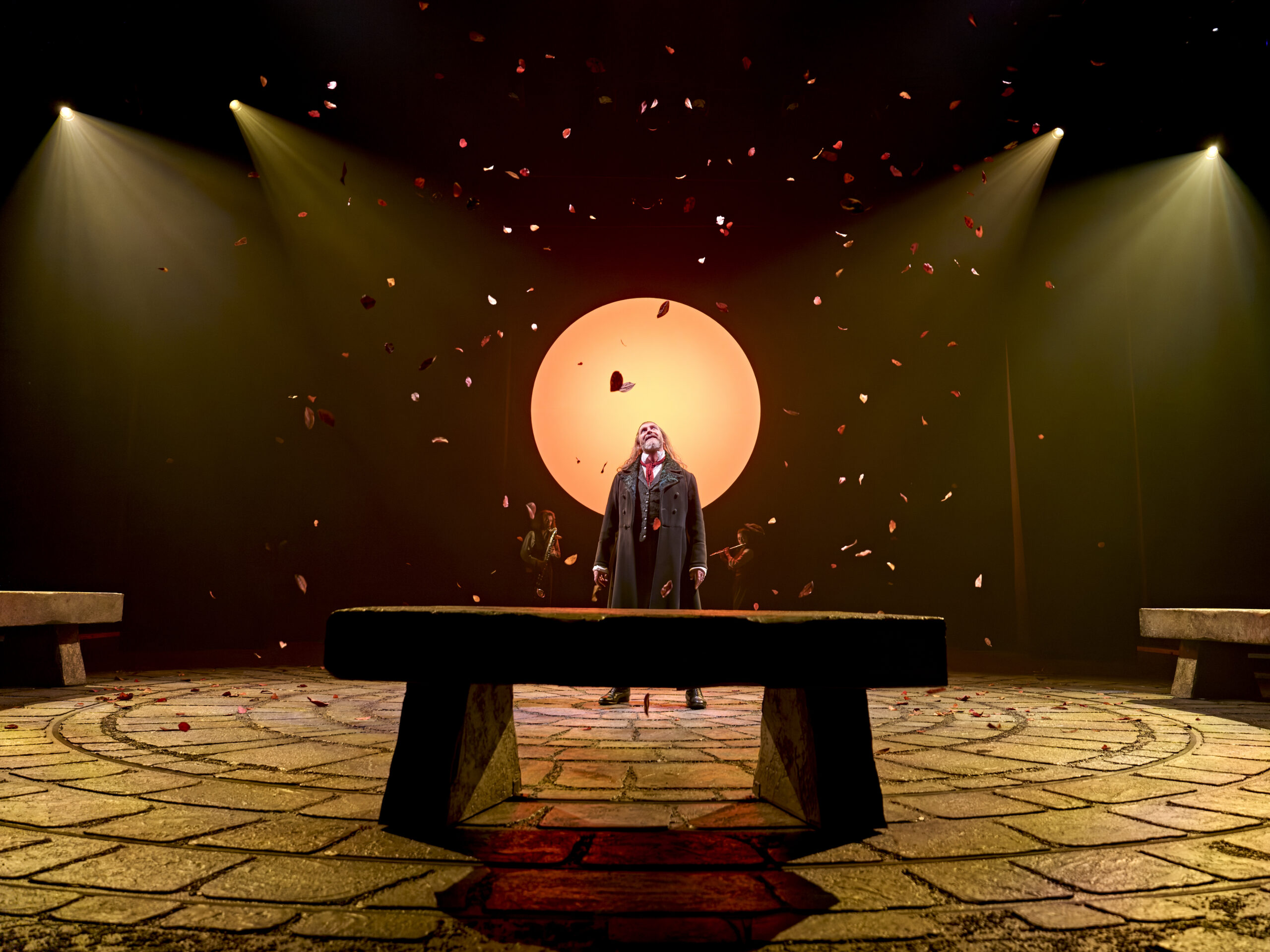
The staging is simple. Three benches are shifted around by unseen hands, while a glowing sun or moon overhead signals each new scene. It’s a neat trick, and it works. Genevieve Dawson’s music adds a rich undercurrent, swelling at key moments such as Cesario’s reunion with Sebastian. David Birrell’s Feste is the production’s heartbeat. His haunting songs, and the repeated reminder of the play’s “whirligig of time”, set the rhythm of the evening far more than the acts or the interval do.
At the centre is Bebe Sanders’ Cesario, who delivers “I am not what I am” with a perfect mix of exasperation and humour. Her command of the verse has the assurance of an RSC production. She sparks with both Fode Simbo’s Orsino and Justina Kehinde’s Olivia, which makes the love triangle feel alive and believable. Kehinde is a standout. Her Olivia is sharp and self-possessed, so her sudden infatuation with Cesario feels less like a whim and more like a woman choosing what she wants.
Glover’s boldest choice is Simbo’s Orsino. This is no charming Duke. When he lectures on women’s capacity for love, he sounds uncomfortably like the online incel and red-pill voices of today. The choice grows more unsettling as the play goes on. Orsino keeps calling Viola “Cesario” even after her identity is revealed, and beneath the tidy comic ending his misogyny seems to lie dormant rather than vanish. I found that compelling.
The comic ensemble is just as strong. Milo Twomey’s Sir Toby Belch is charming, sleazy and physically assured, like one of the older men you might pass on West Street at midnight. Casting James Chetwood as a younger Sir Andrew Aguecheek sets the pair apart and gives their friendship a slightly pathetic warmth. Their jewel-toned velvet blazers are among the few costumes with the flamboyance this play, so obsessed with status and showing off, deserves. Elsewhere the costumes feel underused. With such a bare stage, Orsino in particular could have done with bolder design.
Mathew Horne’s Malvolio, who is on the posters, earns his place. His longing for Olivia is played with a campness that has the audience roaring, and his reading of the forged letter is a masterclass in self-delusion. Then he returns in yellow stockings, cross-gartered and grinning, and the house erupts. Yet Horne never lets the cruelty slip from view. His Malvolio is ridiculous, excessive, ambitious and wounded all at once. Katie Wimpenny’s Maria is especially striking here, keeping the prank on the edge of real discomfort.
The final image is pure Crucible. Feste sings “The rain it raineth every day”, twirling an umbrella as autumn leaves whirl around him. Twelfth Night may be a comedy, but Glover understands that its laughter is always shadowed by fragile identities, desires and social standing. The dynamic cast earns the four stars by balancing joy with ambiguity, even if the costumes are a missed opportunity.
Crucible Theatre, Sheffield
Twelfth Night by William Shakespeare
Director: Jamie Glover
Set and costume designer: Amanda Stoodley
Cast includes: Mathew Horne, Bebe Sanders, Fode Simbo, Milo Twomey, David Birrell, Justina Kehinde, James Chetwood, Katie Wimpenny, Harry Redding
Running time: Approximately 2 hours 35 minutes, including interval
Runs until: Saturday 31 October 2026
Photography: Manuel Harlan