


The Gambler occupies an intriguing, shadowy place in Prokofiev’s output. While composed during the First World War, it was not performed until 1929, and a number of later versions exist too. There is an instability about its tone. Setting Dostoevksy’s satirical novel of 1866, it is far from a simple morality tale about the way in which gambling addiction can warp personality and destroy lives. This is not at all the world of Tchaikovsky’s Queen of Spades. Instead there is a lot of artful artifice in circulation.
We find ourselves in Roulettenberg, a fictional German spa town, where the Russian and German elites are at play. Almost everyone is in debt to everyone else, and gambling is both the cause and the perceived escape route. Alexei, a frustrated tutor, is infatuated with Polina, the step-daughter of a retired General, who is Alexei’s employer. The general, in turn, wishes to marry Blanche, a courtesan on the make, but he can only do so if he inherits from his elderly grandmother, who arrives unexpectedly and herself decides to have a turn at the tables. Add in a dubious Marquis who has tabs on some of the others, and several people on the make who are less than they appear, and you have a human house of cards ready to fall. Who will be the lucky survivor, and will victory turn out to be worthwhile?
The music brilliantly conveys the combination of romance and lack of heart. Themes are declaimed rather more than melodically developed, and there is a glitter and bombast to the orchestration that savours satire rather than sentiment, and when it is sentimental is simultaneously satirical. The slipperiness of the orchestral writing mirrors the unreliability and unpredictability of the characters. Valentin Uryupin and the Wexford Festival Orchestra are fully on top of the tricky demands of the glittering score.
There are no weak links in the cast either. Taras Prysiazhniuk was singing Alexei on the night and seemed very much at ease in the role – entitled, resentful and obsessive, but also poignant in the final scenes when real raw emotions finally spill over. He was fully equal to the challenge of the eaborate gambling scene in the final scene which he has to carry for its whole length. Equally impressive was Sophie Gordeladze as the chilly, contained, unreachable Polina. Again, she really delivered in the final scenes, whether damaged or damaging. Both the marquis and the general are unsympathetic roles, alternately bullying and wheedling; but they were excellently sung with mounting desperation by Alexei Botnarciuc and Gavan Ring. There was a delightful cameo from Clarry Bartha as unillusioned Grandma, all black bombazine and haughty disdain, very much an echo of the Countess in Queen of Spades, and similarly decisive in the plot. Hilary Ginther was characterful and plausible as Blanche, and Seán Tester, a talent to watch, made the most of the small role of Prince Nilsky.
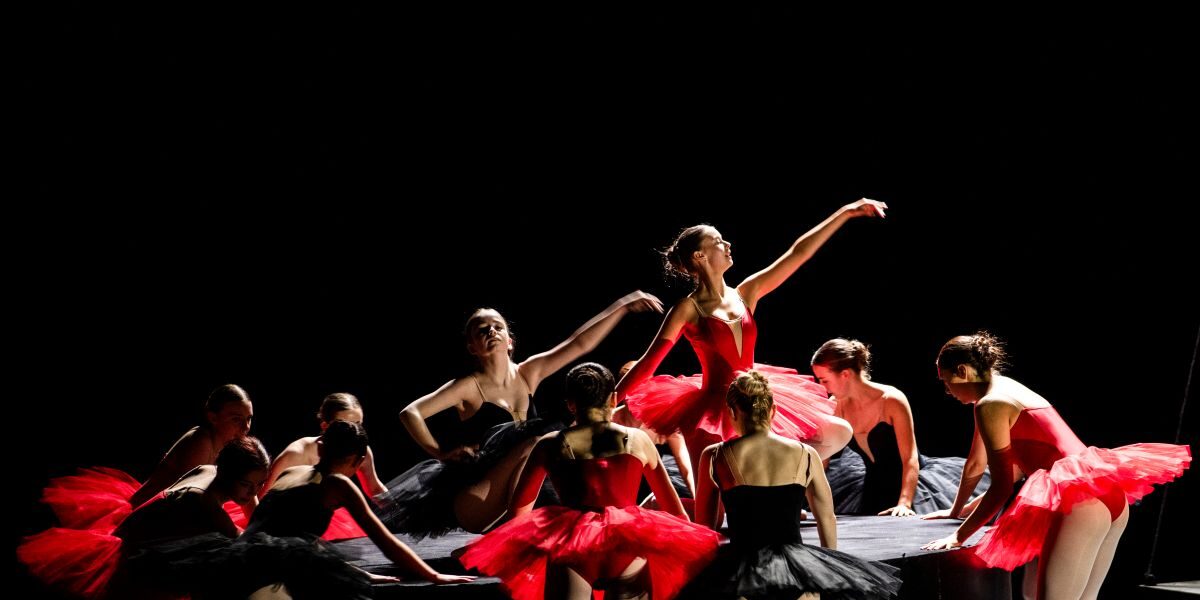
The artifice of the action carried over into the set. For much of the evening Ivan Popovski and set designer Maria Tregubova contented themselves with white walls labelled ‘hotel’ and ‘casino’. I thought initially this was thanks to a reduced budget. However, all was explained when in the final act we moved into the casino and ballet dancers in red and black shifted the colour palette decisively, even jarringly. With symbolic wheels and balls for the roulette tables and a confetti shower of paper cash, the production did full justice to the climactic finale.
This opera will never be a regular crowd-pleaser, but it is hard to imagine a production that will do it fuller justice than this.
Music and Libretto: Sergei Prokofiev, based on Dostoevsky’s novel
Conductor: Valentin Uryupin
Director: Ivan Popovski
Cast includes: Clarry Bartha, Alexei Botnarciuc, Hilary Ginther, Sophie Gordeladze, Taras Prysiazhniuk, Gavan Ring, Seán Tester
2 hours 30 minutes with interval
Until 30 October 2026
Photo Credit: Padraig Craig