

The longer you live, the more likely you are to face and contain some form of tragedy. Early onset tragedies are perhaps, the hardest, because they kill a part of you that was burgeoning and could have grown.
We all live lives of secret selves and when we meet – in the square, at the water-cooler, in the home, we present, for a moment, or a little longer, a pretence of wholeness. Those who know our early cracks (our tics, our turns and our numerous buttons), are more likely to be our siblings than our parents because they inhabit, for the most part, the same time-frame as we do. The narrative story of ‘Hand to mouth to’ is about two brothers who return, in middle-age, to the home where their father ruled the roost with an iron rod which he often and cruelly, wielded. With the name of one of the brothers being Caleb, I thought the writer was American but it turns out that he is the French writer, Jean Baptiste Del Armos. He was commissioned specially for this piece. In its darkness, in the subtle way the story reels you in, it reminded me of Martin McDonagh’s ‘The Pillowman’.
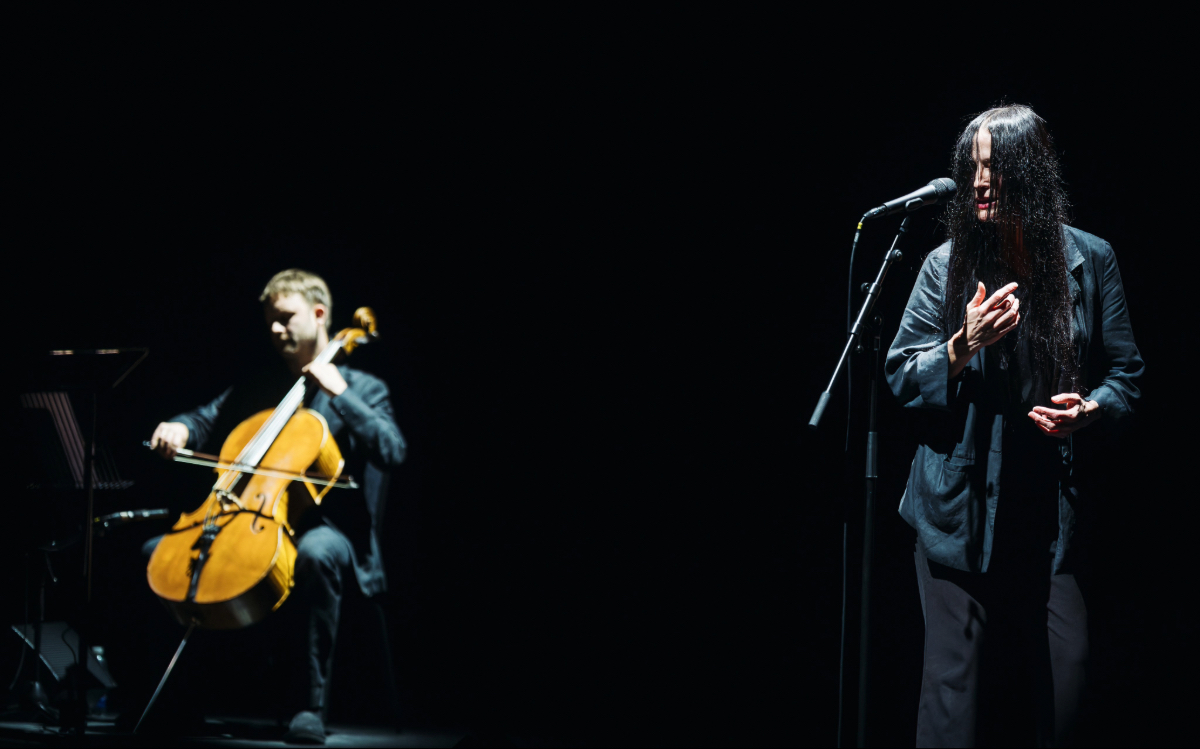
As an image in black and white is burnt onto the back frame, Keeley Forsyth turns her back on the audience and in a wonderfully artificial detached rackety male voice, with little to no intonation, reads/tells the story of the two boys who return to their house on the hill. She then steps forward and her hair falling over her face like Cousin It in the ‘Addam’s Family’, and her body contorting into shapes of uncomfort, she sings. She sings like an angel, but not like those bland pure angels, the ones with fluffy wings, but like an angel who remembers the glory of being intimate with God and knows too, the suicide thoughts that accompany the Fall. To one side of Forsyth is the cellist, Ross Downes and on the other, the pianist, Matthew Bourne, Forsyth’s long-term collaborator.
The story of the two brothers builds up to an epiphany of the human spirit gone bad. Forsyth sings her songs of despair, word repeated after word. Her range is remarkable and her voice so uniquely her own, I couldn’t think of one single singer she reminded me of. The songs, on the page, are, for the main, not stunning, though some are; but Forsyth’s rendition of them undoubtedly is.
The cellist was good, but the piano scores and Matthew Bourne’s playing, had me leaning in throughout. Like Forsyth’s voice, the music and Bournes’ playing of it, made me ceaselessly curious.
I was talking to a friend after the show and he said he found the performance monotone; blackness followed by more blackness. Yes, structurally, that is true. But then voice and music broke through that fortress, not necessarily offering lightness to counter the darkness but offering us other sensibilities to ponder.
A lesser artist would have ended her last song with just the refrain, ‘I have a voice; A voice I must use.’ But Forsyth adds, A voice I have to abuse.’ Darkness carries over and floods us. But then we recall the timber and quality of her voice and of the piano score, and Bourne’s playing of it, the beauty of the images as changing backdrop, and we see, as in Beckett’s bleakest moments – where nothing is the meaning – that there is a smidge of a counterpane.
My only criticism is that the show, which could as equally have played at an avant garde theatre as at the ROH, was only on for one night. More people should have had the chance to see it.
It was so grand a show that it made me, in one tizzying shot, believe in art again.
Production: Hand to Mouth to
Venue: Royal Opera House
Voices: Keeley Forsyth
The No-End House story: Jean Baptiste Del Amos
Piano/Piano score/Memorymoog/Sampler: Matthew Bourne
Cello: Resina/ Colin Alexander
Song Lyrics: Keeley Forsyth and Adrian Shaw
Sound Design/Art Director: Ross Downes
Producer: Laura Ducceschi
Till : 23rd September