

The title of Fran Kranz’s explosive and powerful play Mass will undoubtedly conjure images of a church service or a sacred choral work. But the “mass” referenced here is a mass shooting at an unnamed US high school, and the attempt by the parents of the perpetrator and one of his victims to reconcile the complex emotions that surround the horrific event. Originally produced as a film in 2021, Kranz has adapted his own screenplay for this premiere stage production at the Donmar.
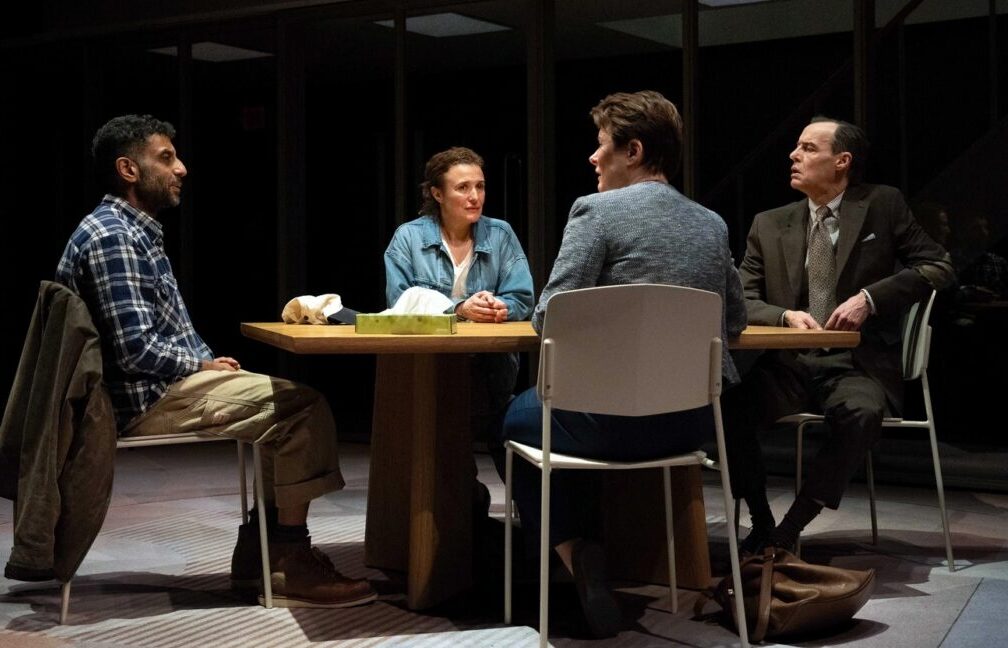
The setting is a church basement where we first encounter church staffers Judy (Susie Trayling) and her helper Brandon (Amari Bacchus) nervously preparing a room for a meeting, overseen by Kendra (Rochelle Rose), a mediator guiding a restorative justice encounter. The tension builds slowly as we gradually learn both the timeline and the circumstances of the tragedy. We meet four grieving parents: Jay and Gail, played by Adeel Akhtar and Lyndsey Marshal, and Linda (Monica Dolan) and Richard (Paul Hilton). It takes time to understand the nature of their relationship – their conversation circles uncomfortably around grief, guilt, memory and the rituals of social politeness. Gail and Linda have corresponded previously, but Kranz and director Carrie Cracknell are in no rush to reveal why these families have come together.
It is not until the four are well into their conversation that Gail says, “because your son killed my son,” and the line lands with devastating force. From that moment, the purpose of the meeting becomes unmistakable. We watch both sets of parents grapple with unspeakable loss, blame and responsibility, while searching desperately for an almost unattainable resolution.
The emotions on display are painful and intense. Each parent has endured relentless media scrutiny, community judgement and legal proceedings, all while trying to make sense of their children’s actions alongside their own private grief. In one moment, Jay recounts the minute details of his son’s death, and we sense how every excruciating second has been seared into his memory through endless retellings. Richard, too, knows the precise location of each victim in almost unbearable detail. Monica Dolan’s Linda is particularly moving, conveying both compassion and bewilderment as she struggles to reconcile her love for her son with the knowledge that he was responsible for the deaths of ten students before taking his own life. She and Richard were forced to plead for a place that would allow them to mourn and bury their son.
Once seated around the discussion table, the four barely leave their chairs. Yet the production remains visually dynamic. Anna Yates’s simple but carefully observed design places the audience in close proximity to the action, while the slowly revolving set subtly shifts our perspective, allowing us to view the confrontation from different angles and preventing the evening from ever feeling static. Combined with Cracknell’s intense yet perfectly attuned direction, the focus remains squarely on the actors and Kranz’s finely calibrated script.
With superb performances across the board and writing that refuses easy answers, Mass confronts the complexities of grief, accountability and forgiveness with remarkable honesty. At times the experience feels almost relentless, but perhaps is precisely the point. The use of Judy, Brandon and Kendra to frame the action is not entirely seamless. Their presence serves a clear dramatic purpose in establishing and concluding the encounter, but it also leaves three capable actors somewhat underutilised.
The final moments of the play are quietly revealing. As the choir rehearsing upstairs resumes its practice, voices drift into the room below. How does one forgive and move on from such tragedy? The shaft of warm, afternoon light that fills the space and the celestial hymn that follows do not offer a definitive answer, but they hint at the possibility of grace amid the aftermath of unimaginable loss.
By: Fran Kranz
Director: Carrie Cracknell
Designer: Anna Yates
Cast includes: Adeel Akhtar, Monica Dolan, Paul Hilton, Lyndsey Marshal
1 Hour 40 minutes, without interval
Until: 6 June 2026
Photo credit: Richard Hubert Smith