

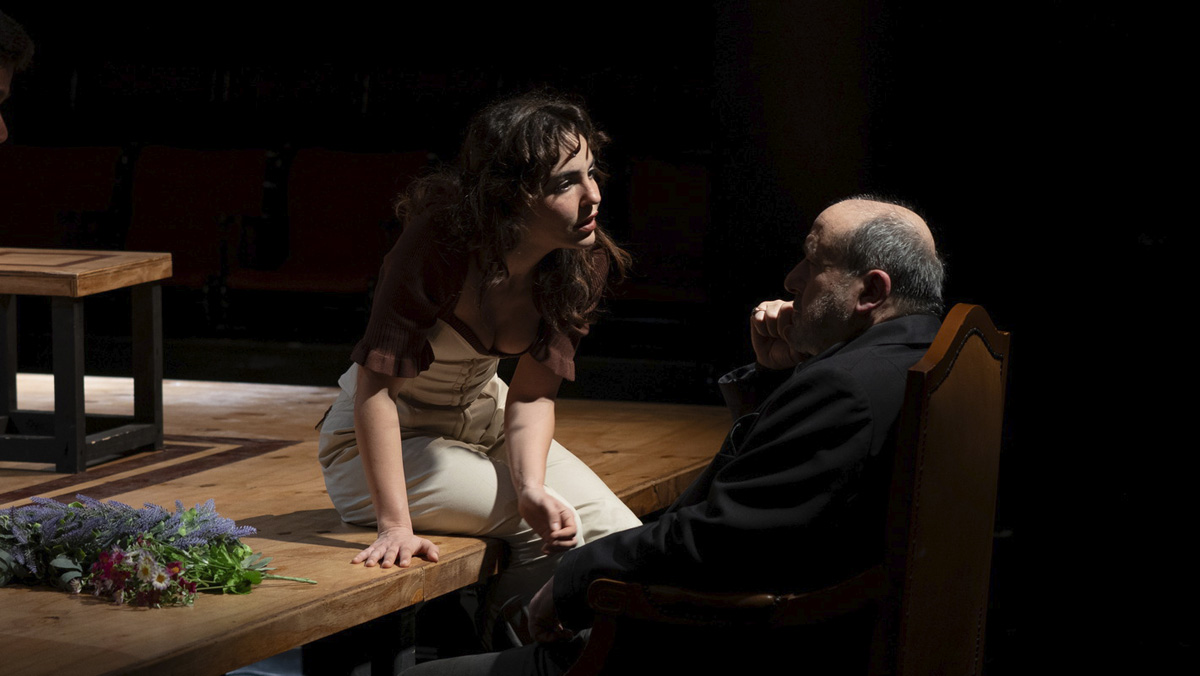

Ambition, guilt, desire, and the fear of decline lie at the heart of Henrik Ibsen’s The Master Builder, one of the playwright’s most psychologically unsettling works. One hundred and twenty years after his death, the play returns to the Athenian stage for a second time this season, now at the historic Theatro Technis – Karolos Koun.
The Master Builder remains one of Ibsen’s most psychologically complex plays, exploring the relationship between ambition, guilt, fear of decline, and the human desire for transcendence. At its centre stands Halvard Solness, a successful master builder who, despite his professional and social status, is haunted by deep insecurities, guilt, and an overwhelming fear of decay and replacement. Through his encounter with the young Hilde, the play gradually unfolds into an existential confrontation between past trauma, desire, fantasy, and the dangerous limits of human ambition.
The production’s central scenic concept – a large square table dominating almost the entire stage and functioning simultaneously as workspace and stage itself – is visually striking in theory. In practice, however, it is employed somewhat awkwardly throughout the performance, often restricting rather than enhancing dramatic movement and contributing to a certain static quality in the staging.
Theodoros Grampsas approaches the role of Solness with seriousness and restraint, offering a controlled interpretation of a particularly demanding character. His performance captures aspects of Solness’ inner anxiety and emotional fatigue, especially the sense of a man burdened by guilt and haunted by the fear of decline. At times, however, the interpretation remains somewhat understated, leaving parts of the character’s authority, psychological intensity, and emotional volatility less fully realised.
Katerina Dandoulaki, a long-established leading figure of the Greek theatre scene, approaches the role of Aline with emotional discipline and understated intensity. Dandoulaki conveys the character’s unresolved trauma with restraint, transforming silence and stillness into expressive theatrical tools and successfully capturing the quiet devastation of a woman trapped between memory, grief, and resignation. At the same time, however, the relative passivity of the role somewhat limits the theatrical radiance and commanding stage presence that usually define Dandoulaki’s performances.
Isidora Doropoulou, as Hilde, brings a refreshing vitality to the stage, delivering one of the production’s most emotionally vibrant performances. Her youthful energy and emotional immediacy create an effective contrast with the oppressive emotional world surrounding Solness and Aline, introducing a much-needed sense of emotional openness into the production.
Dimitris Degaitis delivers a nuanced and convincing performance as Dr Herdal, bringing warmth, sobriety, and subtle emotional intelligence to the role, while Thrasos Stathopoulos successfully captures Ragnar’s gradual transition from youthful insecurity and dependence to artistic ambition and emotional self-assertion.
As a whole, the direction approaches Ibsen’s work with clear ambition and intellectual seriousness, seeking to foreground its existential and psychological dimensions rather than merely its realist surface. The production offers moments of emotional intensity, while maintaining a thoughtful and coherent reading of the play. At times, however, the staging adopts a rather conventional approach, which occasionally diminishes the haunting metaphysical undertones and dramatic tension lying beneath the text.
Theatro Technis – Karolos Koun Athens, Greece
The Master Builder by Henrik Ibsen
Music By Stamos Sempsis
Director Konstantinos Aspiotis
Cast Includes Theodoros Grampsas, Katia Dandoulaki, Dimitris Degaitis, Isidora Doropoulou, Ania Lembentenko, Thrasos Stathopoulos
Until 24 May 2026
Running Time: One hour and 40 minutes, no interval