


Shakespeare’s King Lear becomes a family tragedy first and a political one second in this modern adaptation. Reimagining Lear as a queen and a mother in the early stages of dementia brings the play closer to home, but it also softens much of the original’s violence and tragic force.
There is little sense of royal grandeur from the outset. The play opens in Lear’s spacious office, a set that cleverly transforms into several locations during the first half. Maroon walls and ornate cornices hint at former splendour, but the room already feels abandoned. Furniture lies beneath white dust sheets, the chandelier is wrapped up, and the floor is worn and flaking around the edges. Dark marks stretch towards one doorway, while a long pale scar on the wall suggests that a painting or frame has already been taken down. Even Peter Paul Rubens’s The Fall of Phaeton leans against the back wall instead of hanging in pride of place. The kingdom seems to be packing itself away before Lear has even divided it.
That fading world makes Maureen Beattie’s entrance all the more striking. Immaculately dressed and carrying herself with complete authority, she immediately becomes the centre of the room. The production also places unusual emphasis on the women. Lear and her three daughters dominate the stage, while their husbands remain largely on the sidelines. However, for all the talk of a kingdom, the story rarely feels political. Lear divides her realm almost casually: she hands out portfolios to her daughters while they still clutch champagne flutes. Even the threat of France barely shifts the mood. This is less a struggle over power than the breakdown of a family, and while that makes the relationships more immediate, it also shrinks the scale of the tragedy.
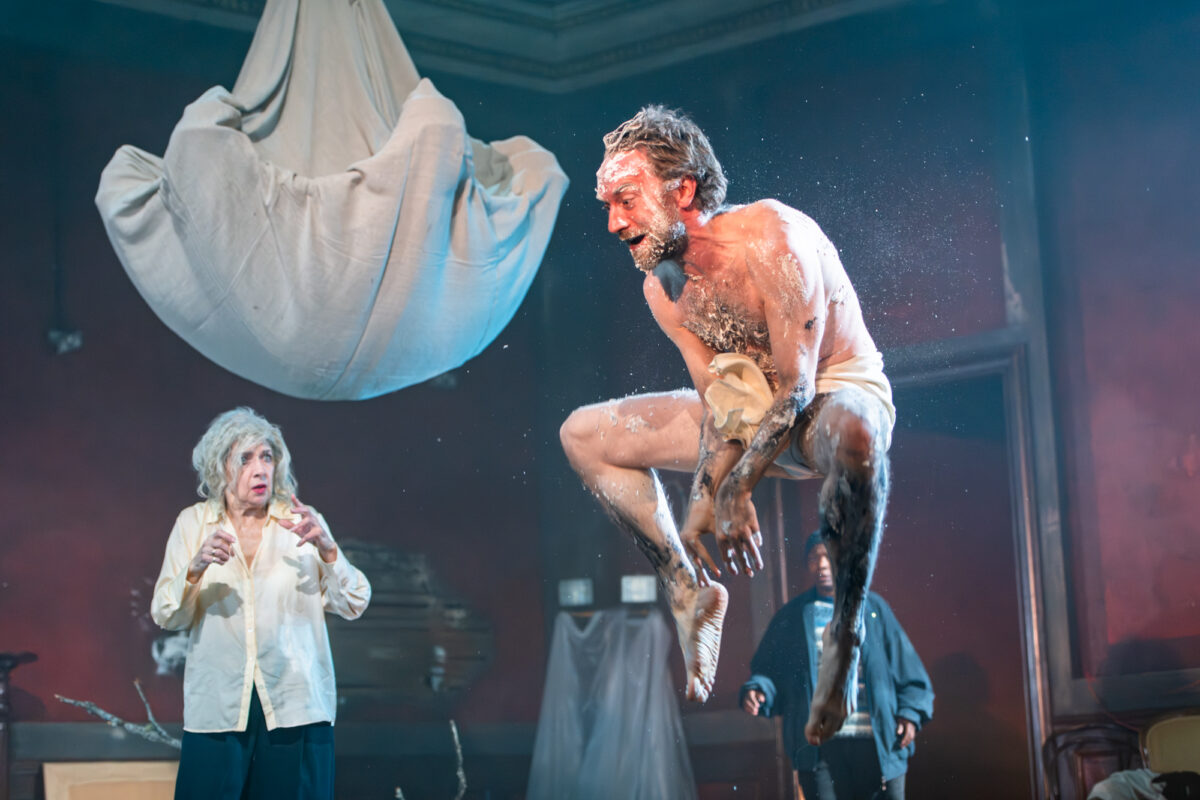
The second half reflects Lear’s mental decline as much as the collapse of her world. The walls disappear, replaced by a tall brick backdrop, while a bare fallen tree sprawls across the chequerboard floor. Mist hangs constantly in the air. Characters wait silently at the back of the stage before stepping into each scene; they remain visible even when the focus is elsewhere. When Lear meets the blinded Gloucester, everyone else simply watches from the shadows. The effect is unsettling, as though every memory and every relationship still linger in Lear’s mind. It’s a striking visual idea, although it leaves the later scenes feeling oddly static. Where the first half gathers momentum, the second seems suspended in time.
That uneven rhythm runs through the production. Everything moves at speed, but some of the play’s most shocking moments barely have time to land. When Regan gouges out Gloucester’s eyes, the second act of violence follows almost immediately after the first. A longer pause would have allowed the horror to sink in before it was repeated. The production is often in such a hurry to move on that it sacrifices some of the emotional weight Shakespeare builds into these scenes.
The decision to make Lear’s failing judgement part of her dementia also raises difficult questions. In Shakespeare’s play, Lear misreads Goneril and Regan because of pride, vanity and a desperate need to be loved. Here, those mistakes increasingly feel like symptoms of illness. That makes Lear more vulnerable and more sympathetic, but it also blunts the tragedy. Her downfall feels less like the consequence of her own choices than something happening to her.
Even so, Maureen Beattie gives a performance of tremendous energy and presence. She captures Lear’s authority, vulnerability and bewilderment without ever losing the audience’s attention. It’s a performance strong enough to carry the production through its quieter passages, but it also hints at the play this adaptation might have been. Had it balanced the personal with the political, and the mother with the monarch, it could have matched Beattie’s performance with a tragedy of equal scale.
Drama
Written by William Shakespeare
Directed and adapted by Finn den Hertog
Cast Includes: Maureen Beattie, Forbes Masson, Lindsey Campbell, Ailsa Davidson, Jenny Hulse, Mercy Ojelade, Reuben Joseph, Ali Craig, Dylan Read, Beruce Khan.
Until: 1 Aug 2026
Running Time: 2 hours 55 minutes including a 20-min interval