


There is a joke from the 1970s that runs ‘When God created people She put in a joke: She created 57 varieties of sex but told them there were just two.’ Cerys Duffy’s You’ve Gone Quiet gives us quite a few of these varieties. Questions of transgender (pre-op and post-op), IVF, parenthood, being gay and being straight, are vigorously tackled in this witty exposition on all the difficulties of love, sex and money.
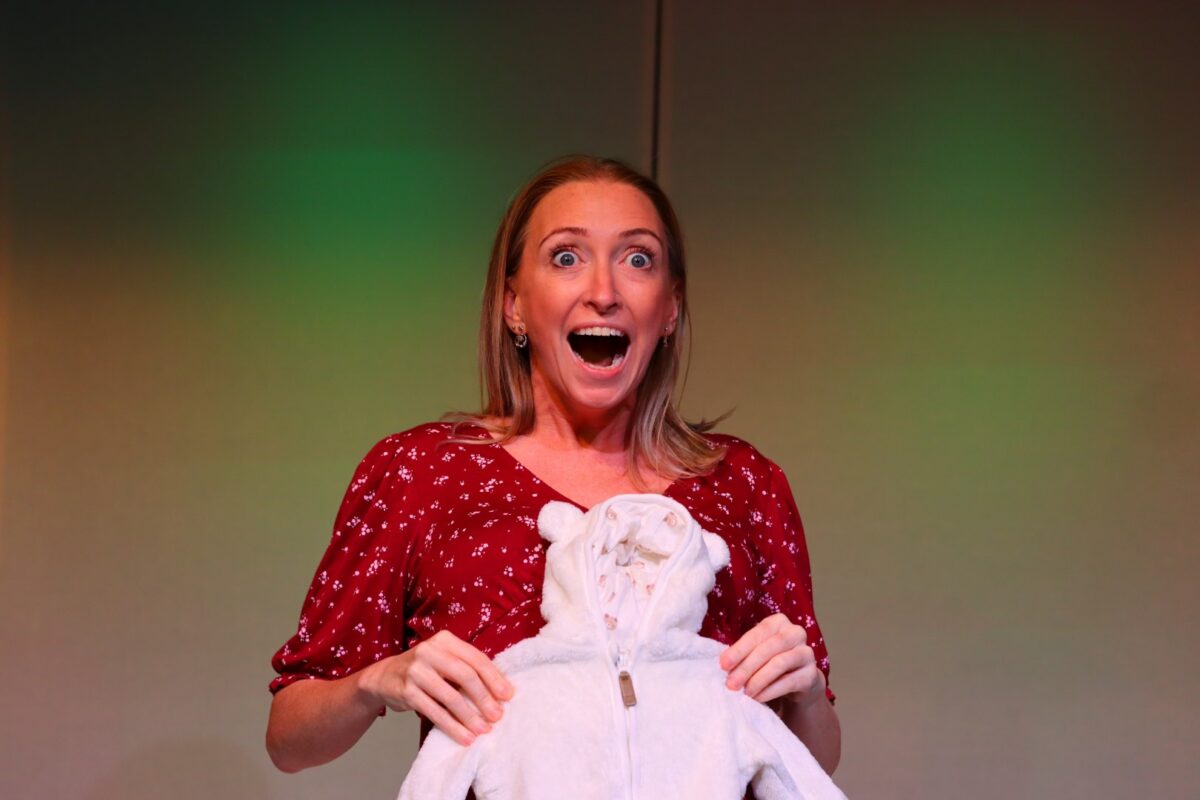
Tara is the centre of the movement around whom the other characters whirl and Gennifer Becouarn’s performance is brilliant. We warm to her Tara with her nervy energy, full of apologies for her ADHD and allergies. We see her in the opening set-up with her quest for IVF – ‘I can visualise my womb sucking up spunk like a Dyson’. She struggles as she asks Beth, her transgender friend (pre-op), if she will impregnate her. ‘You weren’t my first choice’ she says, then rapidly apologises with what she hopes is a compliment: ‘You’re the only woman I could ask.’ Her only concern is, ‘I wonder if there’s enough flour in the baby batter?’ With these sorts of lines, we can see we are on a winner with Duffy’s script.
Tara chooses Ian, a Welsh ‘hard man’, as a substitute dad played with the right amount of working-class bonhomie and indifference as so many people who have a lack of sensitivity around trans issues show. Ian is full of, it’s ‘they-them, whatever’ until his own interests are threatened and he reverts. Then there is Rory who is confused and ashamed about his sexuality who is in love with Beth, glamorous and pre-op. Rory is emphatically not gay, a suggestion he rejects with disgust, but what is a man who adores a woman with a penis? His brother Gaz fancies Beth, not knowing what gender she is, he just thinks she’s gorgeous. Samantha has taken the trip to Thailand and is post op. She is assertive and ambitious. Most adventurous of all, Beth, played by Shane Convery, does not even physically appear in the first half, other characters address the audience as if we are Beth. It is a bold and effective move which genuinely achieves its purpose of obliging us to see the word through another person’s perspective.
While this might be a play simply about transgender, Duffy complicates it with her subplot of disloyalty, making the characters all ultimately more human. Tara ditches Beth as the real second parent; Rory ditches Beth the person he loves most (Beth is the subject of most of the rejection); and worse still, Beth’s friend Samantha betrays Beth and Tara to advance her journalistic career: ‘This could be the new trans tipping point’, Samantha says at one time, ‘a chance for them to see us as something close to human.’ The story is upended by the media into a spurious story of a man who dressed as a woman to rape a woman – our characters struggle to stay upright and maintain their identities. The script speaks to the trans experience, but also to common humanity.
This play navigates a world veering between people who have trouble with pronouns to those who are so advanced in nonbinary ideology think the use of the term transexual instead of transgender is an affront. This is a very modern play in its staging and subject matter. The characters and script are everything – they relate only to the play’s themes, there is no padding. Truly a gender reveal production!
Playwright: Cerys Duffy
Cast: Gennifer Becouarn, Matt Vickery, Oliver Redpath, Sophia Vi, Matt Roberts, Shane Convery
Director: Andy McLeod
Duration: Two hours including a 15 minute interval
Until: 6 June 2026