


The King’s Lynn Festival of Music and the Arts celebrates its 75th anniversary this year. Founded by Ruth, Lady Fermoy, back in 1951 it has now grown into a two-week presentation of many different musical ensembles, combinations and genres that allow you to criss-cross the historic quarter of the town several times a day to appreciate highly rewarding performances. Whether your interest is in lieder or chamber music or jazz or folk, there is truly something for everyone in a series of wonderfully atmospheric settings.
Indeed the venues impress more and more as you get to know them better. Not only do the Minster, Townhall and St Nicholas Chapel have a storied history, but they also have fabulous acoustics and generous sightlines that immediately make an audience feel both relaxed and absorbed in the experience. You sense the same combination in the artists themselves, who feel free to break up their performances with detailed insightful commentary, whether on the music itself or on the performance intricacies of their instruments, or their own personal histories. This makes the concerts wholly accessible and engaging to afficianados and newbies alike.
The festival website carries a delightful set of memories by Paul Berry, a long-time supporter, who sadly died just after completing this record. These recollections tell the story of the festival’s evolution from its beginnings, with events sustained by the local community, through to the outward-facing international festival of today, shaped by artistic director Ambrose Miller and festival manager Ben Horden. You get a very clear sense of how much of a tonic the festival was originally in the grim days of post-war rationing, and how far it has travelled and developed since in its outreach.
An example of that international perspective came in the first concert I attended, a recital by Boris Giltburg, that took on four substantial peaks in the late Romantic piano repertoire. We began with Bach, but in form of an arrangement by Busoni of the Chaconne from the Second Violin Partita. Busoni opens out the dynamic scale and harmonic richness of the original with huge chords and great washes of sound that filled the acoustic dimensions of the Minster most impressively. But alongside the striding bass lines and torrential treble decoration this was a highly tasteful performance, with careful voicing and selective pedalling. By ensuring that the full range of colour and dynamics were explored, the concluding avalanche of sound and its attendant echo were all the more overwhelming.
The same qualities were displayed in his performance of Liszt’s Sonata in B minor. Yes, the grandiose and percussive aspects of the work were prominent, but so were the sweetness and gentleness of the composer of the Liebesträume, not to mention the unexpected addition of the sound of seagulls outside the west door of the Minster. Next Giltburg played a selection of Rachmaninov’s Preludes Opus 23, all substantial pieces in their own right and still rarely programmed. They illustrate a variety of moods, from the swagger of the well-known number five through to the brusque quicksilver impressions of number three and the surging passagework of number seven. The variety of characterisation was tastefully achieved in each case with deft shading of colour and well sculpted long, lyrical lines.
The toughest challenge of all came with Ravel’s suite Gaspard de la nuit. It is customary to remark on the technical problems posed by Scarbo, but the earlier movements are scarcely less demanding. In Ondine we heard the delicate play of spume and spray around the water nymph, but also her brittle unpredictability; and in Le Gibet Giltburg found still spaces between the layers of sound that could have evoked a misty morning on the Ouse at Lynn. When we reached Scarbo it was the pointillist delicacy as much as the febrile energy that stood out. In the most hair-raising episodes you always felt the pianist was in complete control, building and shaping the final climax to immense effect. A carefully calibrated, never perfunctory performance of Clair de lune concluded a hugely rewarding evening.
The following evening took us across the road under medieval rafters of the Townhall, where Craig Ogden gave a solo guitar recital. He is, of course, a natural communicator, able to engage an audience in the technicalities of his instrument, neither dumbing down, nor overly academic. While there was, perhaps, a bit too much talk, at least in the first half, the musical programme was a fascinating overview of the sheer range of music written for the Spanish guitar in the twentieth century, often solicited by famous players, such as Segovia, to flesh out their range of repertoire. It was particularly revealing to be able to match individual techniques for evoking timbres, colours and harmony with pieces that illustrated them.
In the second half, Ogden broadened his range to perform arrangements of Vivaldi, Bach and Django Reinhardt, among others, that demonstrated how effective the instrument is in opening out and expanding music written for other instruments and combinations. The concert ended with three pieces by Rodrigo, which, intriguingly, sounded far less difficult than other items but were, according to Ogden, some of the hardest to perform. The evening gained hugely from insightful programme notes by Ben Horden, pitched at just the right level for the benefit of the audience.
We were back the next day at the Town Hall, but in its eighteenth-century extension, a hall of mirrors, oil paintings and whipped cream plasterwork. Appropriately, it was for a bright and cheerful combo of flute and harp, with Sirius Chau starting proceedings offstage with Syrinx, and Gwendllian Llyr following with a version for harp of Clair de lune. It was a good idea to introduce us to the sonorities of the individual instruments first before hearing them together.
Louis Spohr does not get many outings these days, so it was a particular pleasure to hear their collective take on his Sonata Concertante. Maybe it was because his wife was a harpist, but this mellifluous piece achieved a very effective balance between the instruments. Each had their virtuosic moments, but there was an easy fluency and Mendelssohnian lightness in their dialogue too that consistently impressed.
It was also a rare pleasure to hear a concert fantasy by Doppler and Zamara on themes from the opera Casilda, a reminder that for so much of the nineteenth century instrumental transcription was the way in which operatic experience was widely shared. The long melodic lines typical of bel canto were divided equitably across the instruments, showing the scope of the harp for melodic projection as much as harmonic underpinning. Would that there were more performances of works such as this! They are a great way of drawing audiences in both to operatic literature, and offer unusual arrangements that make us hear familiar music from reavealingly oblique angles.
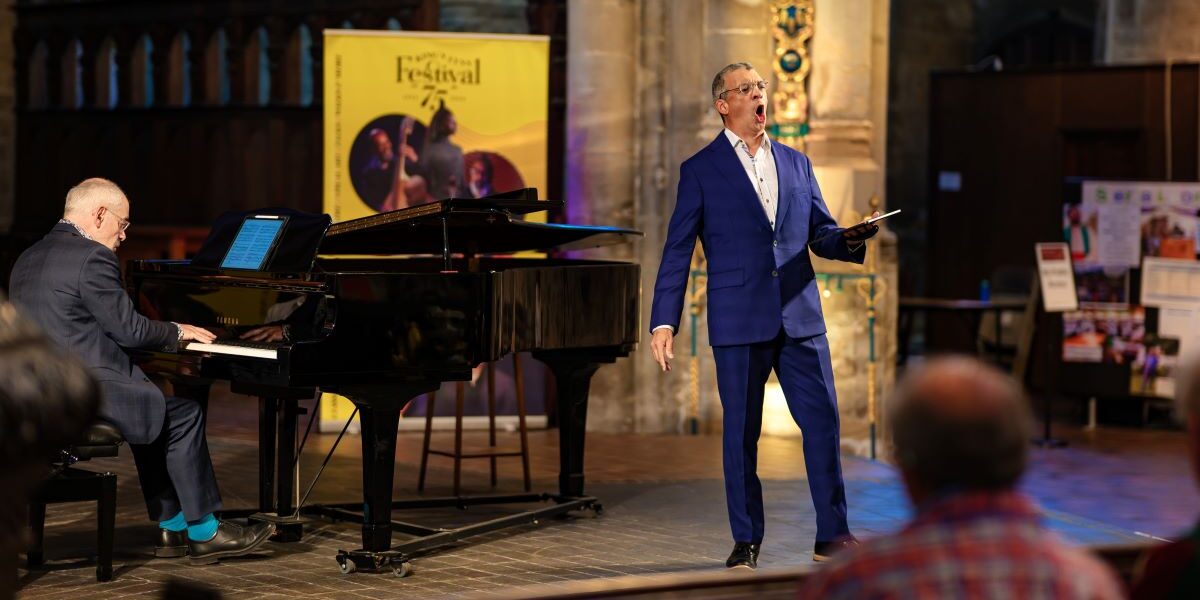
For the final concert I attended we shifted back to the Minster to hear Roderick Williams and Iain Burnside deliver a song recital titled ‘From the Forest of Dean to the Appalachians.’ A review can only comment on a few of the twenty or so items in the programme, but suffice to say that this was a journey through the less well known pathways of English song, with a unifying theme provided by the texts, many of which had been written by six poets who resided at Dymock in Gloucestershire in the years before the First World War. Just as in the case of the other performers, Williams offered commentary and insight in between the songs that greatly enhanced our experience. Indeed, in the second half he went one step further and got the audience to sing as well! The programme culminated in some ‘number songs’ arranged by Vaughan Williams from tunes brought to America by migrants from Northern England. It is testament to Williams’ qualities as an inspiring teacher that the audience picked up what was required far more quickly than is customary.
Burnside and Williams are long-term collaborators and veteran performers of this repertory. The songs were dexterously pointed and shaped with an art that conceals art. Two that stood out for me were both settings of Edward Thomas – Gurney’s take on ‘Lights Out’ finds a music to add to a poem that already seems to have a complete music within it. A poem that pinpoints the transition between life and death is vivid enough, but in this performance you felt the forest close over the walking figure as never before. In a very different register, Anthony Payne’s setting of ‘Adlestrop’ captured the sense of simmering heat and time suspended in an Edwardian train carriage, one that we could all relate too on an overly hot summer evening. As an encore, we were reminded of Williams’ skills as a composer in his own arrangement of ‘Deep River.’ He opened up the harmony in the final verses in a way I have not heard done before so as to make the aspiration and hope in the text ever more appealing.
While I was only able to sample a small range of concerts, each of them affirmed the unique qualities of this festival – the unusual programming that takes us persuasively from the familiar to the unfamiliar; the geniality and welcoming nature of the events, efficiently organised but still in touch with the town and community spirit that provides its origins and home; and above all the quality of the performances, where the music comes first but where you also gain direct insights into the performers and the texture of their lives and work.