

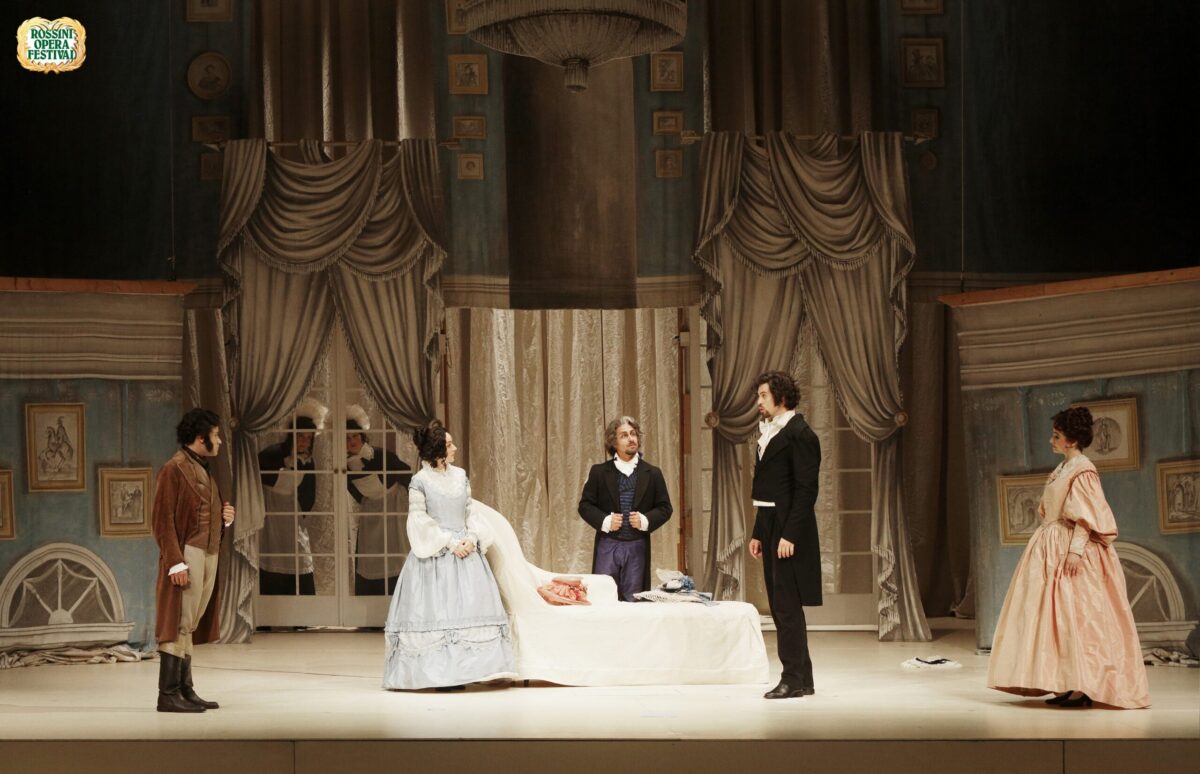

L’Occasione fa il ladro is the fourth of five one-act operas the 20-year-old Rossini composed for Venice in 1812, hurriedly finished in eleven days after he arrived late from Milan, delayed by La Scala.
Two strangers with identical suitcases shelter from a storm at an inn. When Conte Alberto leaves, he mistakenly takes Don Parmenione’s case instead of his own. Alberto is travelling to Naples to marry Berenice, whom he has never met; Parmenione is searching for his friend’s eloped sister, Ernestina. Discovering Alberto’s papers and portrait in the case, Parmenione seizes the chance to steal his identity and pursue the girl in the portrait. In Naples, Berenice and Ernestina — friends living in the same house — swap identities so Berenice can secretly observe her intended husband. Misunderstandings multiply until all is unravelled: Alberto and Berenice fall in love, Parmenione falls for Ernestina. The plot is slight, but the music is first-rate.
Jean-Pierre Ponnelle’s iconic 1987 production, revived once a decade, remains as inspired as ever. Martino bustles through the auditorium with a suitcase, distributes scores to the conductor and soloists, then unpacks the set piece by piece as it’s built before our eyes — a set within a set, the inn’s curtain lifting to reveal an elegant drawing room. Ponnelle’s meticulous designs enable the farce’s split-second entrances and exits. By the end, everything is repacked and the stage stands empty, as if it had all been a dream.
Conductor Alessandro Bonato, making his ROF debut, sustains lively momentum while balancing the score’s demands with Ponnelle’s split-second timing, giving the soloists room to shine. The comedy dispenses with an overture, opening instead with a Rossini storm later recycled into Il Barbiere di Siviglia.
This predominantly Italian cast had the rapport to make the comedy fizz, with all six singers well matched and full of genuine Rossinian style. Giuseppe Toia’s endearing Martino, sung with a flexible baritone and assured comic patter, belongs to a line of Rossini servant-agents stretching from Germano in La scala di seta to the fully realised Figaro of Il barbiere. Dave Monaco brings a lyrical, elegant tenor to Alberto; “D’ogni più sacro impegno” is a highlight, and his final “libertà” — crescendo through diminuendo to an exquisite pianissimo and back — is unforgettable. Monaco is a name worth watching.
Damiana Mizzi’s Berenice is spiky and funny, with fine coloratura and secure high notes (“Vicino è il momento”), dazzling further in “Voi la sposa pretendete.” Martiniana Antonie, a 2017 Accademia alumna, brings warmth and vivacity to Ernestina. Matteo Mancini towers comically over the cast as Parmenione — his duet with Berenice, “Che sorte, che accidente,” is another highlight — while Manuel Amati rounds out the ensemble as Don Eusebio.
Rossini’s one-acters are brilliant theatre. It’s a shame they aren’t performed more often — fortunately, we can still see them in Pesaro.
Music by Giachino Rossini (1792-1868)
Libretto Luigi Prividali
1987 Production by Jean-Pierre Ponnelle
Director, set and costume designer Jean-Pierre Ponelle
Revival director Sonja Frisell
Conducted by Alessandro Bonato
First performance Teatro San Moisé Venice, 24th November 1812
Photo Credit Amati Bacciardi