

‘Everything in Cuba is an excuse to dance’, said Carlos Acosta in the discussion with the audience that followed this remarkable double-bill; and that spirit of syncretism certainly suffused both works, one newly assembled, the other a modern classic that was first seen in Germany in 2011. Cuba is a genuine melting pot for dance, with many classic and modern rhythmic forms, and here they are fused with Baroque music that is discreetly disassembled and then reconstructed anew with a Cuban pulse and layering. Both works take the Baroque Chaconne, originally a stately dance with a recurring bass line, before breaking it open into fresh variations that are elaborated and reinvented in both tempo and texture. Out of this flexibility emerge many different dance combinations – solos, duos, trios and group work of complex writhing connectedness.
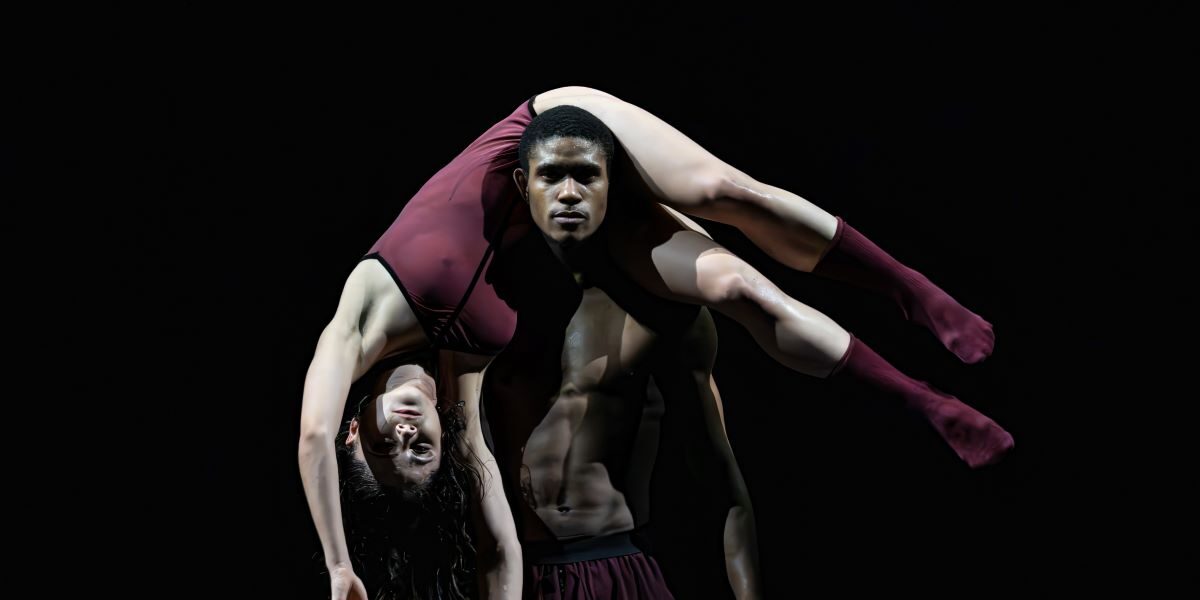
Pearls by Andonis Foniadakis is the longer work of the two, showcasing ten dancers all dressed in dark red costumes with black piping and no set, only a series of cross-crossing beams of light that created a grid on the stage. Gestures were large and lavish right from the start, with particular upper body eloquence. Mirroring the cumulative effect of the music, the repetitions and intricate intertwining gradually evolved into a stubborn and speeded-up ostinato peaking in a high-intensity episode of almost orgiastic ecstacy. As Acosta said afterwards, this was not something to attempt at home! The episodes were short but flowed naturally and elegantly into one another so that there was no real pause between movements – the baton was metaphorically passed from one variation to the next picking up on the cyclical nature of the chaconne itself. A particular highpoint was the fusion between complex choreography and the Salve Regina setting by baroque Cuban composer Esteban Sallas.
Chacona by Goyo Montero had a cooler vibe altogether, as befitted the austere, noble complexity of the Chaconne from Bach’s Second Partita. This time we were treated to live music, courtesy of three musicians playing arrangements of the Chaconne for piano violin and guitar. This time there were sixteen dancers, all dressed in black and dancing with a high degree of synchronicity as if the formal structure of Bach’s music required more reference to the language and gestures of classical ballet. There was a lot of work on pointe and, while soloists broke away episodically, the main body of dancers operated as a single corps. The intricacy of the patterns in the music was echoed in the evolving patterns of the dance. There was a real dialogue with the three fine instrumentalists who were allowed much more expressive freedom in their performances than is usual in a form where predictability of rhythm is so essential for the collective success of the piece. Choreography and playing ebbed and flowed in intensity in line with melodic variation and harmonic experimentation, but remained anchored in the solid predictability of the bass line, echoed in the continuity of the shared stances adopted by the corps. The audience were drawn into the concentration of the dancers in extra silent, focused, concentration and meditation.
It was an inspired idea to choose the Chaconne as the baroque inspiration for this collaboration – its flexibility and fungibility and suppleness left space for the infusion and addition of complex Cuban pulses, while releasing hitherto untapped imaginative resources in the original music, even music with which we have long familiarity. Moreover, Acosta Danza have shown fresh facets of skill, ingenuity and artistic creativity that places them at the heart of the modern dance community.
Pearls – choreography by Andonis Foniadakis, with music by Julien Tarride based on Esteban Sallas
Chacona – choreography by Goyo Montero with music by JS Bach
Until 10 October 2026
1 hr 20 mins, with interval
Photo Credit: Johan Persson