

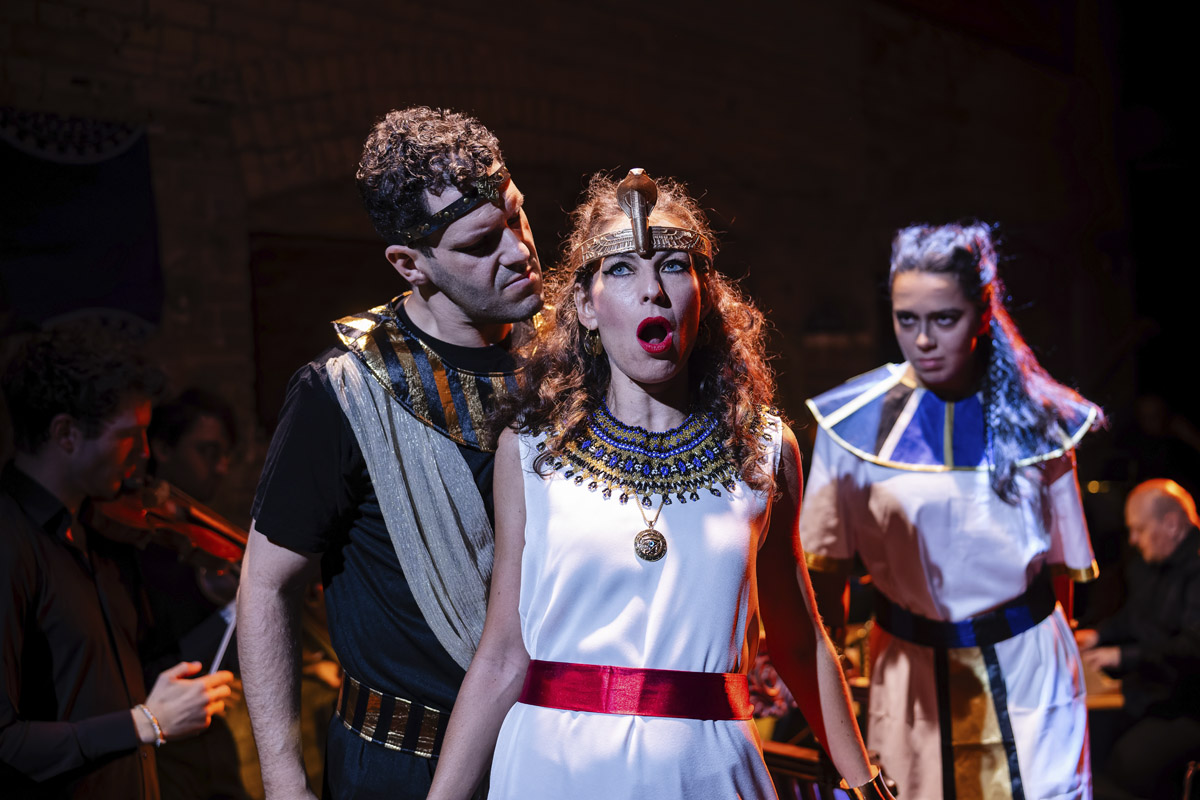

Giulio Cesare in Egitto was one of Handel’s great successes. It was first performed in 1724 for the Royal Academy of Music, with the famous castrato Senesino singing the role of Caesar. For this performance at The Arcola, as part of the Grimeborn season, New Trinity Baroque, led by Predrag Gosta, uses a version that may be shortened but loses none of the drama of a story that tells of Caesar’s adventures in Egypt as he overcomes Tolomeo (Ptolemy) and is overcome by Cleopatra.
Caesar is in Egypt in pursuit of his deadly rival Pompey. He is drawn into the conflict between Tolomeo and his sister Cleopatra for the throne of Egypt. Both wish to gain Rome’s support for their claim, but Tolomeo, who has promised Pompey safe refuge, overplays his hand by betraying his guest and presenting his severed head to Caesar, wrongly expecting gratitude. Meanwhile, Pompey’s widow and her son Sesto abandon old enmities to ask Caesar to aid their plans for revenge on Tolomeo. Cleopatra finds a way into Caesar’s camp and begins her plan to seduce the Roman general. When she reveals her identity, Caesar declares that he will use his forces to defeat Tolomeo and make her queen. Despite early setbacks, Caesar is victorious, and the opera ends as he gives her the crown and they declare their mutual devotion.
The role of Caesar was sung by Belgian countertenor Sandro Rossi. His was a very military take on the character, and vocally this led to some uncomfortable contrasts. But there were also highlights, particularly in Se in fiorito ameno prato, where Caesar ‘duets’ delicately with the violin. It was, however, in the singing of Radoslava Vorgic as Cleopatra that Handel’s consummate skill at creating arias of beauty for the female voice truly shone. She is outstanding, with a glorious tone at every level of her voice. She also used the closeness to the audience that Studio 1 at the Arcola offers performers to create a persuasive picture of a queen who moves from seductress to lover.
In the other parts, Italian contralto Federica Moi impresses as Pompey’s widow, Cornelia. She is right to use the label ‘contralto’ rather than ‘mezzo’: she has a voice of power and depth that is all too rare on the modern opera stage. In her moments of mourning with her son Sesto, there was real grief and anger. Sesto is a ‘trousers’ role (a male character played by a woman) and was well sung by Silvija Radjen Kumar from Croatia. The score gives her fewer chances to shine, so her performance was all the more special. Tolomeo was sung by Julia Portela Pinon and his general, Achilla, by Marcio da Silva. Both gave performances that showed they are steeped in the Baroque singing style needed to make Handel’s music sparkle.
The special merit of this production was that the high-quality singing was matched by an orchestra of ten superb young musicians playing period instruments with real panache. Leader Simone Pirri played the ‘nightingale’ music with a shimmering beauty of tone, and the whole orchestral sound was beautifully balanced by the sure hands of Predrag Gosta, conducting from the harpsichord.
The production was directed by Marcio da Silva with his customary flair for combining storytelling with myth-examining. There was a clever contrast between moments when the cast wore Roman or Egyptian costumes and others when they appeared in black tops and tights. The use of sinister masks added to the tension, and there were striking tableaux, one foretelling Caesar’s murder. A minor complaint: the surtitles were full of errors, some of them comic.
This was a very fine version of a classic Handel opera that will appeal to newcomers and Handel fans alike.
Arcola Theatre, Dalston
Composer: George Frideric Handel
Libretto: Nicola Francesco Haym
Music Director: Predrag Gosta
Stage Director: Marcio da Silva
Performers incl: Sandro Rossi, Radoslava Vorgic, Federica Moi.
Running time: 2 hours 45 minutes
Dates: until 5 September
Photos: Julian Guidera