

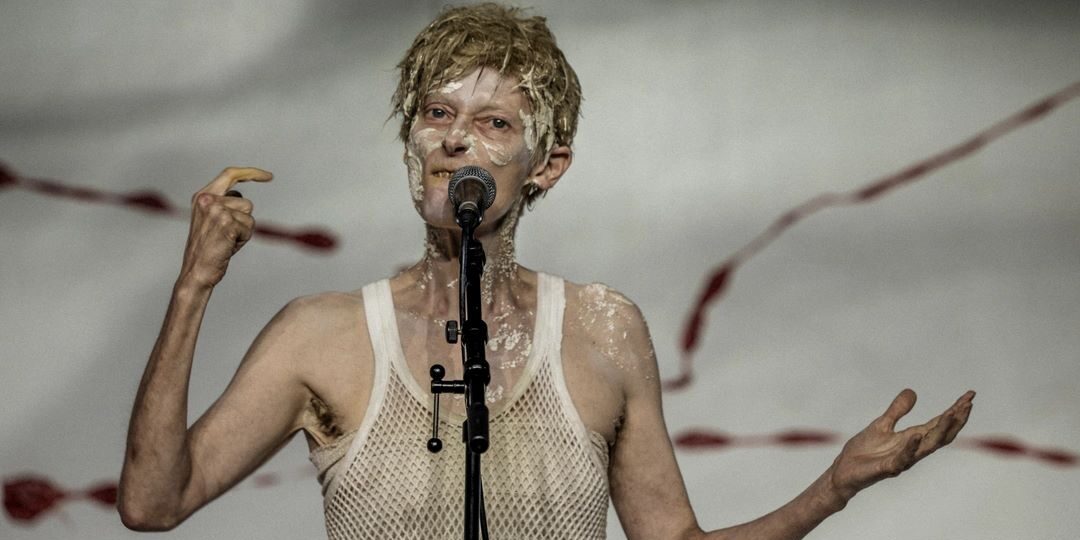

Coming up for 40 years ago, this play was performed to acclaim at the Edinburgh Festival, and then at the Royal Court, helping to make the name of all involved. With the addition of a few extra scenes to bring the action up to the present day, the same team present it again. It has the same startling, visceral and intentionally distancing effect, and the performance by Tilda Swinton is a marvel of stamina and endurance as she punishes herself, and to an extent, the audience for well over an hour of grim action.
The shadow of Brecht looms large over this play. The author worked with Helene Weigel, Brecht’s wife and successor at the Berliner Ensemble, and this monologue embodies many of the favourite techniques of theatre of alienation – satire, shock tactics, extremes of language and action, violent switches of tone and a rapid fire succession of short scenes, some detailed and realistic, others fragmentary and suggestive. And as so often in Brecht, one life stands in for a larger whole. Ella/Max emerges into adulthood as the Nazi era begins, and her tale of canny, resourceful survival is a parable for the twists and turns of German history from the 1930s through to the contemporary rise of the AfD. There is a parallel here with survival strategies of Brecht’s own Mother Courage, who loses all that is precious to her in her desperate determination to save her own skin.
We meet Ella/Max in tottery and degraded old age, pottering around in a shabby flat full of ill-assorted junk which she uses to trigger memories of her complicated past. Starting off as Ella she assumes the identity of her deceased husband Max, so she can take over his job as a crane operator. Despite all that politics and war and the division of Germany throw at her, she manages to eke out a living, but at the cost of her female identity. The price of successful concealment is the absence of any true relationships, no children to cherish, and a cynical and soulless isolation. The rewards, such as they are, are survival itself, a window seat on history, and the chance to live a rich life of observation of people and private fantasy. There are flickers of selfless humanity, such as when she gives away her old identity card to provide another woman in a desperate situation with a chance of escape.
Swinton’s performance is mesmerising. I am not in a position to judge what has changed from the first iteration, nor have I seen the film; but the extremes of emotion she explores are exceptional. Each time you think she has pushed a scene as far as it can go, there is another level. Battered, slathered, and half-naked she still preserves an eerie kind of gamine beauty throughout the recurrent ugliness and catalogue of abuse, violence and self-harm. There are wistful elegiac moments too, with delicate pointing and pacing of the text that draws the audience into her full zone of concentration. The creative team have framed her in harsh lighting, a welter of debris, and a penumbra of politics, suggested in video projections and a degree of amplified recorded sound, that underscores the tension.
It many ways it is a dispiriting evening, but Swinton’s extraordinary performance makes it a night to remember.
Royal Court, Jerwood Downstairs
Writer: Manfred Karge, translated by Anthony Vivis
Performer: Tilda Swinton
Director: Stephen Unwin
85 mins, no interval
Until 24 October 2026
Photo Credit: Rüdiger Glatz