


The two years that Oscar Wilde spent incarcerated in Reading Gaol for a then illegal homosexual relationship marked a profound shift – in his writing, his fortunes, and perhaps most profoundly, in his view of himself. Wilde tumbled from the heady heights of London society as a celebrated playwright to a prisoner scrubbing the floors of his small, rancid cell. Perhaps apocryphally, he was provided with a single sheet of paper per day, on which he wrote De Profundis, a powerful screed where Wilde first rages against society and his lover, Lord Alfred Douglas (Bosie), and then discovers insight and humility, and reconciliation for his former heady and louche life.
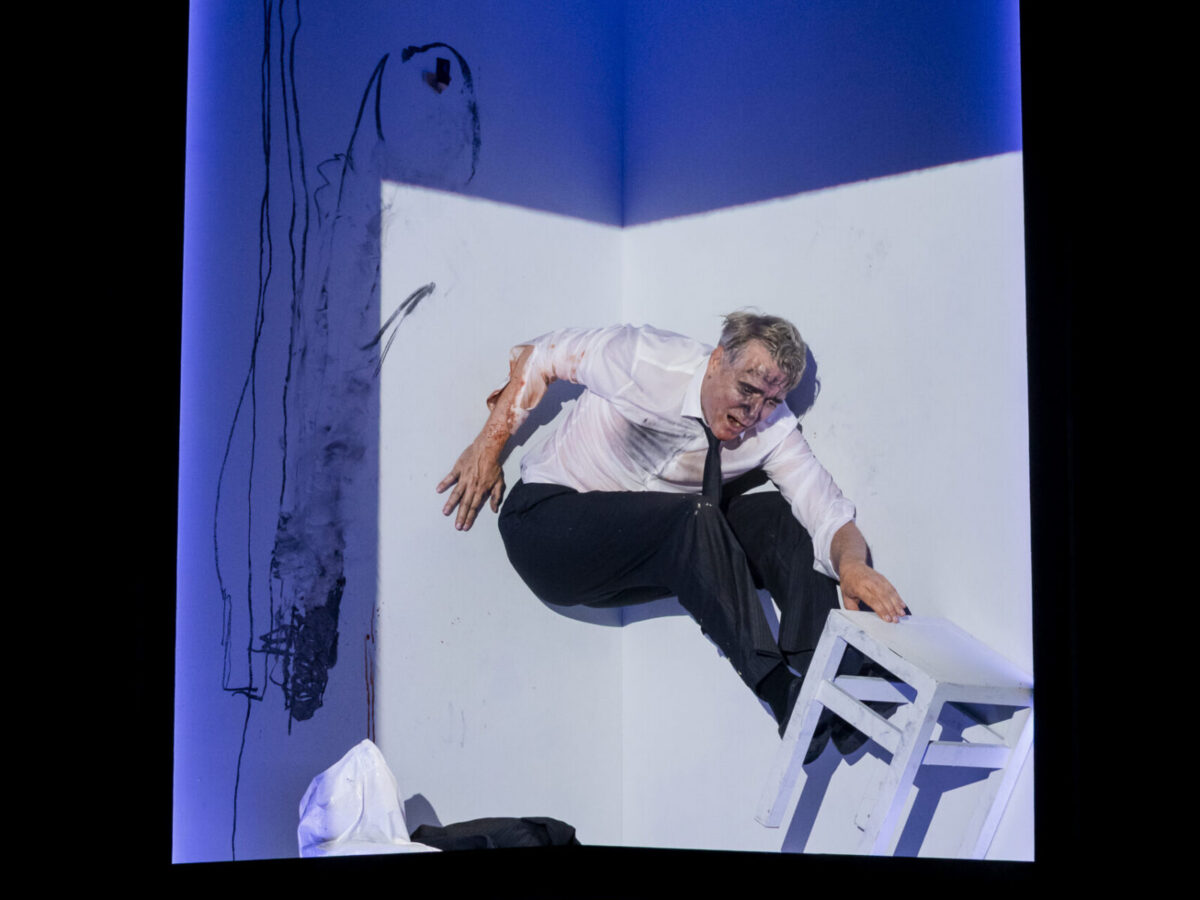
Much of the verbatim text of De Profundis forms the spine of the Berliner Ensemble’s one-man show of the same name, starring Jens Harzer now playing at the Coronet Theatre. Confined to a small box, about two feet square, raised above the stage floor and surrounded by a neon frame (stage design by Hansjörg Hartung) Harzer spends almost the entire show inside this cell-like space. His only furniture is a short stool and his only possession a shopping bag from which emerge a few props – black chalk for drawing, an apple, a toothbrush – with a single picture of Bosie taped to the wall. The performance is in German, with English surtitles projected at the sides of the stage. The production is punctuated with eerie notes of sound – music by Jörg Gollasch — that lends an otherworldliness to the evening.
Without a doubt, Harzer gives an intense and physically impassioned performance – almost relentless in its energy and severity. Yet, to this viewer, it is hard to square that intensity with the reflection and self-examination that seems central to Wilde’s prison writings. The actor emotes anger towards Bosie, certainly, and lashes out with a powerful sense of injustice, but Harzer rarely stops moving: shaking, contorting himself, drawing blood from his scratched and bitten arms, and spitting out the text at machine-gun speed. The effect is less of a man reflecting and feeling his way through his past experience than a lunatic raging in unbridled agitation.
Director Olivier Reese gives Harzer a lot of stage business – tearing up the Bosie photo, putting it into his pocket and then casting it aside; scribbling on the wall and blackening his hair. But I kept waiting for a pause, a moment of genuine inward reckoning, and one never came. I longed for more variety, and for moments of deeper emotional truth.
Perhaps I was expecting a particular interpretation of Wilde’s text. But De Profundis is, for me, a profound and deeply painful reckoning: the attempt of a great and fallen man to examine not only what has been done to him, but his own hubris in the choices that brought him to this cell. Wilde explores anger and self-pity, certainly, but also remorse, self-questioning and an extraordinary desire to take account of what has happened to him.
At the end of the play, following a moment of stunned silence, the audience on the evening I attended were on their feet, and I understand why: it was a feat of sheer physical endurance. But what I saw on stage simply didn’t match what I found in Wilde’s words – the reflection, self-examination and gradual movement towards insight.
Text: Oscar Wilde
Directed by: Oliver Reese
Performer: Jens Harzer
Stage Design: by Hansjörg Hartung
Photo credit: Jörg Brüggemann
Running Time: 1 hour 50 minutes, without interval
Until 7 October