

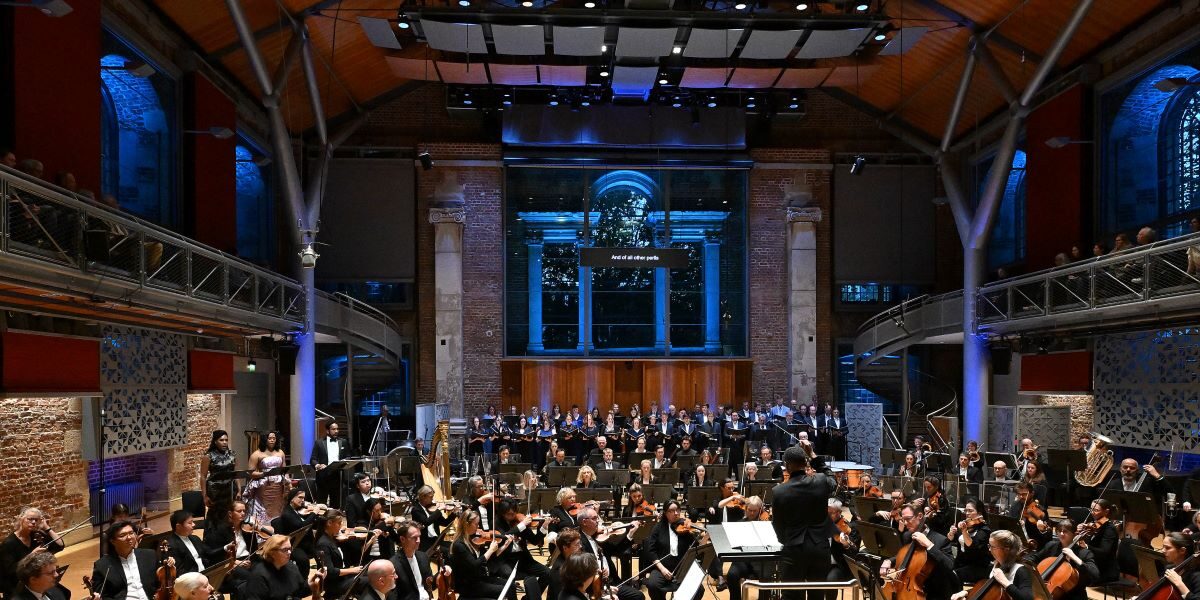

Back in 2020, Lloyd’s of London offered a formal apology for its role in the Atlantic slave trade and followed it up with a substantial investment in projects that include the commissioning of creative responses to the horrors of that episode. David Önaç’s Atlantic Requiem faces up to the substantial challenge involved with music that combines intellectual depth and ingenuity with emotional range and power equal to the dimensions of the events invoked. This is a work imbued, not only with the history of the slave trade, but also the history of musical commemoration of atrocity so that the complex framing in multiple genres provides an apt and convincing embrace of both the scale of suffering and the possibilities of redemption and reconciliation.
In an intriguing preliminary discussion, Errol Francis, one of those who commissioned the piece, pointed out the suitability of a requiem as the structure for the work, given the multiple roles that Christianity played for good and ill in the era of the slave trade, with the name of God deployed both to justify and excoriate the trade, and the conflicting evidence of the Bible itself. The composer uses the standard Latin text of the Requiem Mass, dispersed across five movements, which also contain texts taken from a variety of other sources, including an insurance contract valuing a ship and slaves as chattels, a contemporary description from a court record of a slave being thrown overboard after contracting smallpox, and a visionary section of the book of Revelation, with which to conclude. Each of these elements is interwoven with vivid imagination in both the choral and instrumental writing, with both narrative drive and emotional high points provided by the three soloists.
The mood is dark and ominous at the start, with a prominent role for a copy of the Lutine bell, the traditional marker of disaster in Lloyd’s of London. This mood is intensifed by the cold and clinical language of the shipping contract, delivered with biting precision by tenor Orson Van Gay. Darker still is the second movement, with its graphic depiction of the slave cast overboard tied to chair, her death marked only by the Captain’s regret for the chair. The setting is gruesomely vivid, marked by the anguished screams of soprano Britanny Renee, and vivid orchestral tone painting. The turbulent third movement sets the Dies Irae and presents in stark terms the conflicts and contradictions within Christianity, as a source of both solace and historic repression. But in the final two movements, an Agnus Dei, aspiring to hope, and a ‘polyrhythmic, polymetric and polystylistic’ finale the mood lightens as a celebration of musical and thematic diversity.
There is a lot more to grapple with here that a first impression of a world premiere cannot convey nor a reviewer properly register. In particular the mixture of classical, jazz, gospel and blues elements deserves to be understood in depth and the composer’s intriguing use of a pentatonic scale by including only five black and five white notes of the scale in a principle of schematic equality. What is not in doubt though is the assurance with which these large forces are confidently set in motion, and the quality of the performance the work received. The history of music is littered with examples of under-rehearsed and poorly performed premieres – not a touch of that here.
This first performance attracted three exceptional soloists who more than held their own alongside a full-scale orchestra and large choir. Each of them had fine individual expressive moments indicative of their extensive experience in the world of opera, and natural feel for dramatic representation. Likewise, the BBC Singers produced their customary crisp and confident engagement with new music, with a wide dynamic range and layered ensemble. There was plenty for all sections of the LSO to get their teeth into, together with several notable and demanding instrumental solos, especially for the leader, violinist Benjamin Marquise Gilmore, playing stratospherically high at the very end of the work. Players of a full range of percussion and even a drum kit distinguished themselves. A particular plaudit should go to conductor Malcolm J Merriweather, who stood in at only six days notice, yet seemed entirely on top of proceedings in a work with many and varied technical demands.
This requiem made a strong immediate impression on its first audience and will doubtless yield more on repeated hearings which it fully deserves to receive. Why not move a few sizes up from St Luke’s to St Paul’s Cathedral?
Composer: David Önaç
LSO and BBC Singers
Conductor: Malcolm J Merriweather
Soloists: J’Nai Bridges, Brittany Ree, Orson Van Gay II
11 October 2026
40 minutes
Photo Credit: Mark Allan