

‘We live, I regret to say, in an Age of Surfaces,’ says Lady Bracknell in The Importance of Being Earnest. So true, not just of the world of now, but of Gerald Barry’s operatic take on this classic play. In anticipation, I thought I would really dislike this musically spiky take on a familiar drama, but far from it. This is not a comfortable play, for all its incorporation into the literary canon. Behind the carapace of elaborate, scrupulous courtesy and peerless paradox lies a tone of mounting hysteria, which is properly released in a production that embraces absurdity to the full. The conventional backdrop may be plush aristocratic elegance, but this is not a scenario where Mozart or Strauss would or should feel at home.
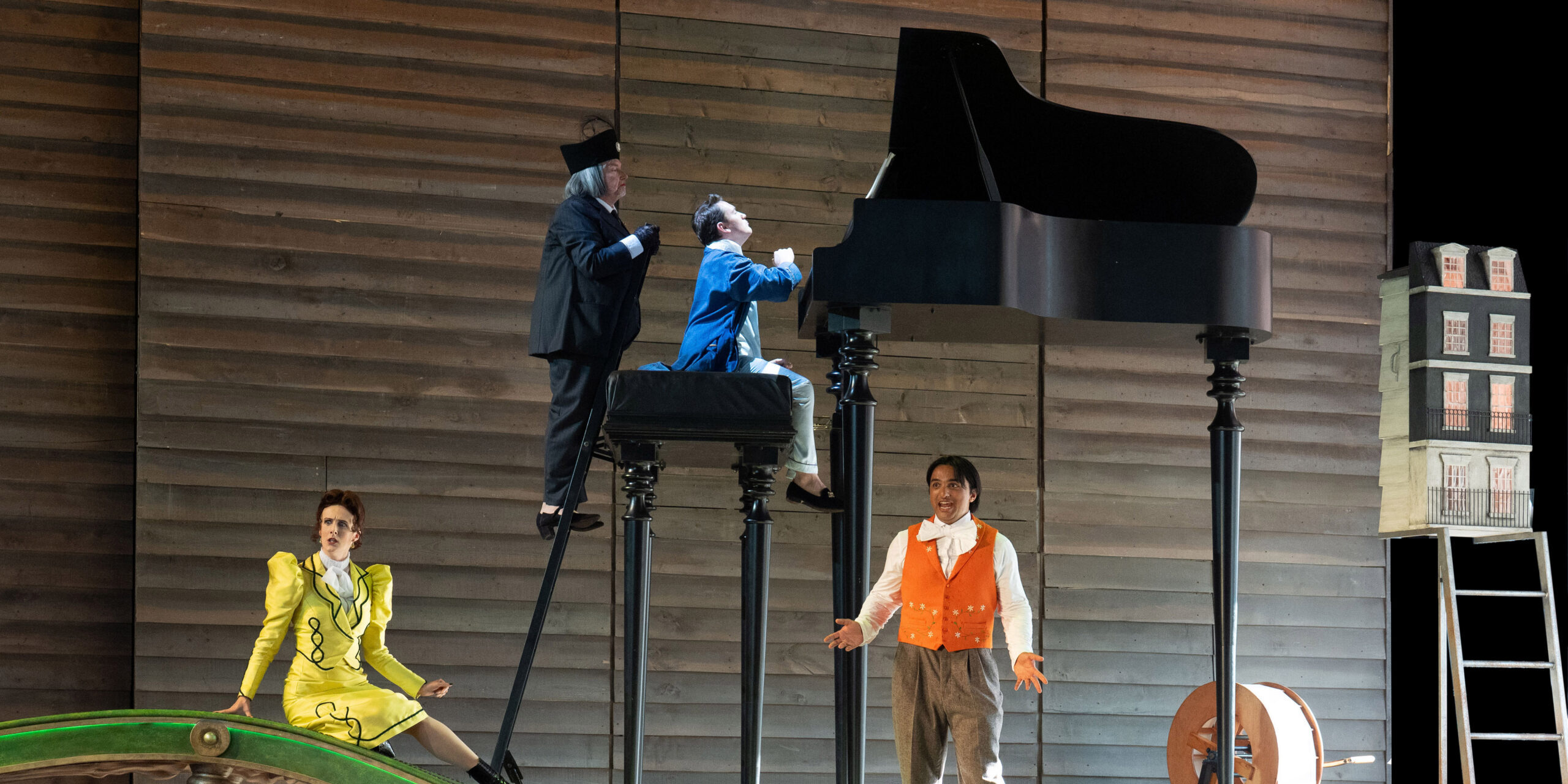
Before a note is sung you know you are in a very different world. The set is dominated by an extravagantly elongated chaise longue that evolves into a vast switchback slide, culminating in the orchestra pit – except the orchestra are off to one side of the stage throughout. A piano sits on stilts at the back, while a butler prepares for tea to be served, but on bare earth rather than an exquisitely laid table. The set anticipates the setting. Familiar starting points lead to freakish and outlandish conclusions. Similarly with the costumes where period style blooms into quirky, if not nightmarish combinations – Lady Bracknell as a rubber-clad Bismarck, Cecily in more pink frills and ruches than an iced wedding cake. A kangaroo bounds across the stage, for no better reason than the mention of one character’s possible exile to Australia.
The music unsurprisingly explores similar extremes of pitch, instrumentation and genre. Much of it is written in a form of Sprechgesang that is rarely relaxes either into a conventional aria or falls back on simple speech. Intervals are distant and exaggerated; orchestration, mainly wind heavy, is as much underscore as independent, and the members of the orchestra act as an unconventional verbal chorus too. There are elaborate passages of satirical interpolation (eg Auld Lang Syne and Beethoven’s setting of Schiller’s Ode to Joy) and pastiche of other composers, particularly Stravinsky.
But there is always method in the madness. One scene that demonstrates this above all comes near the end of the first half when the encounter between Gwendolen and Cecily turns glacially polite once they both think they are competing for the same Ernest. A combination of megaphones and the perfectly-timed smashing of dozens of plates perfectly dramatises the violence of what is really going on behind the icy exactitudes. Here is only one instance of many in which surfaces are turned inside out and real meanings brought unflinchingly but hilariousy into view.
This is difficult music to perform, quite apart from the levels of immersive acting required (literally in the case of one bathing scene!). All the singers perform technical feats in solo and ensemble performance, and Douglas Boyd, who conducts, keeps a necessarily tight rein on proceedings – the musical equivalent of immaculate comic timing. Jennifer France, as Cecily dispatches stratospherically high tessitura with disdainful panache, and contrasts charmingly with Holly Brown’s poised, precise and elegant Gwendolen. Seán Boylan and Zahid Siddiqui make a good pairing as Algernon and Jack, with their love of food brought out memorably by director Jack Furness. Susan Bickley and Kevin Whately (in a speaking role) are Miss Prism and Canon Chasuble, perhaps the least altered and most sane characters in this production; and Peter Lidbetter plays the butlers with to passive-aggressive perfection. Inevitably, Lady Bracknell steals the show here, just as in a conventional production, and it was an inspired idea to invite Garsington regular bass-baritone Henry Waddington to embody her/him.
This opera is a one-off, in so many ways, but deserves to become a repertory piece, in the same way that The Flea by James Fritz, a similar nightmarish satire of Victorian England, has struck a chord and received revivals. We should give Wilde the last word: ‘Moderation is a fatal thing. Nothing succeeds like excess.’ All credit to Gerald Barry, Jack Furness and Garsington Opera for taking this to heart and detonating so many polite surfaces simultaneously.
Libretto & Music: Gerald Barry (based on play by Oscar Wilde)
Philharmonia Orchestra
Conductor: Douglas Boyd
Director: Jack Furness
Cast: Susan Bickley, Seán Boylan, Holly Brown, Jennifer France, Peter Lidbetter, Zahid Siddiqui, Henry Waddington, Kevin Whately
Until 23 July 2026
3 hrs 15 mins with interval
Photo Credit: Richard Hubert-Smith