

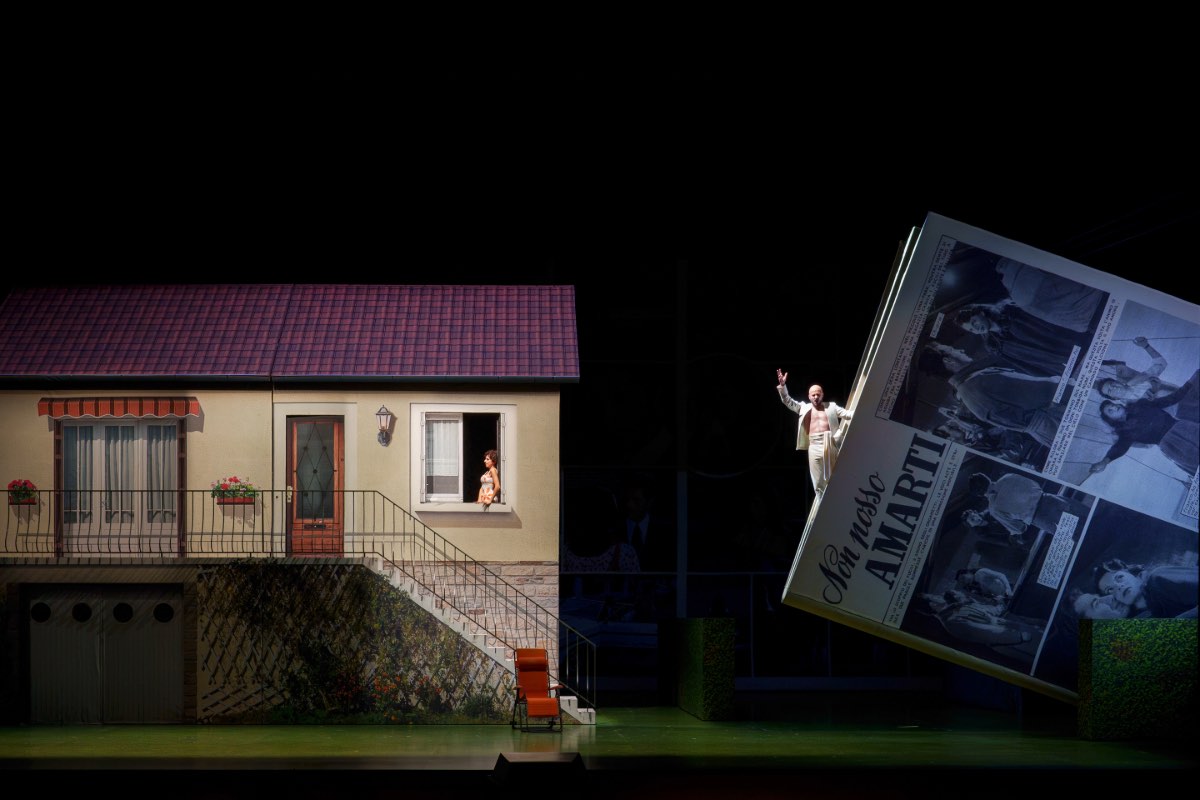

The New National Theatre Tokyo opens its new season with Rossini’s Il Turco in Italia, a co-production between Madrid’s Teatro Real and Opéra de Lyon. Il Turco in Italia, whilst rarely performed, is a gem within the opera buffa genre, and the director Laurent Pelly’s rendition does well to bring Rossini’s colourful, melodramatic world to life.
Photo novels (or fotoromanzi in Italian), invented in Italy in 1947, were a form of storytelling combining staged photographs with dialogue balloons or captions, gaining popularity in the post-war period. Pelly interestingly uses the photo novel as a meta-structure through which to frame the opera. The pre-performance backdrop displays the cover of a fotoromanzo and Fiorilla, the protagonist of Il Turco in Italia, is obsessed by its pages. She dreams of the passion and melodrama promised by their stories, clearly a form of escape from the ennui of marriage to the respectable but unexciting Geronio. When the handsome Turkish prince Selim arrives in Naples, he steps right off the pages of her favourite photonovel, making his entrance down a gangway onto the stage, and into her real life. Pelly’s choice of this staging and his use of the photonovel framing blurs the line between reality and fantasy, emphasising the absurdity of the opera; the exaggerative comedy and buffoonery sits well within the context of a photonovel.
The staging is what makes Pelly’s production stand out. Giant pages appear on stage, complete with speech bubbles subtitling the sung text and even stage directions, while the characters move in and out of photographic frames. The device is particularly apt for an opera in which the poet Prosdocimo both participates in events and stands outside them, observing the lovers as material for his next comedy. His voyeuristic role within the framed staging helps to bind the theatrical and musical worlds together.
The cast play their characters convincingly and a highlight was Claudia Muschio as Fiorilla. Her coloratura has precision and effortless agility, but she has more than just technical display. Muschio’s human portrayal of Fiorilla gives meaning to her promiscuity; her flirtation is the outcome of a woman desperate to escape the mundanity of married life. In the Act II aria “Squallida veste”, Muschio combines technique with genuine emotional gravitas, revealing the vulnerability beneath Fiorilla’s comic self-confidence. Paolo Bordogna’s bumbling Geronio is an ideal foil to the charming Turkish prince, his seasoned bass-baritone and precise comic timing capturing a husband perpetually overwhelmed by his mercurial wife. His confrontation with Alejandro Baliñas Vieites’s Selim over Fiorilla is a memorable scene, the two low voices sparring over Fiorilla with increasing absurdity. His scene with Muschio is another highlight. As their voices become increasingly entangled, marital warfare is transformed into quintessential Rossinian ensemble comedy.
Alessandro Bonato conducts the Tokyo Philharmonic Orchestra with buoyancy and an instinctive awareness of theatre. His brisk but flexible pacing allows Rossini’s intricate ensembles to ring without sacrificing clarity. Most impressively, the characteristic Rossini crescendos feel less like exercises in increasing volume than musical embodiments of the mounting confusion on stage, gathering momentum until the characters appear almost swept along by the music itself.
Pelly’s knowingly kitsch world never overwhelms Rossini. Instead, the visual comedy, the theatrical innovation and the wonderful ensemble continually feed one another. The result is a rare outcome of an evening in which musical sophistication and sheer comic entertainment become inseparable, a celebration of Rossini’s theatrical genius, and tremendous fun.
Venue: The New National Theatre in Tokyo
Composer: Gioachino Rossini (1792-1868)
Libretto: Felice Romani
Director: Laurent Pelly
Conductor: Alessandro Bonato
Set designer: Chantal Thomas
Costume designer: Laurent Pelly
Lighting designer: Joël Adam
Cast includes :Claudia Muschio, Alejandro Baliñas Viettes, Paolo Bordogna, Ruzil Gatin Bruno Taddia and Tajima Yuka
Until 12th October 2026
Photograph: (c)Koji Iida/New National Theatre, Tokyo
Running Time: 3 hours including 1 interval