

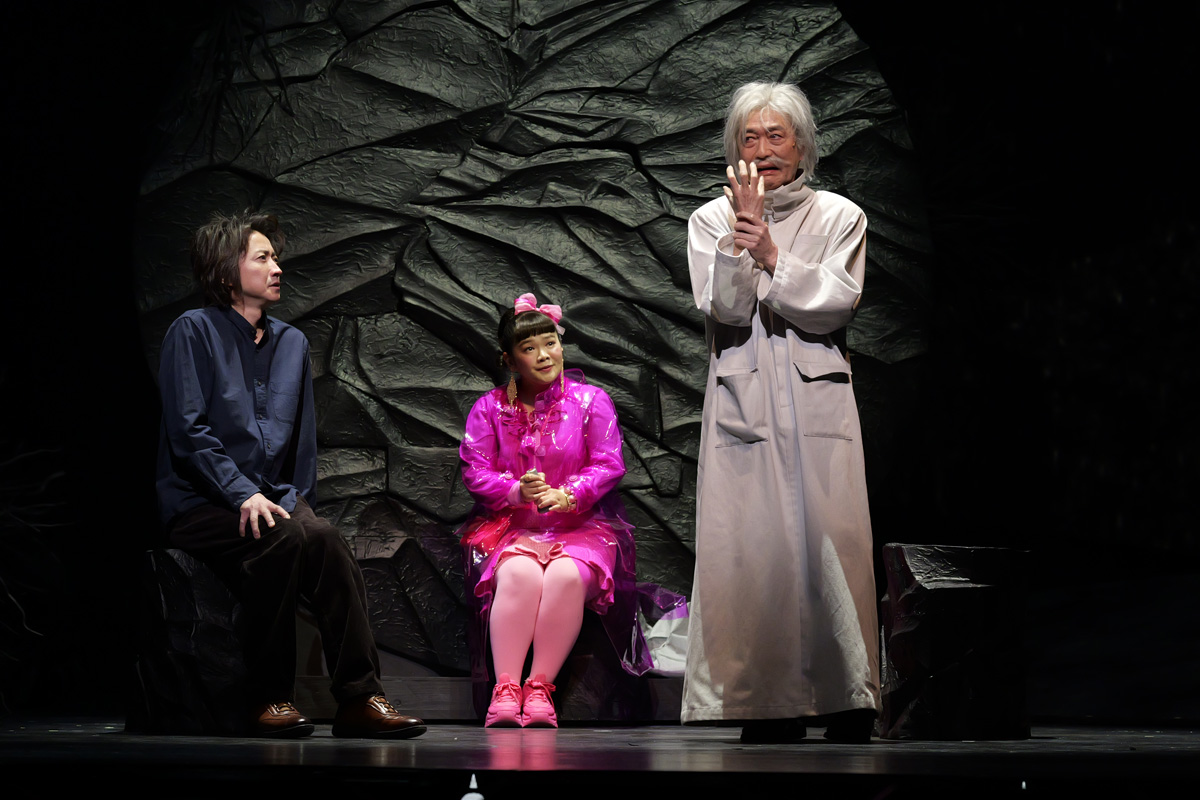

Set between two worlds — a bleak cyberpunk Tokyo and a dreamlike, seemingly perfect Town — one of Haruki Murakami’s earliest novels gets the Cirque du Soleil treatment in Philippe Decouflé’s stage adaptation at the Barbican.
Murakami’s books are famously funny, surreal and tangled. The brief from HoriPro was to create something “highly visual, accessible to a broad audience”, and in this Decouflé has succeeded, perhaps excessively so. The result is so digestible and sanitised that it could almost pass for a children’s show, were it not for the uncomfortable sexual humour involving the 17-year-old Lady in Pink (Miu Tomita). Her main trait is to repeatedly question the much older Watashi (Tatsuya Fujiwara) about his sexual habits and whether he would sleep with her. To me, it felt reductive and unfunny, although the laughter from men and women alike suggested that not everyone shared my discomfort.
Decouflé reverses the novel’s narrative order, opening in the dreamlike Town. With so little of the mundane that usually contrasts with the dreamlike in Murakami, the play registers almost immediately as a fairy tale. Among unicorns grazing at sunset, the young Boku (Kiita Komagine) is separated from his shadow and must navigate the Town’s strange rules to reunite with it. We then cut to Tokyo, where Watashi rides a mysterious elevator to meet a scientist for a “shuffling” job: coding carried out in the coder’s subconscious.
We meet other characters along the way, but apart from Misato Morita, who plays the librarian and love interest in both realities, they rarely have any depth beyond serving to move the story along, or at times simply functioning as visual gags. Fujiwara, the production’s biggest draw, must negotiate the demands of a complex, multilayered narrative compressed into a limited running time. For an English-speaking spectator, the need to follow the surtitles makes it difficult to appreciate the full nuances of his performance.
Condensing more than 400 pages into two hours and fifty minutes, Decouflé has chosen to privilege the visual over the verbal. The plot, stripped to its essentials, becomes so straightforward that it loses much of its mystery. In a Murakami novel, What on earth is going on here? is central to the experience. Yet the broad direction of this story soon becomes apparent, even if individual exchanges can be difficult to follow through the surtitles.
There are also scenes, such as the restaurant dinner and the dancing commuters, that seem to exist purely for their own sake. In fact, I caught myself wishing Decouflé had gone even further. Given the simplicity of the narrative, a pantomime or ballet might have been more effective. Crystal Pite’s Figures in Extinction evokes transience, life and death almost entirely through movement. This production has so many beautiful words and wastes them.
Yet, for all its shortcomings, the production is undeniably pleasant to watch — and that is no small achievement. The lighting is enchanting, and the screens, mesh and projections hold the attention regardless of the plot. The unicorn ballerinas are a highlight, and the physical comedy of the Semiotecs allows some of Murakami’s humour to shine through, language barrier or not. Komagine, who alternates with Ryunosuke Shimamura, is perfectly cast as a lost prince, so naturally charming that he draws sympathy without much to work with. The live music is gently hypnotic, if at times repetitive, much like the production itself.
In this retelling, the connection between the Town and the narrator’s dream world seems obvious almost from the start. The two realities appear so closely linked that there is little sense of revelation when their relationship emerges. There is no great surprise, no satisfying climax. The evening flows along pleasantly, evoking little fear, surprise or sadness, as if we too had left our hearts at the gates of the perfect Town.
Based on the novel by Haruki Murakami
Adapted by Ako Takahashi
Director and choreographer Philippe Decouflé
Music Umitaro Abe
Set designer K Ishihara
Lighting designer Yukiko Yoshimoto
Video designer Taiki Ueda
Costume designer Ayako Maeda
Unicorn design Yoshihiko Tanaka
Musician Mayu Gonto
Performed in Japanese with English surtitles
Duration 2h 50m (including a 20-minute interval)
Photo credit: Ava Tehrani