


Rossini moved to Paris in 1824 as “Premier Compositeur du Roy,” a prestigious position demanding a spectacular French grand opera debut. He rode the wave of international grief surrounding Lord Byron’s death at Missolonghi that year, transforming Le siège de Corinthe (The Siege of Corinth) into one of the first political propaganda operas — a statement and fundraiser for the Greek War of Independence. In April 1826, the real-life year-long Siege of Missolonghi ended tragically, with thousands of starving Greeks massacred rather than surrender; the parallel between that catastrophe and the fictional fall of Corinth made the opera an immediate symbol of European solidarity with Greece.
Musically, the work cannibalised Rossini’s unsuccessful 1820 Neapolitan opera, Maometto II. By shifting the setting to Greece and radically reworking the score, Rossini transformed a misunderstood Italian experiment into a monumental French triumph, creating the framework for French grand opera. Corinthe premiered in Paris six months later, in October 1826, as part of the philhellenic funding effort.
Cléomène, leader of the Corinthians, has promised his daughter Pamyra to the warrior Néoclès. In Athens, Pamyra fell in love with Almanzor — not realising, until she pleads for mercy from Mahomet, that they are the same man. Mahomet offers to marry Pamyra and spare the Greeks. Cléomène refuses the marriage, preferring to sacrifice his people. Pamyra, torn between love and duty, returns to Corinth. They all die as the city burns.
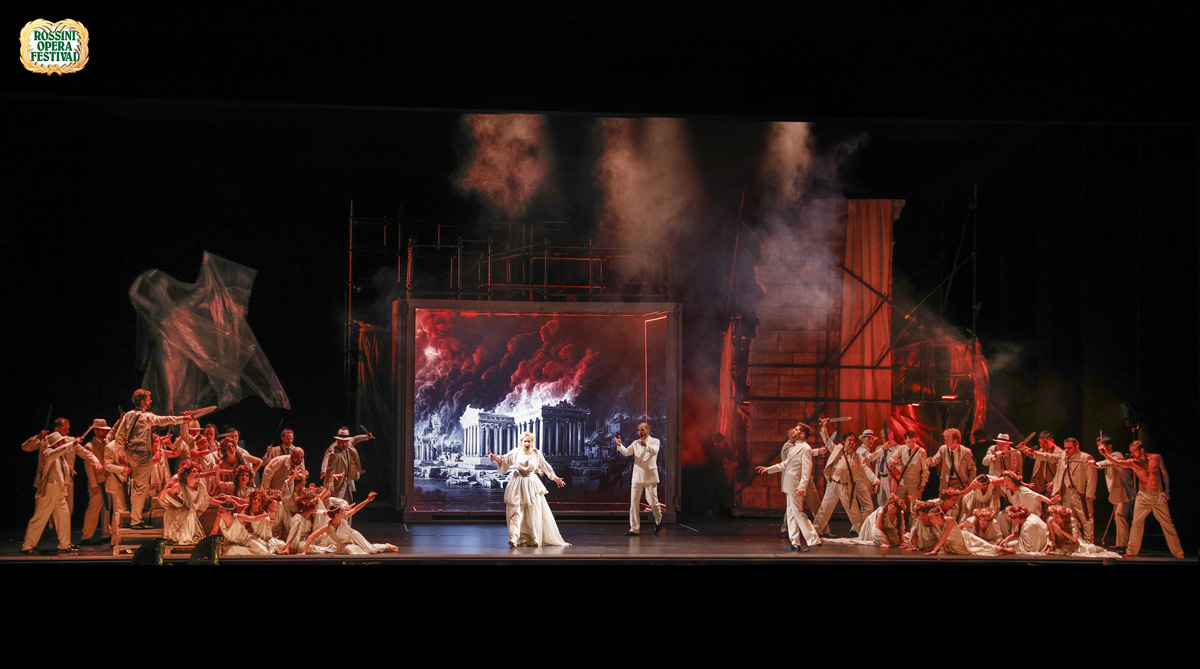
Celebrating 200 years since the Paris premiere, Davide Livermore’s provocative production relies on digital imagery and a deliberate clash of eras. Giant, disintegrating classical architecture morphs into abstract digital landscapes; ancient Greek costumes contrast with the white suits of the Turks, who use grotesque mobile-phone selfies to humiliate the Greeks. Pristine Greek cleanliness contrasts with rubbish bags defiling the beauty of antiquity. D-Wok’s spectacular projections move from peaceful oceans and temples to Corinth under attack, and finally in flames. The 15-minute Act II ballet, obligatory in 1826, adds little drama to an already long evening.
Russian soprano Vasilisa Berzhanskaya is the standout as Pamyra, a role demanding dramatic weight and stamina alongside delicate phrasing and excellent coloratura. Her extraordinarily versatile voice, extending into mezzo territory, gives her the weight required for the drama while retaining the agility and refinement of Rossinian bel canto. “Ô patrie infortunée!” is a tour de force, combining dramatic intensity with perfect agility, exciting pianissimi, sustained phrases of great beauty and a thrilling top register. But it was in “Juste ciel”, the finest aria in the score, that Berzhanskaya truly transfixed, shedding her formidable vocal power for an exquisite, almost weightless pianissimo. A breathtaking performance.
Despite announcing his indisposition, Romanian baritone Adrian Sâmpetrean sings a fine Mahomet, combining vocal authority with physical prowess, clambering up and down scaffolding while negotiating Rossini’s demanding music. He displayed elegant legato and expressive colouring in his recital the previous morning. His Act II duet with Pamyra is a highlight: initially warmly seductive, his Mahomet reveals the ruthless conqueror beneath the instant Pamyra abandons the wedding.
Russian tenor Maxim Mironov’s Néoclès is elegantly sung, but the voice lacks colour and passion, while limited volume causes him to disappear in ensembles.
Italian tenor Matteo Roma lacks the heroic weight and French diction needed for Cléomène. Physically overshadowed by Néoclès, his slight stage presence strips the leader of authority. His refusal of a mutually willing political marriage feels less like noble conviction than short-sighted foolishness.
Spanish bass Simón Orfila brings authority to Hiéros in Act III, with a warm, dark timbre and powerful stage presence. His excellent recital the following morning reinforced the vocal quality.
Chinese tenor Tianxuefei Sun, in Adraste’s tiny part, is a voice to watch for the future.
Carlo Rizzi conducts with precise structural control and dynamic balance, maintaining tension throughout the four-hour score.
Highly recommended as a musical rarity, the production’s clever juxtaposition of past and present makes the story powerfully relevant to war-torn Europe today. The final vision of martyrdom, played out against the burning of Corinth, remains in the memory long after leaving the theatre – a powerful demonstration of what digital projection can achieve and perhaps the future of operatic scenography.
Music by Giachino Rossini (1792-1868)
Libretto Luigi Balochi and Alexandre Soumet
Conducted by Carlo Rizzi
First performance 9th October 1826 Salle le Peletier, Paris (Paris Opera)
Cast includes Adrian Sâmpetrean, Matteo Roma, Vasilisa Berzhanskaya, Maxim Mironov, Simón Orfila, Tianxuefei Sun, Giuseppe De Luca, Anna-Doris Capitelli
Running time 4 hours including 2 intervals.
Photo Credit Amati Bacciardi