

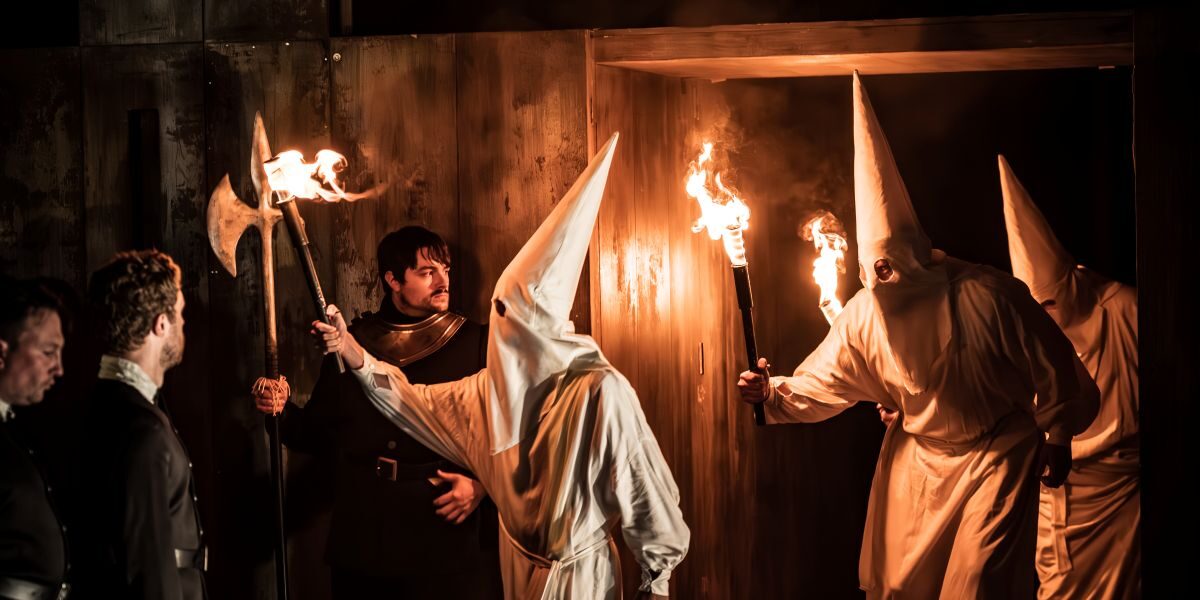

Don Carlo exists in more versions than any other Verdi opera, an indication both of the trouble it caused him and the care he took to get things right. Designed for Paris on the grandest scale, it is usually performed, as here, in the 1884 version minus the Fontainebleau prologue and ballet music. But even in this version it is a huge enterprise to stage, with at least six major roles to cast, a large chorus and orchestra, and a staging that requires both set-piece crowd effects and moments of exquisite inwardness. So it is a huge tribute to the courage and commitment and skills of everyone at Grange Park Opera that it has become something of a calling-card for them, a production that has straddled their transition from Hampshire to Surrey.
This is Verdi at his most explicitly contemporary. Written in the decade of Italian unification, the politics of the day are echoed both in the aspirations to freedom of the people of Flanders, seen here as oppressed by the rule of king Philip II of Spain, and in the idealism of the arias sung by Rodrigo, their eloquent advocate. Likewise, it is Verdi at his most anti-clerical, with his depiction of an auto-da-fé and creation of the Grand Inquisitor, a uniformly evil character, underlining his hostility to the reactionary churchmanship of the Papacy. But it is about a lot more than that too – especially the destructive cost of politics on private life, with the lives of all the lead characters warped and distorted by the choices they have made or have imposed upon them. In some ways it is the closest point that Verdi approaches to the framework of Baroque Opera. Each character faces an impossible choice between love and duty, passion and moderation, and each of them receives at least one aria of surpassing subtlety and power to set out their dilemmas. When you add in the number of superlative sections where the dilemma breaks out into duets and trios of confrontation, you can see how some commentators would claim this opera as the composer’s most intensely realised dramatic work of his later period.
The staging by Leslie Travers sets an appropriately dark, monochrome tone within stifling, restricted angular spaces, lit mainly by candlelight and peopled by singers in sombre, chiefly black costume. The English National Opera Orchestra, led in the pit by Gianluca Marciano, also emphasises the dark colours especially through the solo instrumental commentary that weaves its way through many of the arias. Colour and dramatic lighting appear generally only in lurid settings, and with particular sinister success in the climax of the first half where, for once, the burning of the heretics is genuinely uncomfortable watching, rather than mere operatic spectacle. This radical re-thinking represents a high point of achievement by director Jo Davies.
There is nowhere to hide for the six key principals, and all excel in this production. Matthew Rose’s massive bass is ideally suited to embody king Philip, and while his depiction is physically restrained he rises majestically to the challenges of Act 3, while indicating right from the start the undertow of sadness, regret and pain at the cost of his decisions to himself and others. He is well matched too in the unremittingly evil Grand Inquisitor of Julian Close, in their crucial encounter.
In the taxing title role, Otar Jorjikia is vocally secure in his key arias, and he conveys well the brittle, unstable nature of the Crown Prince who, historically at least, had to be confined for his own safety. He is well paired with Michel de Souza, whose golden tone and incarnation of unalloyed idealism is exactly right for this heroic Verdi baritone role. As the conflicted queen consort, Elizabeth, Elin Pritchard has a purity of tone and still poise that suits her set-piece aria in Act 4 very well; though elsewhere, when under dramatic pressure, there are some signs of strain in her top register. Ruxandra Donose has made the role of Princess Eboli her own in recent years for this house, and she does not disappoint in this revival, with her delightfully skittish performance of her Act 1 aria anticipating the grand moments of dramatic revenge and revelation to come in Act 3.
I am left with a few minor niggles. The scene changes take too long in what is a long opera anyway, where you want dramatic continuity as much as possible. I am also not convinced by the directorial intervention in the denouement, which seems clunky and forced in comparison with the deliberate ambiguity of Verdi’s original conclusion, where we are left to fill out what remains in our own imaginations. But this is a rare mis-step in what otherwise is a convincing and compelling production of an opera that deserves to be revived for more frequently than is the case.
Music: Giuseppe Verdi
Libretto: Joseph Méry and Camille du Locke after Schiller
Conductor: Gianluca Marciano
Orchestra of English National Opera
Director: Jo Davies
Cast includes: Julian Close, Ruxandra Dunose, Otar Jorjikia, Elin Pritchard, Matthew Rose, Michel de Souza
4 hrs 30 mins with dining interval
Until 7 July 2026
Photo Credit: Marc Brenner