


Back in March, during the London Handel Festival, I had the chance to hear Handel’s unfinished pasticcio focused on the clemency and benign rule of the emperor Titus. It contains much fine music that deserves to be better known, but mercy and forgiveness are not inherently dramatic, unlike the clash of good and evil, or passion and duty. You can see, perhaps, why Handel never finished it.
Similar thoughts go through your mind during a performance of Mozart’s later take on Metastasio’s libretto. As plots mount against the emperor’s life, largely instigated by Vitellia, the imperious queen, who is continuously passed over for empress, the tension rises, only to be dissipated by the emperor’s willingess to reconcile. This makes for some wonderful incidental moments of rage and reflection, but only intermittent dramatic impetus. So why did Mozart take the project on, when he had already taken opera seria as far as it would go with Idomeneo (1781)? This was a commission from the new Habsburg emperor, Leopold II, who wanted a festive work for his coronation in Prague. Both the fee and the prestige were irresistible, and somehow Mozart composed this work in three weeks while already engaged on The Magic Flute and the Requiem.
Music written for occasions is only occasionally memorable; and despite persuasive efforts of the expert players of Les Talens Lyriques with the complex contrapuntal lines of the overture, the opening numbers of the work seemed routine and functional. Then the Mozart magic sparks into life in a charming little duet between two of the minor characters, an inspiration that might have slipped across from the mood board for The Magic Flute. From then on the level of creativity and engagement picks up, particularly in the set-piece da capo arias for Titus himself, his conflicted friend Sesto, and the villainess Vitellia.
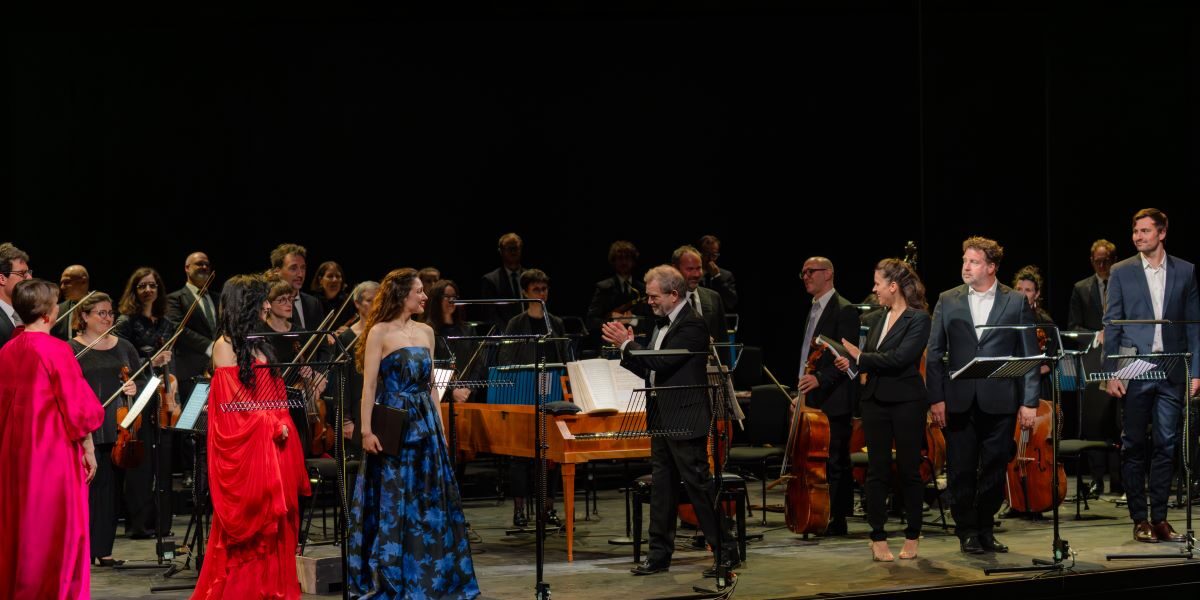
As you would expect from this band, the level of instrumental playing is both precise and stylish – there are some wonderful solo moments, particularly from the solo clarinet, in parts written for Mozart’s close friend Anton Stadler. The interventions of the period brass are free from blemish, and the strings find scope to lean into lyricism as needed, while maintaining period style. Rousset plays the continuo line on the fortepiano as well as conducting.
The six solo parts are all well taken and rise successfully to the considerable demands of the score. Jeremy Ovenden fully inhabits the sorrowful tolerance of the title role, acting plausibly so far as the concert format allowed. Aphrodite Patoulidou captured the wounded brilliance and hurt pride of Vitellia admirably, with her final aria in the second act a great showpiece success, a real highpoint of the evening. Much of the emotional burden of the evening rests with Maite Beaumont as Sesto, who has to embody the conflict of loyalties between Vitellia and Titus. She delivered the famous aria ‘Parto, parto’ with immaculate technique and command of structure. Ambroisine Bré, Anna El-Khashem, Adrien Fournaison made the most of their supporting roles and are clearly talents to watch for the future in this repertory – they have a grasp of the poise, purity of tone, and dramatic flair that are key marks of the Mozart manner.
This was a memorable performance of a rarely performed work, by forces all too rarely seen in this country. Also a reminder again of just how much creative achievement Mozart packed into his tragic final year – he truly is the composer whose lesser-known works continue to yield astonishing rewards.
Music: W.A Mozart
Libretto: Caterino Mazzolà, after Pietro Metastasio
Les Talens Lyriques
Conductor: Christophe Rousset
Cast: Maite Beaumont, Ambroisine Bré, Anna El-Khashem, Adrien Fournaison, Jeremy Ovenden, Aphrodite Patoulidou,
Until 10 June 2026
3 hrs 30 mins with dining interval
Photo Credit: Connor Apps