

Puccini was the master of the verismo style—that is, a type of opera which is rawly human and true to life, gritty in its documentation of real emotional and financial struggles. La bohème (1896) was his great masterpiece. ‘It is Sunday, a quarter past twelve, and my eyes are moist … Mimi has just died, and the poor bohemians are weeping, gathered in silence around her corpse,’ he wrote as he worked feverishly at the opera in 1894, experiencing the story with the force of reality. But of course, for Puccini, bohemian impoverishment had been his reality. Upon moving to Milan in the 1880s, he endured unemployment, fatigue and hunger. And yet – against humiliation, against the world’s overbearing cynicism – he stubbornly clung to his dreams of artistic greatness. In the end, he would have cause for laughter, not tears.
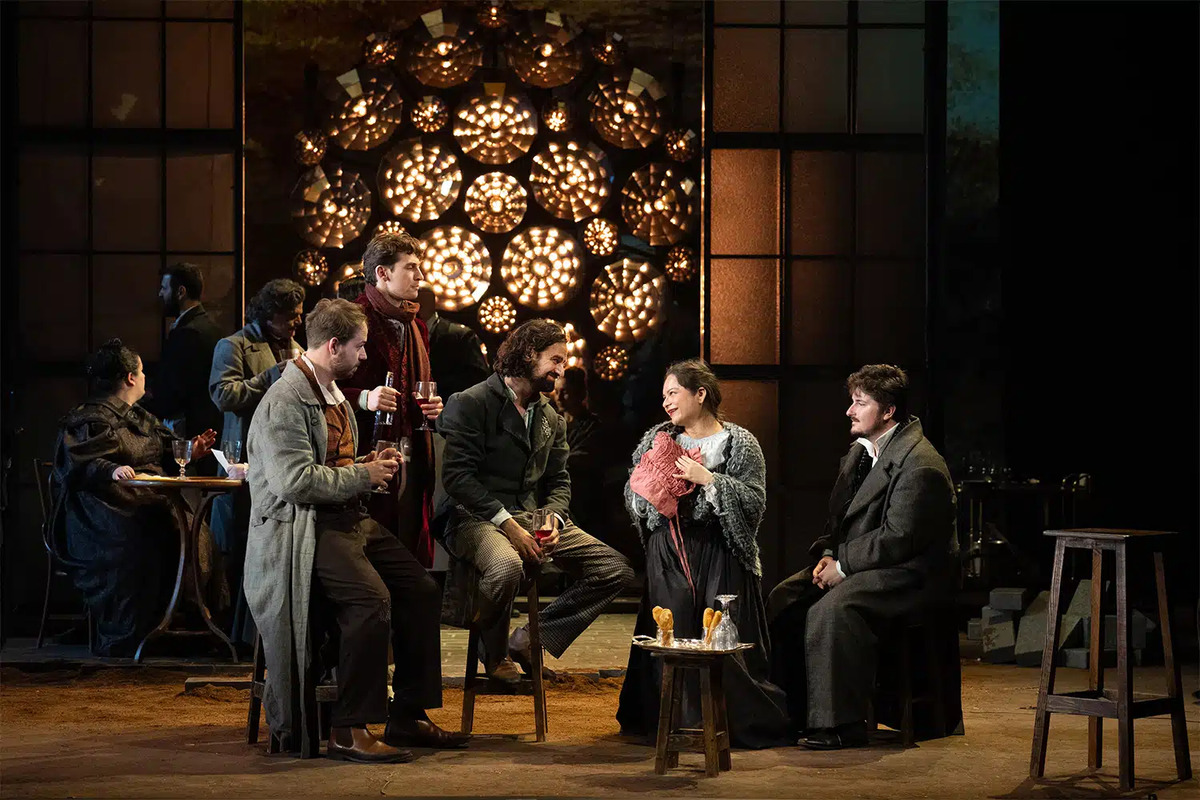
And so, at this year’s Grange Festival, Puccini’s opera returns, with actor-turned-director David Geselson, taking the reins. His version of La bohème is one that is steeped in historical context; it is set at the point of Louis Philippe’s ascendency following the July Revolution of 1830. And while monarchies have toppled all over Europe, bohemians do not seem to enjoy any greater freedoms (at the start of the piece, we see how a playscript is worth more as kindle for a fire than it is to the theatre managers). The historical backdrop of the show is laboured through random projections of commentary onto gauze fabric throughout. The source of this text isn’t cited, so it’s difficult to ascertain whether it’s a quotation from a poem, or if it’s been written expressly for the production.
Other aspects of the design, however, are pleasing. Benjamin Moreau’s bohemian costumes are marked by authentic raffishness and romanticism; think billowy shirts, moth-bitten shawls and dirty, earthy tone fabrics. The set design, comprised of two halves, is admirably versatile, with easy shifts made between the cat-flap windows of the garret, the jovial café society scenes at Momus, and the final moments Mimi and Rodolfo share in bedside reminiscence.
Commandeering the music is Richard Farnes, who navigates the Bournemouth Symphony Orchestra through a range of tempos, from moments of high emotional drama to Puccini’s characteristic tranquil lyricism. He handles particularly well the moments of quiet contemplation, knowing exactly where to let the performers voices hold the silence. As Rodolfo, Luke Norvello was a stirring and clear-voiced tenor. However, it was his inamorata, Mimi, played by soprano Isabela Diaz, who captivated; her hands may have been deathly cold, yet her voice was a river of burning passion. The supporting singers added enjoyable variety to the production. Jamie Woollard’s base was assured and fine throughout, while Dan D’Souza’s Schaunard was an entrancing storyteller. Rhian Lois as Musetta gave a glorious performance, countering bohemian penury with a colourful tonic of wit and vocal spiritedness. And of course, she looked matchlessly debonair in her gaudy peacock of a hat.
‘Food is only as good as the atmosphere around it,’ so wrote A.A. Gill, and the organisers of the Grange Festival clearly abide by a similar gastronomic philosophy. For those operagoers able to prise themselves away from the delights of a lake-side picnic on a summer evening, you could choose to dine in the Greek Revival house (as I did), where tables look out onto infinite stretches of ancient Hampshire verdancy. And once inside the restaurant, it’s hardly less theatrical. The walls are exposed and crumbling in a way that is best described as elegantly déshabillé, like something that might have inspired Claude Lorrain to pick up his paintbrush.
As for the food, the upshot of expending all that emotional energy in the auditorium (those poor, pocket-pinched bohemians!) is that by the interval you’re rather hungry. To begin your meal, you might choose to have cured chalk stream trout with crisp asparagus salad, or glazed heritage beetroot offset by creamy goat’s cheese. These starters are intentionally light on the palette, and zing with freshness. Next is the main course; wild venison in red wine jus accompanied by buttery mashed potatoes, baby courgettes and a dash of onion purée (why not?). If that’s a bit too meaty for you, then opt for the herb and lemon crusted Cornish cod, served with tender stem broccoli, pea purée and a potato croquette. Pudding choices are serenely sweet, if a little heavy; you can have your pick between Sicilian lemon cheesecake with candied ginger, summer berry panna cotta, or the trusty old salted caramel brownie, with its thin shards of dark chocolate and a scoop of vanilla ice cream.
It’s often said that no one is perfect. But somehow, taken as a whole, a ticket to the Grange Festival provides a near-perfect summer evening in the British countryside. It lacks the artistic pretensions of say, the Palais Garnier or the ROH, but this is precisely its appeal. It’s a place for people who simply want a good time. There is no extraneous fuss or silliness; drinks are sipped, picnics are had (or, in my case, a spoiling three course meal), and the opera itself is a ravishing emotional affair because it is enjoyed as part of a wider evening of experience. It’s hard not to walk away half in love with it.
The Grange Festival, Alresford
La bohème
Music and libretto by Giacomo Puccini
Conducted by Richard Farnes
Directed by David Geselson
Cast includes: Isabela Diaz; Luke Norvell; Rhian Lois; Patrick Dow; Dan D’Souza; Jamie Woollard; William Dazeley.
Until: 11th July 2026
Review by Olivia Hurton
2nd July 2026